IN Brief:
- Welsh Government has allocated another £2.4m in capital funding to the National Slate Museum redevelopment at Llanberis.
- Conservation includes 113 historic windows with almost 12,000 glass panes, while new café and community-centre foundations are in place.
- The Grade I listed museum remains closed for redevelopment, with no newly confirmed reopening date in the funding announcement.
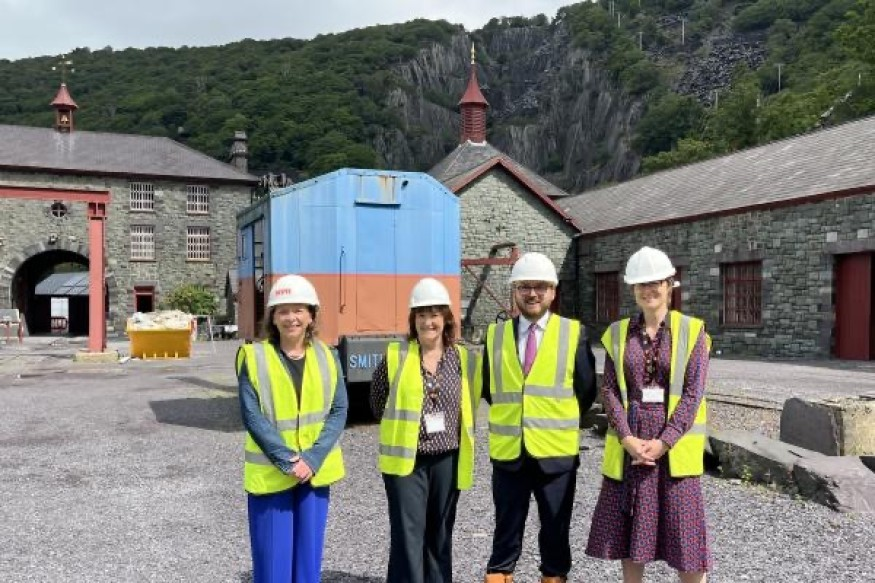
The Welsh Government has awarded a further £2.4m of capital funding for the National Slate Museum redevelopment in Llanberis, where conservation of the Grade I listed Gilfach Ddu workshops is progressing alongside construction of new visitor facilities. Culture and Sport Cabinet Minister Heledd Fychan confirmed the investment during a site visit on Friday 20 November, when the project team demonstrated work on the buildings’ historic windows and doors.
The additional allocation is for Amgueddfa Cymru – Museum Wales and supports an established programme, not a newly approved redevelopment. Gilfach Ddu closed to visitors in November 2024, allowing collections to be moved before the main conservation and building works began. The former slate workshops stand within the north Wales slate landscape UNESCO World Heritage Site, so repair and alteration must address the condition of the historic industrial fabric as well as the requirements of a working museum.
The project has a particularly substantial window conservation package. Across the museum are 113 windows, most of them metal, with many originally cast on site. Their designs allow individual glass panels to be replaced, avoiding the need to discard otherwise serviceable window assemblies. Specialists are stripping, assessing and selectively reglazing the windows, handling almost 12,000 pieces of glass that differ slightly in size and shape. Damaged panes are replaced, while traditional linseed oil putty is used to seal the glazing.
This method retains a greater proportion of original components than wholesale replacement. The metal frames, glazing bars and their connections form part of the workshops’ industrial character, but must still provide durable weather protection. Inspection establishes which parts can remain and where intervention is necessary. The public project information does not specify a completion percentage for the window package or claim that every pane has already been repaired; the figure of almost 12,000 describes the scope of conservation work.
Historic pine doors are being dealt with individually. Each door is removed and stripped back so that the team can assess rot and other damage. Where timber has deteriorated, replacement sections are cut to match the originals before being fitted, planed and finished. The procedure also includes structural repairs and refurbishment of the ironwork. Retaining sound timber while replacing failed sections is central to conserving the doors without losing their construction details or visual character.
The repair work differs markedly from installing new components in a contemporary building. Metal windows that have survived for decades and timber doors exposed to long service require condition-led decisions, particularly where each assembly has slightly different dimensions or wear. Repair must reconcile structural integrity, weather resistance and continued use with the conservation of material already in place. The published examples show the approach being followed, rather than providing a complete specification for every repair across the site.
Elsewhere at Gilfach Ddu, the former shop and café buildings, constructed approximately 30 years ago, have been demolished. Foundations are now in place for a replacement café, learning and community centre. The new facility is intended to provide more space for community use and events, while offering improved access for visitors. The project team has not yet confirmed the new building’s structural completion or a date when these facilities will open.
The redevelopment also provides for dedicated exhibition and interpretation spaces and a new play area designed around the slate landscape. These elements are intended to explain both the industrial processes carried out at the workshops and the history of the communities connected with quarrying. Their delivery will bring new public uses into a site whose machinery, buildings and working spaces are themselves central to what the museum preserves.
Work on the listed workshops therefore has to be sequenced with new visitor facilities. Conservation teams are retaining and repairing original components, while other contractors are completing foundations and progressing new accommodation on parts of the site where the former visitor buildings stood. The November update gives evidence of both types of work but does not provide a revised overall construction timetable or certify the completion of either programme.
The museum’s redevelopment receives support from the National Lottery Heritage Fund, the UK Government through Cyngor Gwynedd’s Llewyrch o’r Llechi project, Welsh Government funding streams, the Garfield Weston Foundation and the Wolfson Foundation, among others. The additional £2.4m is a new capital contribution. An earlier project account described an overall £25m scheme, but the latest announcement does not specify a revised approved total, and the two numbers should not be added without knowing how the funding is accounted for.
Although the main workshops remain closed, parts of the collection and the museum’s specialist skills continue to be presented elsewhere. Museum on the Move activity includes the Quarry Hospital at Parc Padarn, slate splitting at Penrhyn Castle and blacksmithing at The Forge in Caernarfon. Tours are also available at the Collections Centre in Llandygai, while a limited number of hard-hat visits have been offered at Gilfach Ddu. The latter require booking because construction is continuing.
The latest funding decision comes with physical evidence of progress: window and door restoration, demolition of redundant visitor buildings and foundations for the new café and community facilities. A reopening date has not been confirmed in the November update. Remaining work must bring the conserved historic workshops and new public accommodation into a usable museum complex before regular visitor access can resume.