IN Brief:
- National Grid has opened Stage 2 consultation on Eastern Green Link 5.
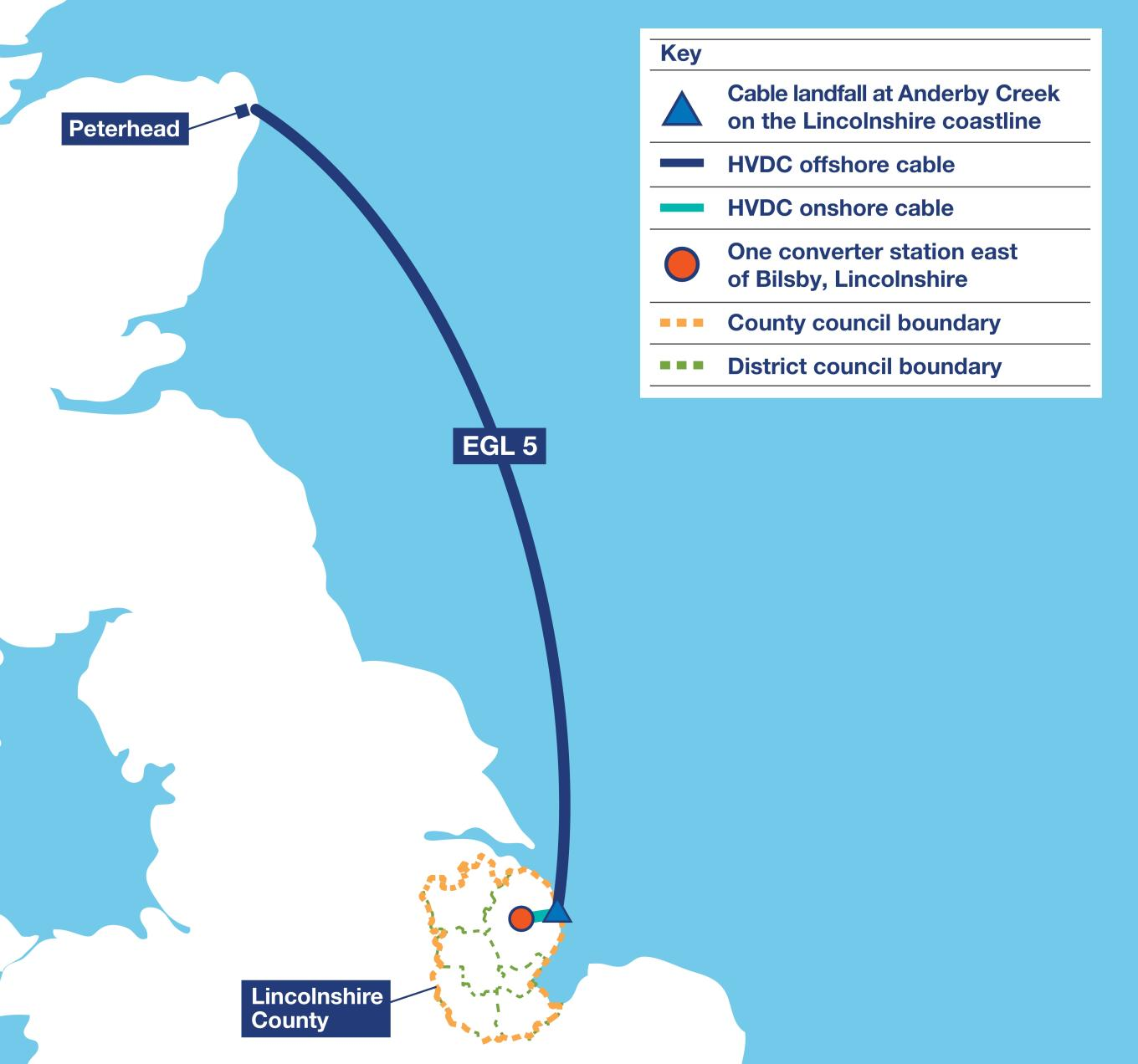
- The proposed link would run mainly offshore between Scotland and Lincolnshire.
- The English works include landfall infrastructure, underground cables, and a converter station near Bilsby.
National Grid has opened Stage 2 consultation on Eastern Green Link 5, a proposed high-voltage electricity connection between Scotland and England.
The project would be a primarily offshore link, with subsea cables running from Scotland to landfall at Anderby Creek on the Lincolnshire coast. From there, underground cables would run for up to 8km to a new converter station in north-east Bilsby, before connecting into the proposed Lincolnshire Connection Substation-B being brought forward through National Grid’s separate Grimsby to Walpole project.
The Stage 2 consultation opened on 29 May and is due to run until 24 July 2026. National Grid plans to seek consent for the English offshore and onshore elements through a single Development Consent Order application, while SSEN Transmission is responsible for the Scottish elements of the project and the relevant Scottish waters consents.
Eastern Green Link 5 is one of several major grid schemes intended to increase electricity transfer capacity between regions with strong renewable generation and areas of high demand. The construction scope would combine marine cable installation, landfall engineering, underground cable routes, converter-station works, temporary compounds, haul routes, grid connections, landscaping, and environmental mitigation.
Large electricity links are now carrying a much wider construction brief than conventional power infrastructure. Coastal landfall works must account for flood risk, ecology, access, temporary logistics, ground conditions, and reinstatement. Converter stations require substantial permanent sites, acoustic design, heavy equipment movements, secure compounds, drainage, building services, and integration with the transmission network.
That workload is gathering pace across the UK. Ofgem’s early construction funding approvals for major Scottish transmission schemes have already allowed operators to move earlier on procurement and enabling works, while other eastern subsea links are progressing through consultation, consenting, or delivery. Grid capacity is no longer a downstream consideration for renewables; it is one of the main determinants of whether generation, storage, and industrial electrification projects can proceed on workable timescales.
The delivery challenge will be shaped by the volume of similar work moving through the system together. Contractors, cable suppliers, marine specialists, electrical OEMs, civil engineers, planning teams, and environmental consultants are being asked to support a grid programme of unusual scale. Skills and equipment capacity will become more contested as multiple links, substations, overhead line reinforcements, and converter-station schemes compete for the same delivery base.
The consultation stage also carries practical construction value. Route refinement, compound locations, traffic planning, landowner engagement, survey findings, and environmental feedback all influence later programme risk. On linear infrastructure schemes, early design decisions can determine the complexity of access, the number of interfaces with roads and utilities, the sensitivity of working areas, and the level of mitigation required before construction can begin.
If consented, Eastern Green Link 5 would add another major project to the UK’s grid construction pipeline. The scheme remains in pre-application, but its shape is already clear enough for contractors and suppliers to read the direction of travel: electricity infrastructure is becoming one of the defining civil engineering markets of the next decade.