IN Brief:
- Poured Earth is developing unfired clay-based materials with Darwen Terracotta.
- Experimental samples were displayed at the National Festival of Making in Blackburn.
- Further testing is required before the materials could enter regulated building applications.
Darwen Terracotta is working with designer Lewis Jones on a programme investigating whether unfired clay-based materials could provide lower-carbon alternatives for selected construction applications.
Developed through Jones’s Matter at Hand design practice and the National Festival of Making’s Art in Manufacturing programme, the Poured Earth project has given the designer access to Darwen Terracotta’s workshop space, production knowledge, raw materials, and manufacturing facilities.
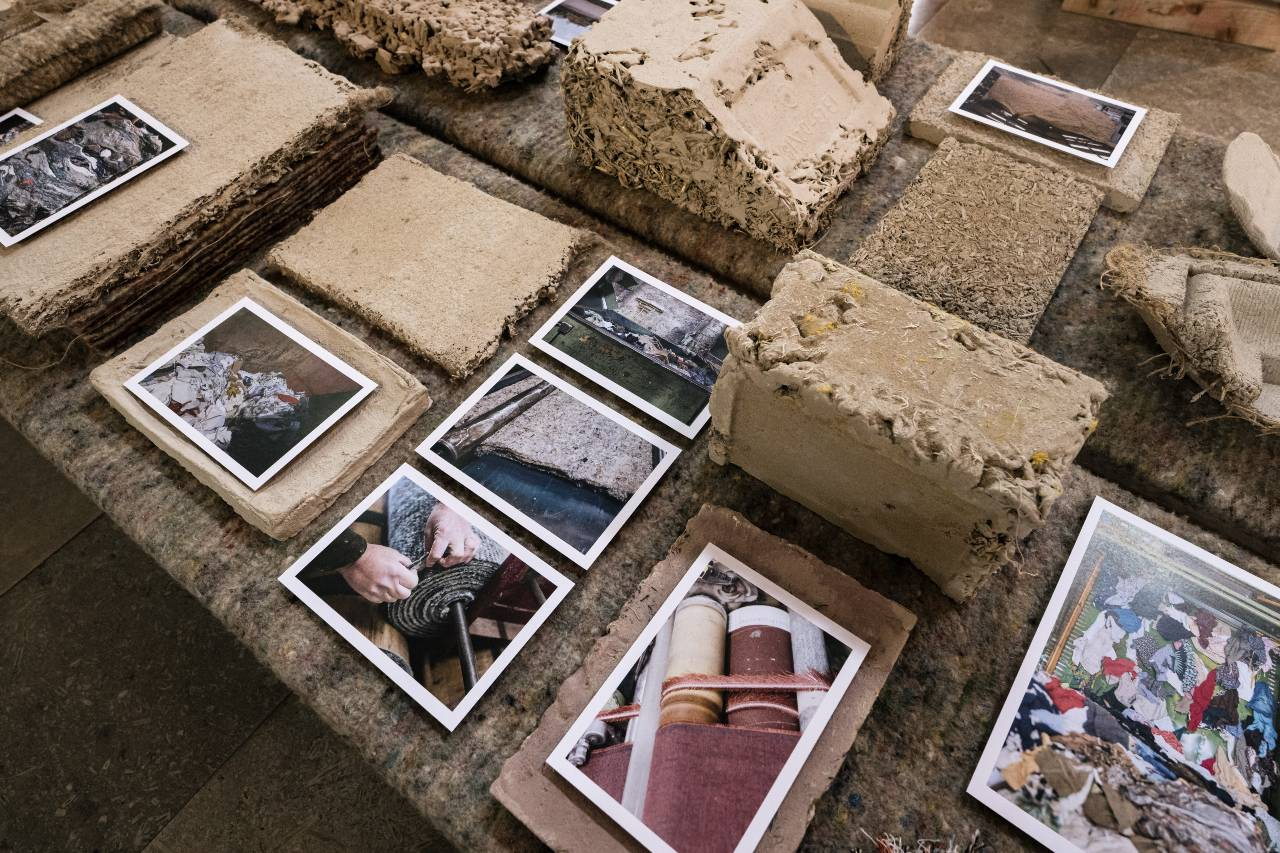
Experimental samples produced through the collaboration were displayed at the National Festival of Making in Blackburn on 4 and 5 July, two years after the partnership began. The installation demonstrated the textures, forms, surface finishes, and mixtures being examined through the programme.
The research combines unfired clay with other constituents to create pourable or mouldable materials. By avoiding high-temperature firing and reducing reliance on Portland cement, the process could lower manufacturing emissions, although any eventual carbon assessment will need to include formulation, processing, transport, durability, maintenance, and the quantity required for each application.
Darwen Terracotta is the UK’s largest manufacturer of architectural terracotta, with industrial roots extending to the late nineteenth century. Its established products are used in restoration, façades, architectural detailing, and new buildings, giving the company practical experience of clay preparation, forming, drying, firing, finishing, and quality control.
Simona Weldon, Marketing Manager at Darwen Terracotta, said the partnership was intended to develop information that could support more sustainable homes and buildings. She added that the work extends the company’s established use of terracotta by examining alternative ways to combine and form clay.
Poured Earth remains an experimental materials programme, and the current mixtures are not being presented as a certified replacement for structural concrete. Progression into construction would require repeatable manufacturing controls, defined applications, specification guidance, environmental assessment, and performance evidence appropriate to the intended use.
Unfired earth has a long history as a building material, but modern projects require measured performance across strength, fire, moisture, thermal behaviour, acoustics, dimensional stability, durability, and indoor environmental quality. The balance between those properties changes considerably between structural walls, partitions, panels, blocks, finishes, and landscape elements.
Moisture behaviour is likely to be a central part of the development process. Fired brick and terracotta obtain much of their durability through heat, while cement-based concrete hardens through hydration. An unfired clay product must control water absorption, shrinkage, softening, erosion, and repeated wetting without relying on a treatment that removes its intended carbon advantage.
Consistency will present another manufacturing challenge because natural clay varies with geology, mineral content, particle distribution, extraction conditions, and moisture. A scalable product must tolerate a reasonable degree of raw-material variation while still producing predictable results from batch to batch.
Additives or stabilisers may improve strength, water resistance, or workability, but their embodied carbon, toxicity, recyclability, and end-of-life effects must be included in the assessment. A lower-carbon binder can lose part of its advantage if it depends on energy-intensive or difficult-to-recover constituents.
Construction-material research is advancing across several complementary routes, including cement replacement, alternative binders, recycled content, design optimisation, component reuse, and substitution where concrete is not structurally necessary. Full-scale lower-carbon cement systems are already moving through industrial precast trials, while earth-based materials remain at an earlier stage of technical development.
Poured Earth occupies that exploratory part of the market, bringing manufacturing experience into the process before a fixed product specification has been established. Access to a working terracotta factory allows the research to consider batching, mixing, forming, drying, storage, handling, and production repeatability alongside visual and material experimentation.
Darwen Terracotta’s involvement follows its Environmental and Social Value Certification from Made in Britain. The certification provides a framework for demonstrating environmental and social-value activity, although product certification, declarations, and technical approvals would remain separate requirements for any material entering regulated construction.
The next phase will need to extend from exhibition samples into measured testing, lifecycle assessment, exposure trials, prototype components, and clearly defined applications. Results from those stages will determine whether the mixtures can progress towards practical building systems.
Concrete will remain essential across foundations, frames, infrastructure, and heavily loaded structures, but carbon reduction does not depend on finding a single universal replacement. Materials capable of displacing concrete in narrower and technically suitable applications can still deliver meaningful reductions when used repeatedly at scale.
Poured Earth is now establishing the performance evidence needed to determine whether unfired clay can occupy any of those roles, and whether an experimental collaboration can be converted into a controlled manufacturing process.