IN Brief:
- Mammoet supported Van Oord with marshalling and lifting 78 Baltic Power monopiles.
- The foundations measured up to 86.3 metres long and 9.1 metres in diameter.
- XXL transporters, hydraulic support systems, and two MTC 1600 cranes handled the components.
Mammoet has completed a heavy lifting and marshalling programme for 78 monopile foundations serving the Baltic Power offshore wind project in Poland.
The work was undertaken for Van Oord through the Port of Rønne in Denmark. Individual monopiles weighed up to 1,680 tonnes, measured as much as 86.3 metres long, and reached 9.1 metres in diameter.
Components arrived by barge before being unloaded with self propelled modular transporters fitted with Mammoet’s XXL monopile transport system, which was developed to accommodate the increasing diameter and weight of offshore wind foundations.
After unloading, the monopiles were placed in temporary storage using hydraulic saddles and jacking systems. They were then moved for sealing, testing, preparation, and transfer to the quay in the sequence required by the installation programme.
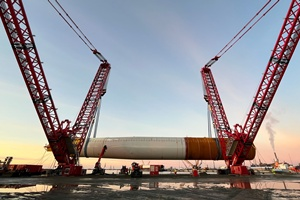
Two MTC 1600 terminal cranes handled load in and load out operations. Each crane provides lifting capacity of 1,600 tonnes and can be installed on a prepared quay without requiring the permanent civil works associated with a conventional heavy harbour crane.
At the quayside, the foundations were lifted into the water for transfer to Van Oord’s installation vessel Svanen. Transition pieces were also handled through the port using related transport and lifting arrangements.
Baltic Power is being developed by Orlen and Northland Power. The project comprises 76 wind turbines and two offshore substations, accounting for the 78 monopile foundations handled through the campaign.
The wind farm is scheduled to enter operation during the second half of 2026. Its foundation logistics form part of a wider programme involving fabrication, ports, transport, installation vessels, transition pieces, turbines, cables, offshore substations, and grid connection.
Larger foundations reshape port requirements
European offshore wind turbines have increased substantially in capacity, reducing the number of machines required for a given project output while increasing the size and weight of individual components. Foundations must support larger turbines and withstand complex wind, wave, fatigue, and seabed loads throughout their operating lives.
Poland’s offshore programme is advancing across several major developments. Construction has also begun on the 1.5GW Baltica 2 wind farm, where 111 monopiles are being installed for turbines and offshore substations.
Parallel programmes will increase demand for fabrication capacity, installation vessels, port space, heavy lifting equipment, marine engineering, and experienced project teams. Different wind farms may have separate owners and schedules, but many depend on the same limited European industrial base.
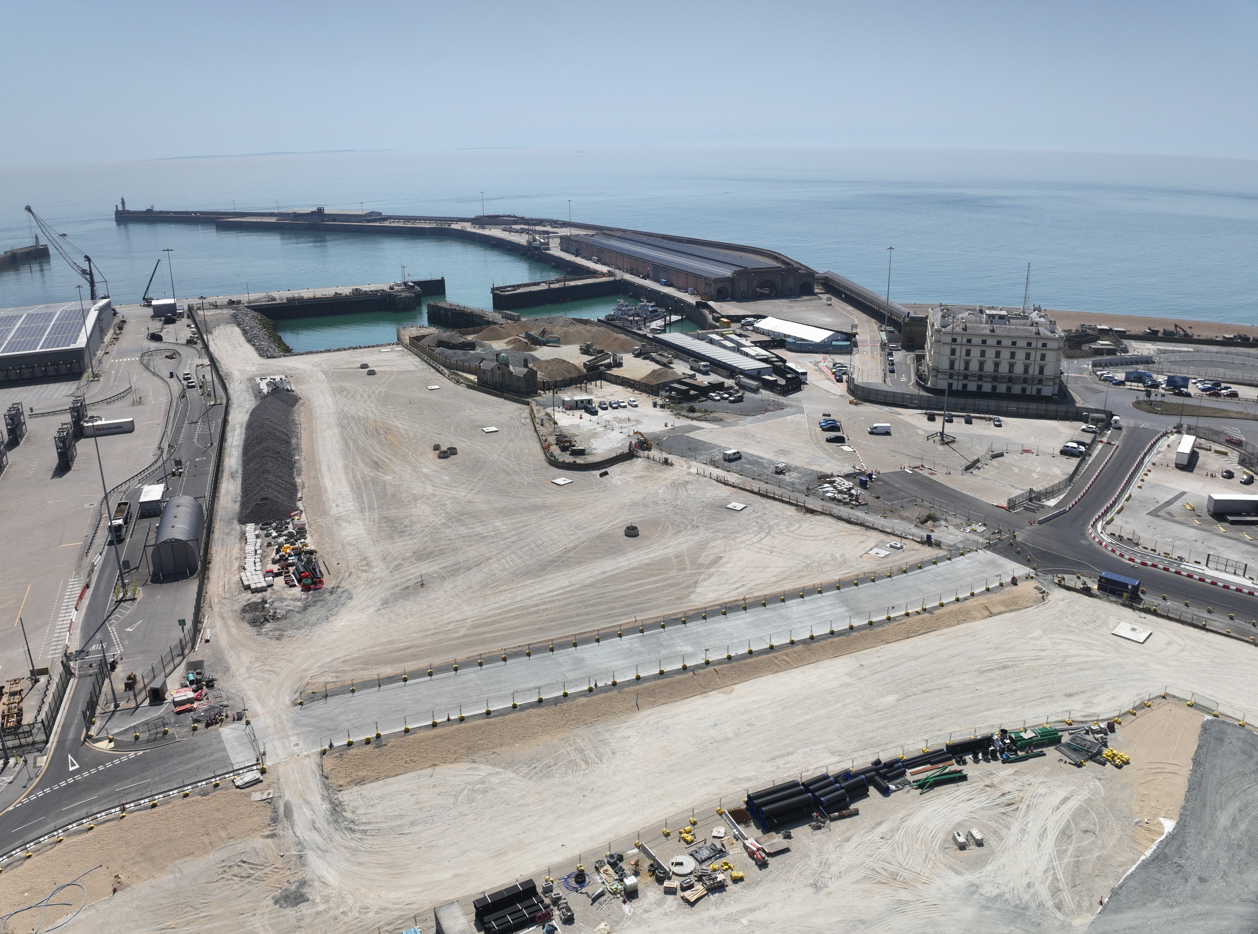
Ports must receive components by sea, unload them, move them safely across the quay, store them, complete preparation work, and reload them in the order required offshore. Ground bearing capacity, quay strength, water depth, navigation, storage layout, and transport routes all become part of the construction system.
Mammoet’s XXL arrangement reduces some of the civil preparation required beneath stored monopiles because the transport system supports the component differently. Lower and shorter gravel bunds can be used, reducing temporary material and preparation work across the marshalling area.
Temporary works remain extensive. Saddles, grillages, jacking points, restraints, lifting frames, and transporter configurations must be engineered for components whose cost and replacement period leave little tolerance for damage.
Weather creates further programme risk because high winds can stop crane operations and installation vessels work within defined marine limits. Storage and marshalling provide a buffer between factory output and offshore installation, although excessive accumulation can quickly consume port capacity.
Relocatable terminal cranes give ports another route to support project campaigns without immediately investing in permanent heavy lifting infrastructure. Mobilisation, ground preparation, assembly, operation, and dismantling still require detailed planning, but the cranes can move when the programme ends.
Offshore wind construction now reaches well beyond the marine installation site. Turbine capacity depends on steel manufacturing, port upgrades, roads, factories, substations, cable routes, and onshore grid work, so delay within one package can leave high value equipment waiting elsewhere.
The Baltic Power programme demonstrates the scale now moving through European ports. Each component was heavier than many completed structures, yet it had to be transported, supported, inspected, and lifted repeatedly within a controlled production sequence.
Completion of the marshalling work removes one substantial logistical stage from the project. Remaining activity will centre on offshore installation, turbine erection, electrical completion, commissioning, cable systems, and the readiness of Poland’s onshore network to receive the generated power.