IN Brief:
- JCB INTELLISENSE has won Hire Industry Product of the Year at the Hire Awards of Excellence.
- The AI camera-based system alerts operators and pedestrians when people are detected in risk areas.
- The technology is compatible with JCB 535-125, 540-140, and 540-180 Loadall telehandlers.
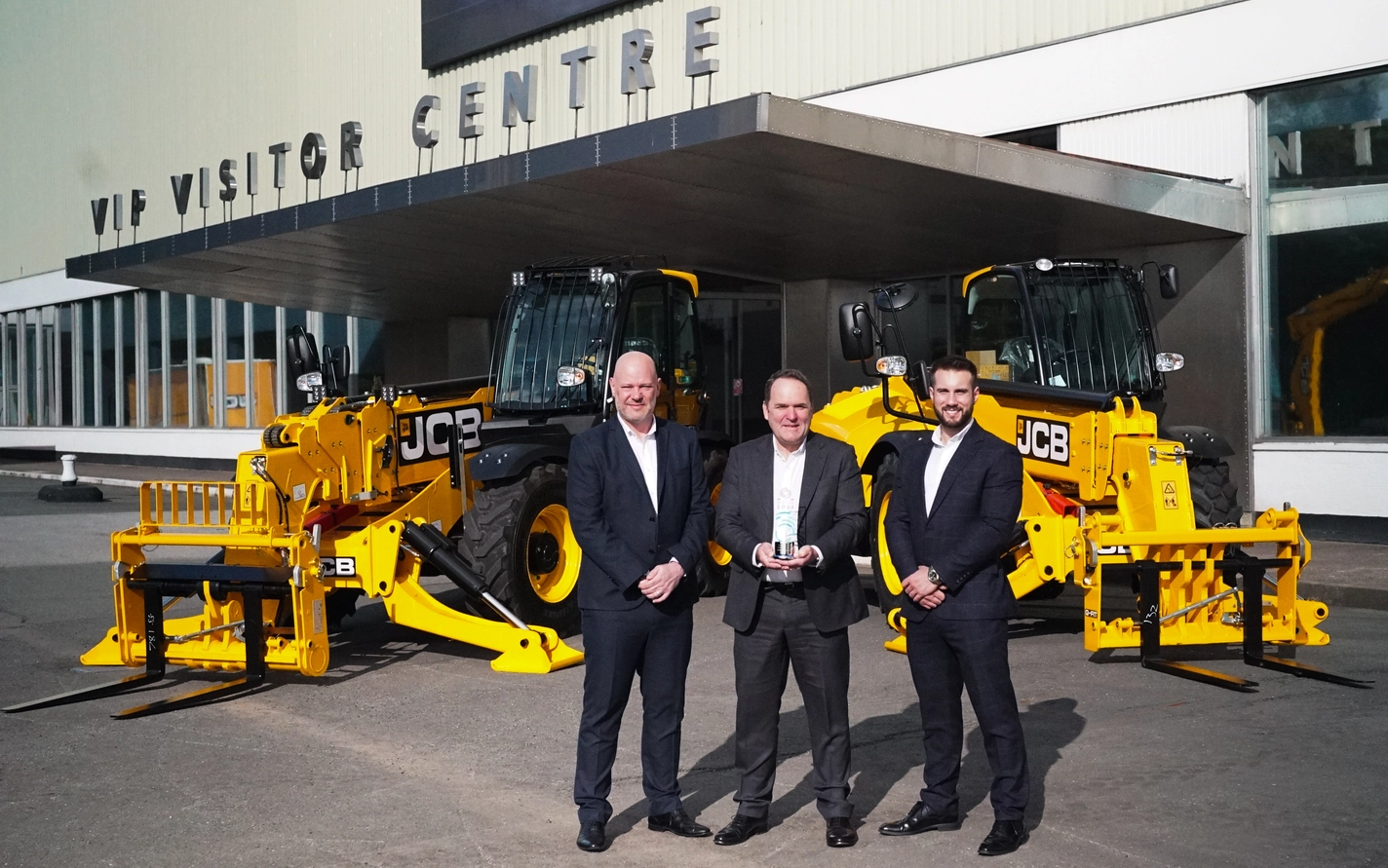
JCB has won Hire Industry Product of the Year for its INTELLISENSE machine safety system, which is designed to reduce pedestrian risk around Loadall telehandlers.
The award was presented at the Hire Awards of Excellence in London, organised by Hire Association Europe and the Event Hire Association. The recognition covers JCB INTELLISENSE, an operator assistance system that uses artificial intelligence cameras to detect pedestrians in areas of risk.
When a pedestrian is detected, the system provides visual warnings inside the cab and audio warnings both inside and outside the machine. The alerts are designed to warn the operator, the pedestrian, and nearby site workers before a hazardous interaction develops.
JCB INTELLISENSE is compatible with the JCB 535-125, 540-140, and 540-180 Loadall telehandlers. Those machines are widely used across building sites, housebuilding, industrial construction, logistics yards, and materials handling operations.
The award reflects the direction of travel in plant safety. Telehandlers are among the most versatile machines on site, but that versatility also places them in close contact with pedestrians, delivery routes, partially segregated work areas, and changing site layouts. Visibility can be restricted by loads, site conditions, and the constant movement of people and materials.
Camera and detection systems are becoming more sophisticated as manufacturers move beyond passive visibility aids and into active operator support. AI allows systems to distinguish people from general site clutter, which is essential in environments where conventional alarms can become too frequent and risk being ignored.
The hire sector is a major route for this type of technology. Hired machines often operate across different sites, sectors, and operators, making standardised safety features more valuable. Contractors increasingly expect plant supplied through hire fleets to arrive with collision avoidance, telematics, access control, emissions monitoring, and operator support systems already integrated.
That expectation is being reinforced by procurement and insurance pressure. Clients and principal contractors are asking for stronger evidence of site-risk management, while machine owners need to protect asset value and reduce incident exposure. Safety technology is becoming part of the commercial specification rather than an optional extra.
There is also a data element. Machine systems that identify risky interactions can help contractors understand how sites are being used, where pedestrian routes are breaking down, and whether segregation plans are working in practice. The immediate function is operator warning; the longer-term value sits in safer workflows and better logistics planning.
As construction sites become busier, more constrained, and more closely monitored, plant manufacturers are being pushed to design safety systems around real working conditions. INTELLISENSE shows how that shift is moving into mainstream equipment categories, with wider deployment across mixed fleets likely to shape the next phase of machine-level safety management.