IN Brief:
- The first 170 metres of the roughly 700-metre Duddeston Junction Viaduct have been launched over two freight lines.
- The 14-span weathering-steel structure will cross six live railway lines, with up to 90 operatives and engineers working on the constrained site.
- Further launching over passenger lines is scheduled from December as the Curzon Approaches move towards completion.
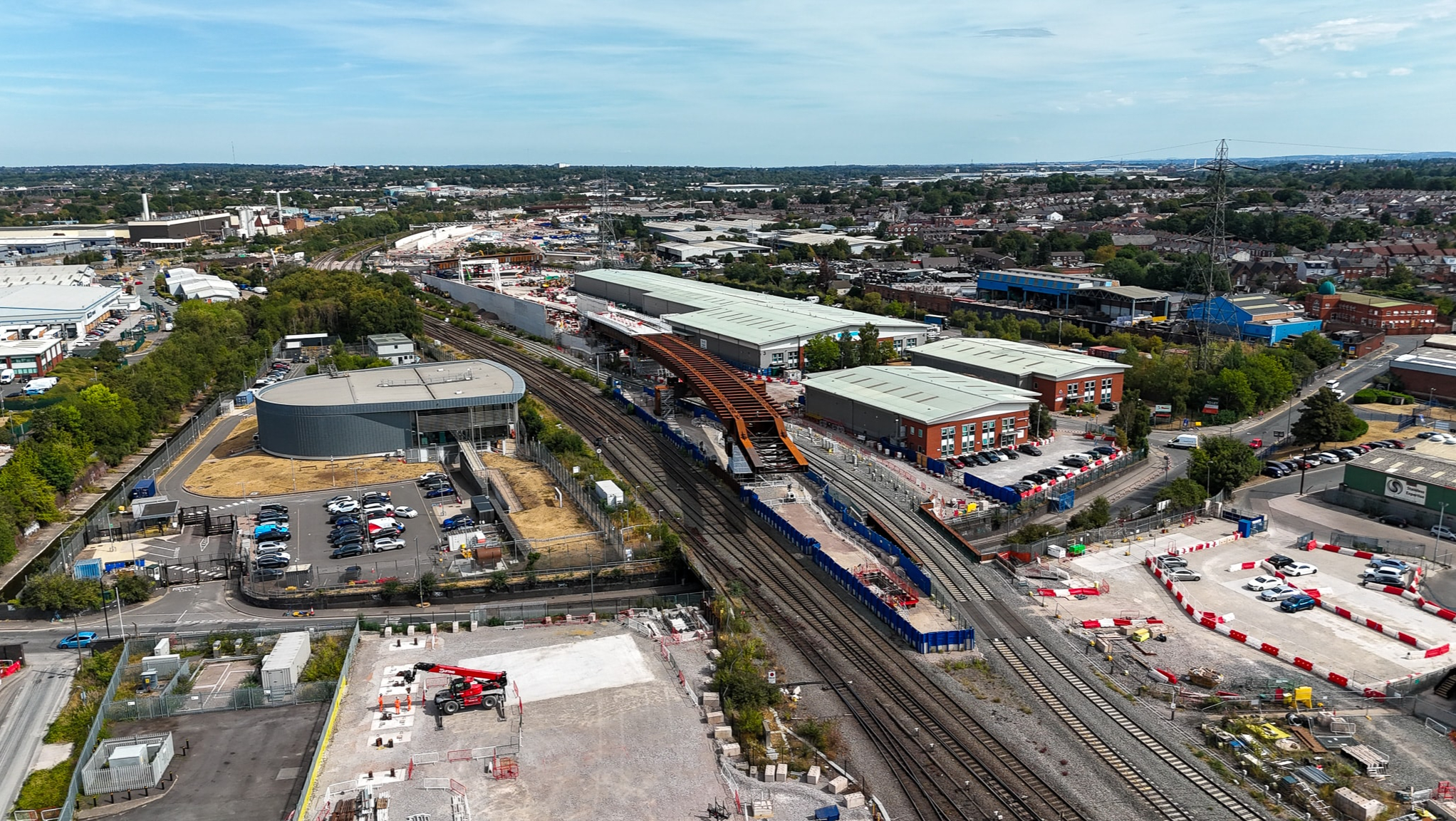
HS2 Ltd has completed the first major launch of the Duddeston Junction Viaduct in Birmingham, moving 170 metres of the weathering-steel structure over two live freight lines on the approach to Curzon Street Station.
Duddeston Junction is the first and longest of five interconnecting structures forming the Curzon Approaches. The completed viaduct will extend for roughly 700 metres through a heavily constrained industrial and rail corridor, eventually crossing six existing railway lines — three used by freight and three carrying passenger services.
The structure follows a varying horizontal curve while climbing at a three per cent gradient, reaching around 12 metres above the existing railway. It comprises 14 spans of about 55 metres, with the steelwork weighing up to 6,835 tonnes in total. That geometry means alignment, temporary works, and launch control have to be managed while the bridge is both curving and rising.
Balfour Beatty VINCI began preparatory works in 2023, including utility diversions, treatment of heavily contaminated ground, and the diversion of two freight lines. The contractor also built the Duddeston Mill Road Underbridge, allowing the realigned tracks to create a roughly 20-metre-wide construction corridor between operating railway infrastructure.
Up to 90 operatives and engineers are working within that corridor. Seven spans are being assembled and progressively launched across the live railway, with each completed section added at the rear before the structure is pulled forward using a sliding technique. Once the launch has cleared all six tracks, the remaining seven spans will be lifted into position by crane from the opposite side.
Ross Rendell, section manager at Balfour Beatty VINCI, described Duddeston Junction as “hugely complex and a key section of the HS2 route”. The difficulty is rooted in the site rather than the scale alone: the bridge has to pass above operating rail lines, sit within a narrow industrial corridor, and connect into a sequence of other viaducts that are being built in parallel.
The supporting arrangement reflects those constraints. Duddeston Junction will use one abutment, two steel piers, four portals, and eight concrete piers, allowing the structure to negotiate the existing tracks and surrounding infrastructure without imposing a uniform foundation solution across the route.
The next launch phase is scheduled to begin in December, when work moves over the passenger railway lines. Network Rail says more than 200 passenger and freight services use the corridor each day, making possession planning, monitoring, and temporary works central to the programme. Construction has to progress without treating the railway below as a conventional closed site.
The viaduct will ultimately form part of the elevated route carrying HS2 trains towards Curzon Street. Trains will emerge from Bromford Tunnel, travel through Washwood Heath, climb through Saltley, and then cross the Duddeston structure before continuing across the remaining Curzon Approach viaducts into the station.
Other work is advancing around the same interface. HS2 and Network Rail are preparing works near Duddeston to install the first section of the new Saltley viaduct, while separate structures across the Curzon Approaches continue through launch, assembly, and deck construction.
The wider Birmingham programme increasingly depends on interfaces rather than isolated structures. Viaducts have to pass over operating roads and railways, tie into retained urban infrastructure, and align with future railway systems whose installation will follow the heavy civils.
That puts a premium on sequencing. A launch can be delayed by rail access, utility conditions, temporary works, or geometry even when the steel structure itself is ready, while changes to one approach structure can affect the programme on the next. The job is less about building a bridge in open space than controlling a chain of linked constraints through an existing city.
Duddeston Junction remains some distance from completion. Further spans must cross the passenger lines, crane-installed sections still have to be placed, and the bridge must be integrated with adjoining structures before deck, railway systems, and finishing work can follow.
Railway access will remain a controlling constraint throughout the remaining launch programme, particularly as work moves above passenger services and into later interfaces. The first 170-metre launch nevertheless removes one of the early construction risks on the route into Curzon Street. The next test will come when the operation moves over passenger tracks in December, extending the same launch method into the busiest part of the existing rail corridor.