IN Brief:
- HS2 has completed all 34 cross passages on the 8.4-mile Northolt Tunnel in west London.
- The works used sprayed concrete lining, with ground freezing applied to 11 cross passages.
- Structural works on the tunnel are expected to complete later this year before rail systems installation follows.
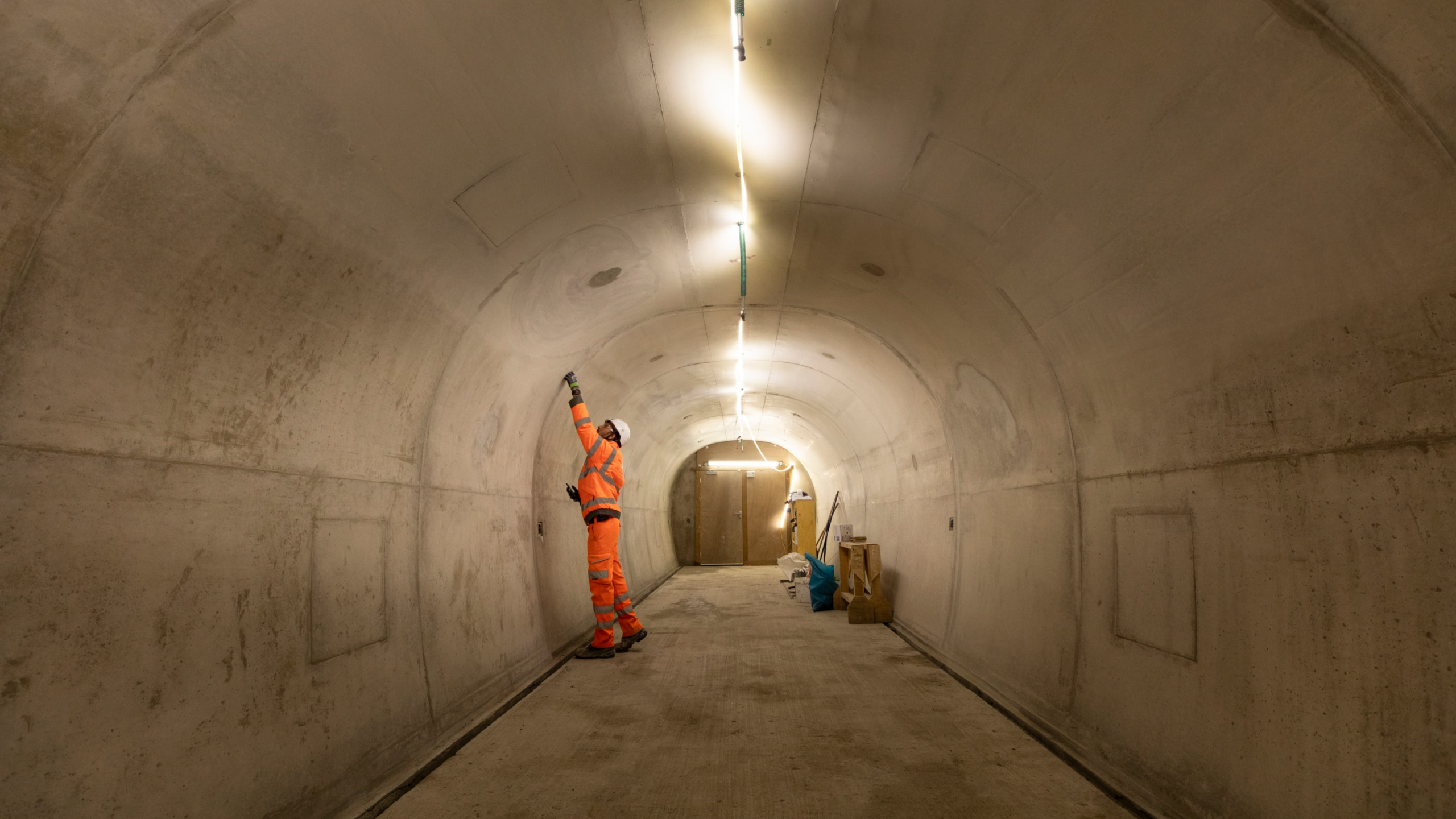
HS2 has completed construction of all 34 cross passages on the Northolt Tunnel in west London, marking a major tunnelling milestone on the route between London and the West Midlands.
The cross passages connect the northbound and southbound tunnel bores and provide an emergency route for passengers to move into the adjacent tunnel if required. The 8.4-mile Northolt Tunnel runs underground between West Ruislip and Victoria Road in Ealing, just outside Old Oak Common station, and reaches a depth of 35 metres below ground.
The tunnel was excavated using four tunnel boring machines, with the main excavation completed in June 2025. With the cross passages now mined, engineers will move on to reinforced concrete secondary collars that will form the permanent openings for cross-passage doors. Permanent fire-rated sliding doors will then be installed before the tunnel is prepared for track, overhead power, and other rail systems.
HS2’s London Tunnels Contractor is the Skanska Costain STRABAG joint venture, which is responsible for main works civils construction between Hillingdon and Camden, bringing the high-speed line into Euston.
The cross passages were constructed using a sprayed concrete lining mining technique, with teams cutting through the ground between the two tunnel bores. The distance between the bores ranges from six metres to 20 metres. Mini-excavators were used for the work, with each metre of excavated ground supported by sprayed concrete lining as the passages advanced.
Once the lined tunnel sections were completed, a waterproof membrane and secondary concrete lining were installed. Eleven of the cross passages used ground freezing because of water-bearing soils and a high water table in the western section of the tunnel. The method required freeze pipes to be inserted through special tunnel segments to create a two-metre-thick freeze wall, stabilising the ground before excavation.
Malcolm Codling, project client for HS2 Ltd, said: “Completing the construction of the cross passages is an important step towards finishing the civil engineering on the tunnel which will allow us to ultimately begin rail systems work including laying track.”
The next phase will bring another specialist supply-chain element into the programme. Booth Industries in Bolton is manufacturing doors for tunnels across the route. The doors will need to withstand constant 14Kpa pressure cycles caused by high-speed trains passing within metres, while also providing two-hour integrity and insulation against fire. HS2 has described the door specification as setting a new benchmark for the industry, with the units being manufactured using majority UK-made steel.
The Northolt milestone shows the layered nature of modern tunnelling delivery. Excavation often draws most public attention, but the work that follows — cross passages, linings, membranes, secondary concrete, fire doors, mechanical and electrical systems, track, power, communications, and safety systems — determines when a tunnel becomes an operational railway asset.
Ground-treatment methods and small-scale mechanised excavation remain central to large tunnel programmes. Ground freezing can reduce excavation risk where groundwater and soil conditions would otherwise make conventional methods more difficult. In dense urban tunnelling, that level of control is essential, particularly where programme delays can affect systems installation and station interface works.
All structural works on the Northolt Tunnel are expected to complete later this year. The project still sits within a wider HS2 reset focused on cost, programme, and delivery efficiency, but the completion of the cross passages gives the London tunnelling team a defined civils milestone as the route moves from excavation into fit-out and railway systems.