IN Brief:
- Preparatory activity includes site works, fencing, ground investigations, trial holes, and drainage and pavement surveys.
- Graham is working under the pre-construction phase while design, technical approvals, risks, and costs are developed.
- Cabinet will review progress and the route towards a main construction contract on 24 September.
Herefordshire Council has begun preparatory works on the first phase of the Hereford Bypass as design, investigation, and cost work continues ahead of a Cabinet review on 24 September.
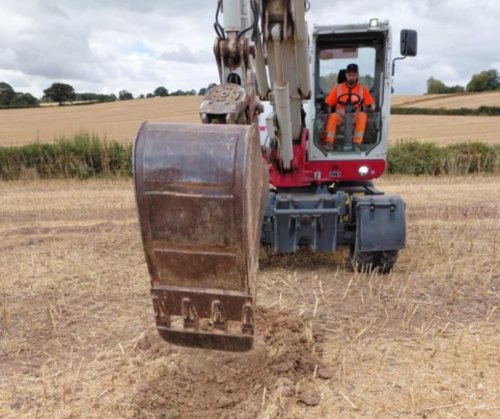
Activity on the route includes site preparation, fencing, ground investigations, trial holes, and drainage and pavement surveys. The council has also authorised additional work around utilities, including surveys and measures needed to make services safe or relocate them where required before the principal construction phase.
The programme sits within the pre-construction stage of the project, which is being used to develop the detailed design, test assumptions, identify risks, obtain technical approvals, and refine costs before the authority decides whether to move into the main construction contract.
Phase one would create a new single-carriageway connection between the A49 and A465 south-west of Hereford, improving access towards the Rotherwas employment area and providing the southern anchor for the longer-term western bypass. The route also has to accommodate interfaces with existing roads, utilities, environmental constraints, and rail infrastructure.
Those interfaces explain much of the work now taking place on the ground. Trial holes and ground investigations can identify conditions that affect earthworks, structures, drainage, and foundations, while utility surveys reduce the risk of discovering conflicts after the principal contractor has mobilised. Pavement and drainage information will also feed into the detailed design and construction methodology.
The current stage is being delivered through a pre-construction services arrangement rather than a full works contract. That allows contractor and designer input to be brought into the programme before final commercial commitment, giving the council more information on buildability, programme, risk, and cost.
Herefordshire Council has previously stated an ambition to begin main construction by December 2026, but its latest update identifies several issues that still require resolution. These include additional design requirements, planning constraints, ecology and seasonal working restrictions, external technical approvals, inflation, construction and labour costs, and reduced scope for some value-engineering savings.
The 24 September Cabinet meeting will consider progress against that position and the further design and cost-planning work needed before a main construction contract can be let. The authority’s forward plan describes the decision as urgent because additional work is required under the pre-construction services agreement to keep the project moving towards that point.
The first phase remains part of a wider transport strategy for Hereford. The council says the new connection would reduce pressure on routes including Belmont Road, Walnut Tree Avenue, and Holme Lacy Road, while improving access between the A49, A465, the south-west of the county, and South Wales.
Longer term, phase one is intended to become the starting point for a western bypass around the city. Council projections link the completed route with land capable of supporting up to 14,000 homes and employment space for up to 10,000 jobs, alongside improved access to the Hereford Enterprise Zone.
Those wider ambitions do not remove the delivery constraints facing the first package. Road schemes of this scale accumulate risk through ground conditions, utility diversions, ecology, land requirements, structures, approvals, and inflation, with each issue capable of affecting programme and price before heavy construction begins.
Early contractor involvement is intended to expose those problems while design decisions can still be changed without disrupting an active main works contract. It also gives the council a clearer basis for deciding whether the emerging construction price remains consistent with the available funding and expected benefits.
The utility work is particularly relevant because buried or overhead infrastructure can dictate sequencing across large sections of a highway scheme. Relocation may require agreement with several asset owners, while temporary protection can influence access, earthworks, and construction compounds. Resolving those interfaces before full mobilisation reduces the number of unknowns passed into the construction programme.
Ecology and seasonal restrictions create a different type of constraint. Surveys, mitigation, vegetation clearance, and work near protected habitats may only be possible during defined periods, meaning a delay in design or approvals can affect the sequence of works months later. The current investigations therefore sit alongside environmental planning rather than being treated as a separate engineering exercise.
Preparatory machinery on the route provides the first visible sign of activity, but the main commercial decision remains ahead. Cabinet must still assess the results of the pre-construction stage before committing the authority to the larger construction package.
The immediate measure of progress will be whether the investigations, technical approvals, and cost work narrow the remaining uncertainty sufficiently for that decision to be taken. Until then, the bypass is physically active on site but remains in the controlled transition between development and full construction.