IN Brief:
- The proposed early works framework is currently valued at £60m–£80m and could run for up to eight years.
- Scope includes principal contractor duties, site logistics, surveys, environmental mitigation, temporary works, demolition, and earthworks trials.
- Anglian Water expects a procurement questionnaire in November 2026, an ITT in January 2027, and award in May 2027.
Anglian Water has begun market engagement for an early works partner framework covering preparatory construction and investigation activity for the proposed Fens and Lincolnshire reservoirs.
The utility currently estimates the framework at £60m to £80m and expects an initial five-year term, with the option of three separate one-year extensions. An anticipated award date of May 2027 would put the arrangement in place ahead of a programme of works that could continue into 2032, with the maximum framework duration extending to 2035 if all options are used.
The proposed scope is broad and weighted towards enabling works rather than the reservoirs’ main construction. Anglian Water expects the early works partner to be capable of acting as principal contractor where reasonably practicable, taking responsibility for overall site coordination, health and safety, logistics, contractor management, and duties under the Construction (Design and Management) Regulations.
Site establishment, welfare, access management, and temporary compounds sit alongside a large investigation programme. The notice identifies topographical and utility surveys, geotechnical investigations, water monitoring, environmental and ecological surveys, archaeology, heritage work, and geophysical investigations. Unexploded ordnance surveys, temporary traffic management, site drainage and discharge infrastructure, property condition surveys, and temporary works are also within the potential scope.
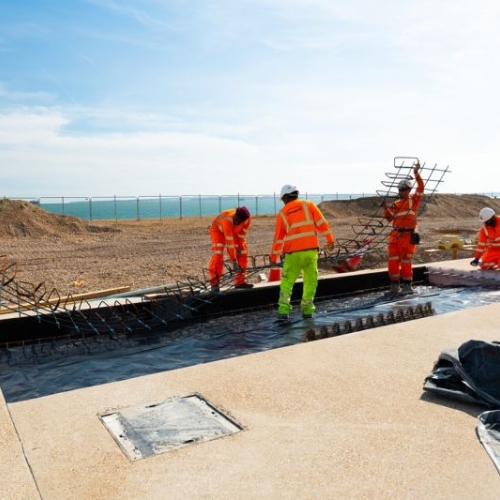
More physical construction activities could include demolition and clearance, environmental mitigation, habitat creation, and earthworks trials. The latter would use a scaled-down embankment to test ground behaviour, construction methods, design assumptions, and specifications before full-scale reservoir embankment work begins. That gives the early package a direct role in de-risking later heavy civil engineering rather than simply preparing access and welfare facilities.
Both reservoir projects are intended to strengthen water security in the East of England as population growth, drought risk, and environmental restrictions place greater pressure on existing sources. The Fens reservoir is being developed with Cambridge Water and is planned as a roughly 55 million cubic metre raw-water reservoir, with about 50 million cubic metres of usable storage. Current project material says it could supply enough water for up to 250,000 homes each year.
The Lincolnshire reservoir is also being advanced as a major regional resource. Anglian Water’s planning material places the proposed site south-east of Sleaford and retains an earliest in-supply target around 2039. Both schemes are being progressed as Nationally Significant Infrastructure Projects, meaning development consent will be sought through the Development Consent Order process rather than ordinary local planning routes.
The procurement notice places the early works inside a more unusual delivery structure. Anglian Water says the Specified Infrastructure Project Regulations are its preferred model for the reservoirs, allowing a major infrastructure project to be delivered under a project licence by a third party where the statutory conditions are met. Early information on ground conditions, logistics, environmental constraints, and constructability will therefore feed both consenting and the commercial structure for later delivery.
The new exercise is distinct from Anglian Water’s recently awarded £1.5bn major-projects framework, which covers a wider portfolio of water and wastewater schemes through AMP8 and potentially beyond. The reservoir early works partner is tied specifically to the Fens and Lincolnshire strategic resource projects and to activity required before Development Consent Order determination, enabling works, and main construction.
Early contractor involvement can expose practical constraints before permanent designs are fixed, particularly where large earthworks, temporary access, sensitive habitats, buried services, and long construction logistics chains interact. On reservoir projects, where embankments and associated pipelines extend across large rural areas, assumptions about haul routes, soil behaviour, or temporary drainage can translate into major programme and cost consequences once mass earthmoving begins.
Anglian Water expects to issue a procurement-specific questionnaire at the beginning of November 2026, with responses due by the end of that month, before an invitation to tender in January 2027. The current market engagement is not a call for competition and does not commit the utility to the procurement route described, but interested organisations are being asked to register for engagement activities ahead of those planned stages.
If the timetable holds, the early works framework would be awarded while both reservoirs remain in their pre-application and consenting phases. Survey data, environmental mitigation, trial construction, and site logistics would then begin moving from planning assumptions into physical evidence before the larger works are fixed. On projects of this scale, that evidence will influence how efficiently the main reservoir packages can be designed, consented, and built.