IN Brief:
- Webuild's PerGenova consortium has extended Genoa's offshore breakwater to approximately 1.5km.
- Giant reinforced-concrete caissons are being installed on prepared seabed reaching depths of 50 metres.
- The completed structure is intended to improve access for the largest container and cruise vessels.
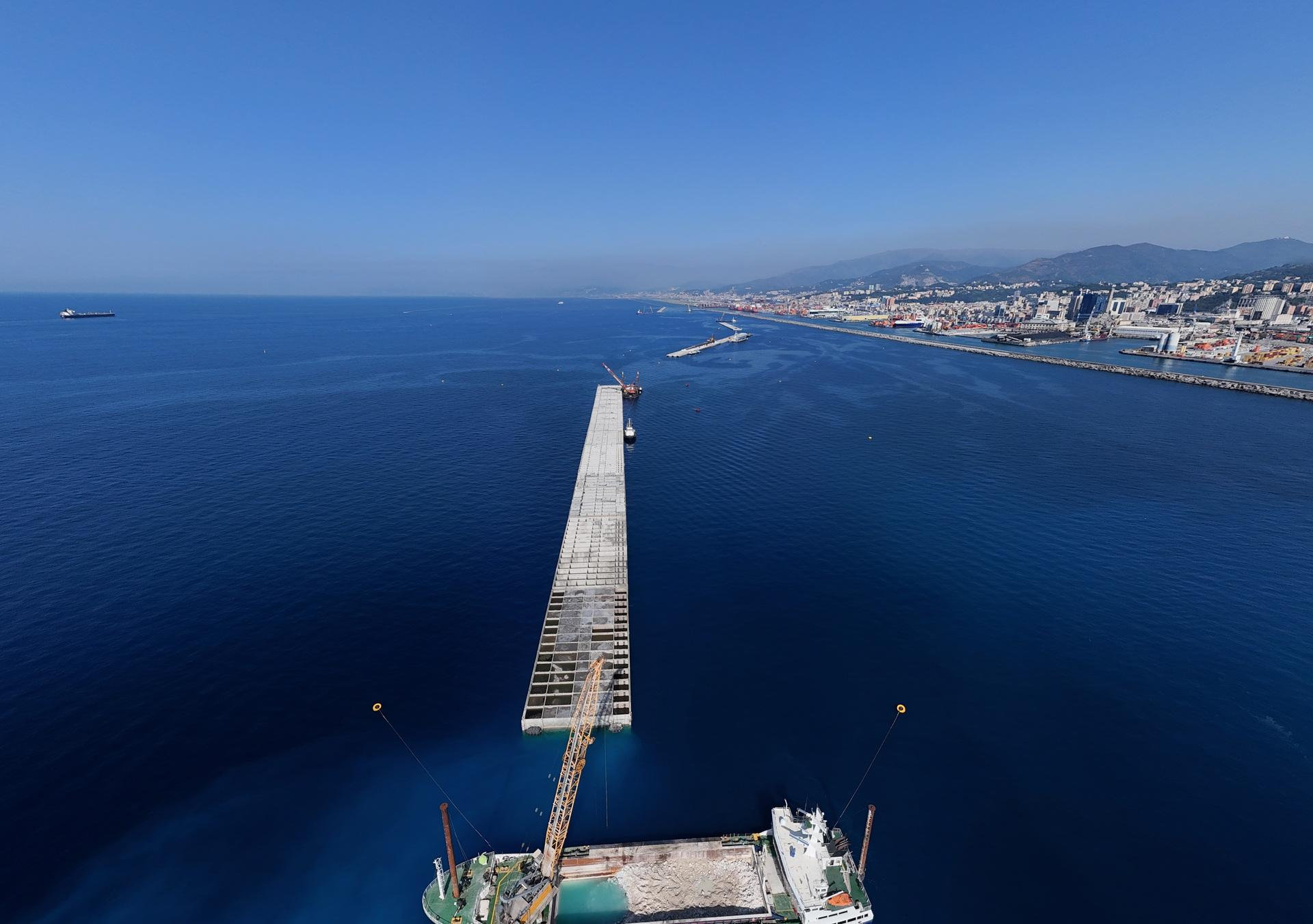
Webuild has taken Genoa’s new offshore breakwater to approximately 1.5 kilometres in length after installing another giant reinforced-concrete caisson, extending one of Europe’s most technically demanding marine construction sites further into the Ligurian Sea.
The project is being delivered by the PerGenova Breakwater Consortium, led by Webuild, for the Western Ligurian Sea Port Authority. The latest caisson was installed on 10 August, less than a week after the preceding unit, while seabed consolidation and construction of the breakwater superstructure continue in parallel.
Reaching 1.5km represents a substantial step from the 1,240 metres recorded after installation of the 27th caisson on 21 July. At that point, the project team had set a mid-August target for reaching approximately 1.5km, subject to the marine and weather conditions governing offshore lifting and positioning.
The operation is considerably more complicated than extending a conventional sea wall from shore. Genoa’s breakwater is being constructed offshore on seabed reaching depths of up to 50 metres, requiring a prepared foundation capable of supporting enormous prefabricated concrete structures under permanent wave and marine loading.
Each caisson has to be transported into position and lowered onto its prepared section of seabed through an operation involving specialised vessels, pontoons, tugs, marine platforms, monitoring systems, divers, and subsea equipment. Wind, wave height, current, and visibility can all determine whether an installation proceeds as planned.
The visible concrete units therefore represent only one part of the construction sequence. Below the waterline, crews have to prepare and consolidate the seabed, survey installation areas, verify levels and alignment, and monitor the foundation before each caisson can become part of the permanent works.
Webuild says seabed consolidation is continuing alongside the latest installations. That work is fundamental because uneven settlement beneath a single caisson could affect alignment, structural performance, and the interfaces between neighbouring units across a breakwater ultimately extending for several kilometres.
Construction is also advancing above water on the superstructure, the part of the completed breakwater designed to manage direct wave action. Several production fronts are consequently moving together: caisson manufacture, marine transport, seabed preparation, installation, infilling and stabilisation, superstructure construction, and environmental and engineering monitoring.
Cossi Costruzioni, a Webuild subsidiary specialising in complex infrastructure, is also involved in delivery. The wider consortium brings together the civil, marine, and logistical resources required for a project whose workfaces operate simultaneously on land, at sea, and below the surface.
The engineering scale becomes clearer in the final configuration. Webuild’s project material describes an overall structure of approximately 6.2km, with foundations descending to seabed levels around 50 metres and roughly 100 prefabricated reinforced-concrete caissons forming the principal permanent elements.
The largest units are comparable in scale with multi-storey buildings. Their size creates a demanding temporary-works problem because each caisson must remain stable and controllable through fabrication, towage, positioning, controlled sinking, and integration into the permanent breakwater.
Production therefore has to remain closely aligned with offshore installation. Manufacturing caissons too far ahead can create storage and logistics constraints, while insufficient production would leave expensive marine equipment and specialist crews waiting for the next unit.
The marine environment imposes constraints that cannot be programmed away. Offshore lifts and positioning operations depend on suitable weather windows, while access for inspection and intervention beneath the water is governed by sea state, visibility, and the availability of divers or remotely operated equipment.
That is why progress is measured caisson by caisson as well as in overall metres. Each installation completes a sequence involving foundation preparation, marine transport, heavy handling, positioning, survey, and verification before work can continue around the newly placed unit.
The completed breakwater is intended to change the operating geometry of the Port of Genoa. Existing harbour arrangements constrain manoeuvring for the largest container and cruise vessels, whereas the new offshore alignment is designed to provide more room for ships exceeding 400 metres in length and around 60 metres in width.
For the port, that links an exceptional civil-engineering project directly to future cargo and passenger capacity. Genoa sits on important freight routes into northern Italy and the wider European transport network, so improved marine access is intended to support larger vessels without imposing the same manoeuvring restrictions found within the existing basin.
Construction also has to coexist with an operating commercial port. Project vessels, navigational safety, environmental controls, and offshore work zones must be coordinated with normal harbour traffic rather than relying on a prolonged closure of the surrounding marine area.
The 1.5km milestone therefore says more than the visible length of concrete above the water. It indicates that caisson production, offshore logistics, seabed preparation, and installation have reached a cadence capable of placing several major units within comparatively short intervals.
There is still considerable construction ahead before the full breakwater is complete. Several kilometres of permanent works remain, together with the underwater foundation, superstructure, and connections needed to make the infrastructure function as a continuous protective and navigational asset.
The immediate programme continues with further caisson installation and seabed work. Much of the difficult engineering will remain invisible from Genoa’s waterfront, which is typical of marine infrastructure whose long-term performance depends heavily on the foundations nobody will see once the finished breakwater is in service.