IN Brief:
- Develon used its Demo Days event near Prague to launch DX360LC-9 and DX400HD-9 smart crawler excavators.
- The event showcased autonomous excavation, electric machines, E-Stop safety technology, and visibility systems.
- The launch expands Develon’s European offer across smart, electric, demolition, and material-handling equipment.
Develon has launched new Series 9 smart crawler excavators in Europe during its Demo Days event at Háje Quarry near Prague.
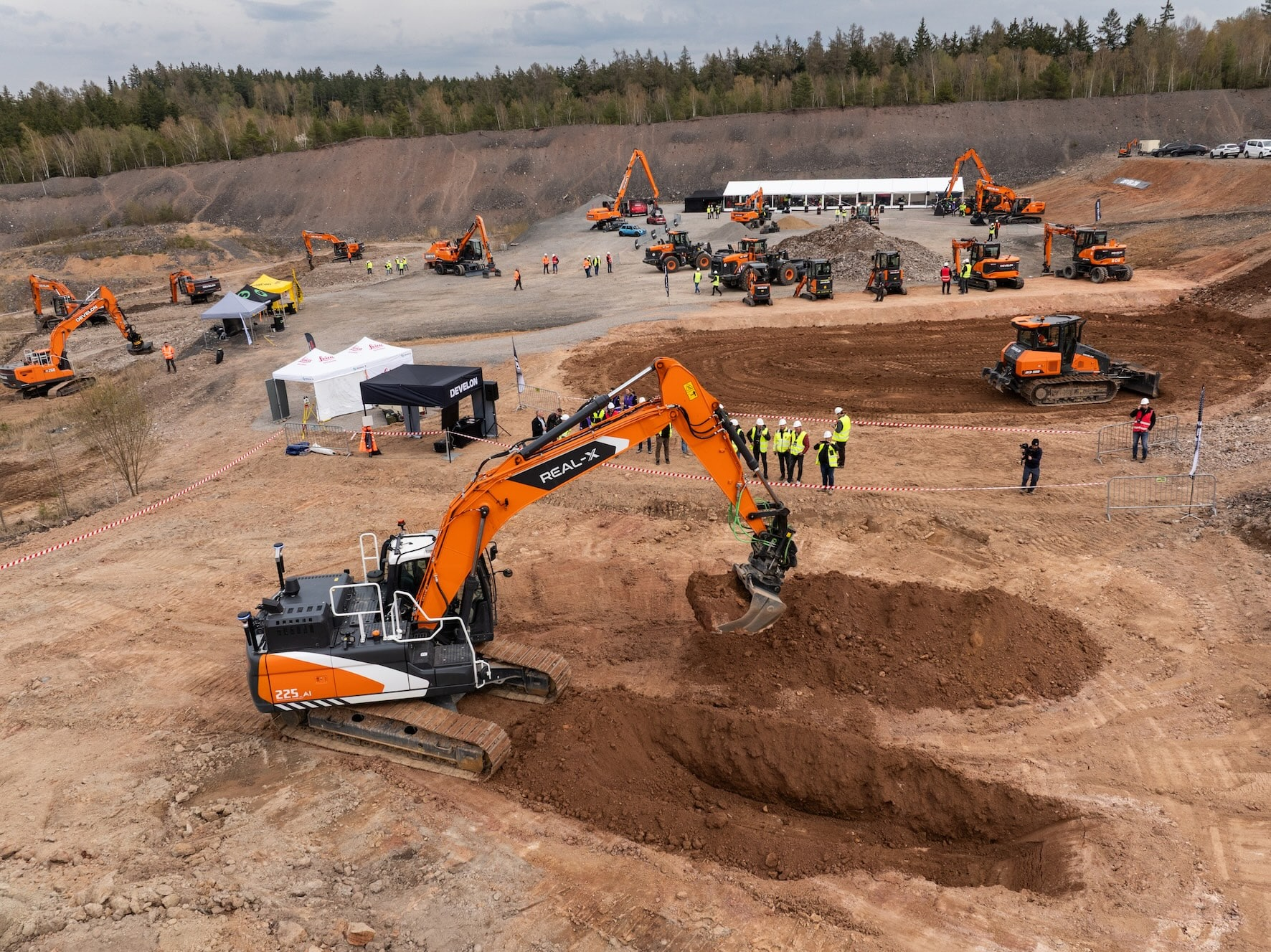
The four-day event brought nearly 900 customers, dealers, and industry media to the Czech Republic between 13 and 16 April, giving attendees the chance to operate and assess new machines in a live quarry environment. More than 25 machines were displayed, covering construction, quarrying, demolition, material handling, autonomous excavation, and electric equipment.
The launch centred on the DX360LC-9 and DX400HD-9 crawler excavators, rated at 37 tonnes and 42 tonnes respectively. Both machines are built on Develon’s next-generation excavator platform, which features full electro-hydraulic technology and integrated artificial intelligence designed to improve precision, control, and operating efficiency.
The new models joined the previously introduced DX230LC-9 and DX260LC-9 machines, giving customers the chance to operate the full set of Series 9 excavators on site. Live demonstrations also covered Develon’s E-Stop system, described by the company as the first technology of its kind developed specifically for the excavator market. The system is designed to reduce job-site incidents and improve operator protection in high-risk environments.
Stephane Dieu, product manager for Develon excavators in Europe, said: “E-Stop technology is comparable to emergency braking systems used in the automotive industry, and has already attracted strong attention from operators seeking practical solutions to improve site safety standards.”
Autonomous excavation was another central feature. Develon demonstrated the Real-X system, developed with Gravis Robotics, combining AI-powered excavation with advanced machine control. The system was shown trenching in a smooth and consistent operating cycle, with Develon stating that the collaboration has already resulted in the first such system being delivered to a European customer.
The company also displayed its Transparent Bucket 2.0 system for wheel loaders, which uses camera and display technology to reduce front blind spots and improve visibility around the bucket. Partners including Leica, Engcon, Trimble, Steelwrist, and Strickland also took part, showing the growing overlap between machine control, attachments, digital positioning, and productivity systems.
Develon’s electric range was shown alongside the diesel and smart-machine line-up. Models included the DX20ZE-7 and DX23E-7 electric mini excavators, the DX230LCE-7 electric crawler excavator, and the DX160WE-7K electric wheeled excavator. The company is expanding its battery-powered portfolio as construction sites face tighter controls on emissions, noise, and local air quality, particularly in urban, enclosed, and public-sector environments.
Special-application machines included the DX140RDM-7 compact demolition excavator, a 14-tonne machine designed for confined-space demolition. Develon also showed the DX160WMH-7 and DX350WMH-7 material handlers for recycling, waste, and industrial applications.
The launch shows how construction equipment development has moved beyond incremental improvements in fuel economy and operator comfort. Manufacturers are now competing on machine intelligence, safety intervention, emissions reduction, attachment integration, and the ability to generate more predictable work cycles. Those changes affect fleet planning, operator training, maintenance requirements, and machine utilisation.
Autonomous excavation remains at an early stage, but the move from concept demonstrations to customer deployment is significant. Earthmoving work involves repetitive cycles where consistency can improve productivity, fuel use, and finished quality, particularly on trenching, grading, and quarrying applications. The practical challenge is integrating those systems into mixed sites where people, machines, changing ground conditions, and temporary works all interact.
The European launch also reflects growing demand for equipment that supports productivity and compliance at the same time. Digital machine control can reduce rework, visibility systems can reduce collision risk, and electric models can help meet site-level environmental restrictions. Plant selection is increasingly shaped by carbon, safety, data capability, and whole-life productivity, rather than purchase price alone.