IN Brief:
- BMBI says builders’ merchants’ Q1 like-for-like value sales were 3.2% lower than Q1 2025.
- Like-for-like volume sales fell 8.1%, while prices increased 5.4%.
- Heavy building materials declined 6.7% by value, with renewables and water saving products the strongest category.
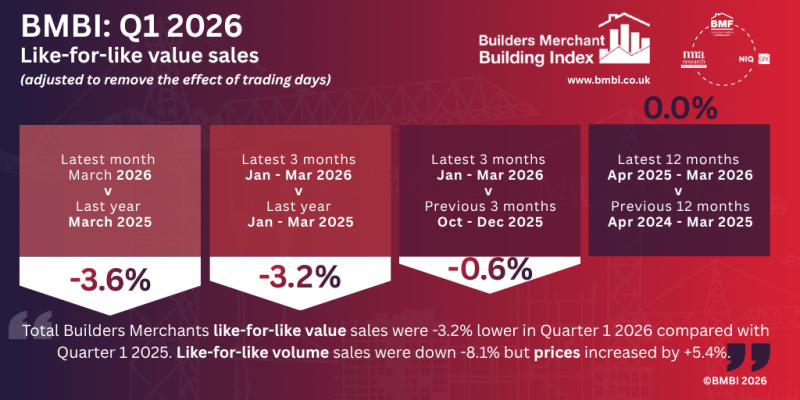
The Builders Merchant Building Index has reported a weak first quarter for UK builders’ merchants, with like-for-like value sales down 3.2% compared with Q1 2025 and volumes falling more sharply.
The latest BMBI figures show like-for-like volume sales down 8.1% year on year, while prices increased by 5.4%. With no difference in trading days between the two quarters, unadjusted total value sales were also 3.2% lower than Q1 2025.
Seven of the 12 product categories recorded higher value sales, with Renewables & Water Saving the strongest performer at 14.3% growth. Timber & Joinery Products rose 0.9% by value and outperformed the total builders’ merchants market, while Heavy Building Materials fell 6.7%.
March followed the same pattern as the wider quarter. Like-for-like value sales were 3.6% lower than March 2025, with volumes down 7.8% and prices up 4.6%. The figures point to a market where price increases are still cushioning revenue while underlying physical demand remains weaker.
BMBI is produced by MRA Research in partnership with GfK and the Builders Merchants Federation, using point-of-sale data from generalist builders’ merchants. The index is widely used as a read on repair, maintenance, improvement, and smaller construction activity because merchant sales often move before wider market statistics catch up.
The decline in heavy building materials is the sharpest signal in the data. Aggregates, blocks, bricks, cement, roofing products, and associated materials are closely tied to live site activity. Lower movement through those categories suggests that projects are being delayed, scaled back, repriced, or pushed more cautiously through procurement.
Those patterns affect more than merchant branches. Materials manufacturers, quarries, hauliers, distributors, contractors, and specialist trades all rely on predictable throughput. When volumes fall but prices remain elevated, the market becomes harder to read: revenue may not collapse, but workloads, site starts, and physical material movement can still weaken.
Housebuilding viability continues to form part of that picture. HBF’s analysis of the £76,000 cumulative cost burden on new homes showed how regulation, taxation, materials, labour, and finance have combined to raise development costs since 2020. Softer merchant volumes sit alongside that pressure, particularly where smaller builders and RMI contractors are exposed to weaker client confidence.
The strength of Renewables & Water Saving provides a different signal. Even in a weaker quarter, spending linked to energy efficiency, water management, retrofit, and sustainability-led upgrades continued to grow by value. That shift changes the role of merchants, which increasingly need to support customers with more technical product categories while still serving traditional building materials demand.
Contractors are also working in a mixed environment. Lower volumes can ease some supply pressure, but they do not automatically improve trading conditions. Higher prices keep estimates under strain, while weaker client demand can delay decisions or reduce project scope. In RMI work, where household and small business confidence directly affects spend, that combination can create a stop-start pipeline.
The 12-month figures present a flatter market rather than a collapse. For April 2025 to March 2026, like-for-like value sales were unchanged, volumes fell 1.0%, and prices rose 1.0%. Stability at annual level masks the more difficult first-quarter movement, leaving manufacturers and merchants watching closely for signs of recovery in spring and summer trading.
The construction supply chain does not need exceptional growth to function well, but it does need predictable volume. The latest merchant data shows a market still trying to regain momentum, with heavy materials exposed and sustainability-linked categories carrying more of the positive movement.