IN Brief:
- Both main tubes of the Brenner Base Tunnel have broken through between Austria and Italy.
- Excavation teams connected approximately 1,400 metres below the Brenner Pass with deviations measured in centimetres.
- Work continues elsewhere on the route before railway systems, testing, and eventual passenger and freight operations.
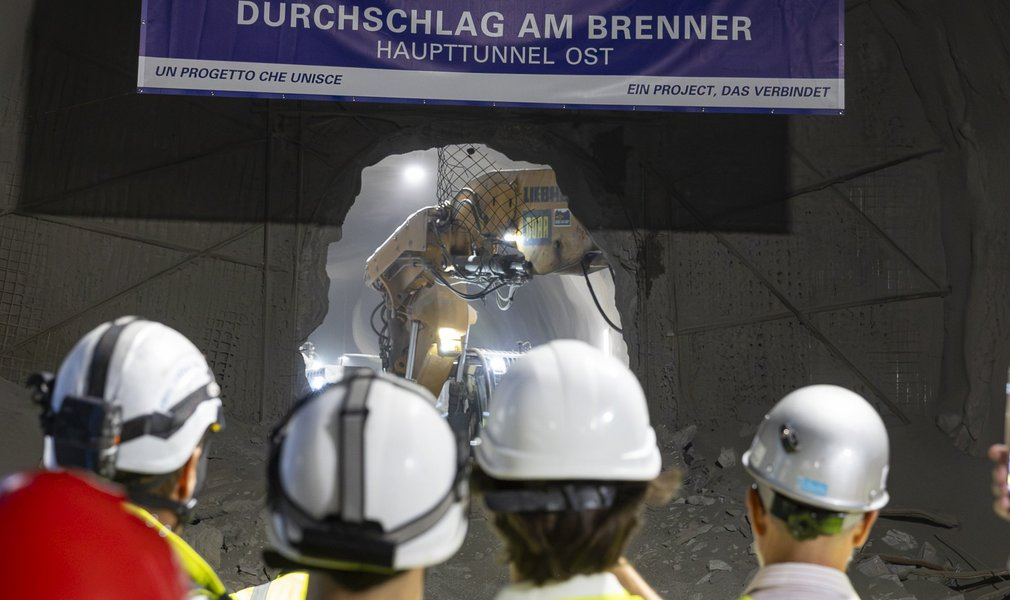
Brenner Base Tunnel construction teams have completed the cross border breakthroughs of both main running tunnels between Austria and Italy beneath the Brenner Pass.
The connections link the Austrian H53 Pfons–Brenner construction lot with the Italian H61 Mules 2–3 lot. The final breakthrough brought together headings excavated from opposite sides of the national border.
Work took place approximately 1,400 metres below the mountain pass, while surveying showed that the approaching tunnels met with deviations measured in centimetres. The result provides a significant validation of the underground control network used across the project.
Italian crews used the tunnel boring machines Virginia and Flavia to drive towards the border, whereas excavation on the Austrian side used conventional drill and blast techniques through the corresponding sections.
The different methods reflect geology, access, programme requirements, and construction lot strategies across the route. Connecting machine driven and conventionally excavated headings required close control of alignment, profile, temporary support, and the final removal sequence.
An earlier cross border breakthrough in the exploratory tunnel was completed in September 2025. Running beneath the main tubes, that connection provides geological information, drainage, access, and additional surveying references.
On the Austrian side, the H53 contract is being delivered by a consortium of PORR and Marti. Tunnel boring machines Wilma and Olga continue to advance north towards Innsbruck, leaving further excavation to complete despite the border milestone.
Precision below the Alps
Long tunnels depend on surveying systems capable of transferring alignment through shafts, portals, access tunnels, and kilometres of underground excavation. Once headings move deep into the mountain, teams cannot repeatedly check their position against visible external reference points.
Minor angular errors can become substantial positional differences over long distances. The centimetre scale result at Brenner indicates that the control network, instrumentation, calculations, and underground setting out remained consistent across two countries and several construction contracts.
The exploratory tunnel has strengthened that process while also providing more direct information about geology and groundwater than surface investigation alone. Support designs and excavation sequences can therefore be adjusted before the larger running tunnels reach difficult ground.
Alpine tunnelling retains considerable uncertainty because fault zones, water ingress, squeezing ground, temperature, stress, and variable rock quality can affect progress. Using both tunnel boring machines and drill and blast gives the project different ways to respond, although interfaces between methods require careful management.
Other major Italian tunnel projects are advancing through similarly complex terrain. Excavation on the Gardena rail tunnel has begun with a tunnel boring machine, adding to a wider programme intended to increase rail capacity through mountainous regions.
The Brenner Base Tunnel forms a central section of the route linking northern and southern Europe. Its eventual operation is intended to allow flatter gradients, longer freight trains, shorter journey times, and greater capacity than the historic line over the pass.
Those benefits depend on much more than the excavation of the main tubes. Cross passages, drainage, ventilation, power, signalling, communications, fire safety systems, track, access, and control infrastructure must still be installed and integrated.
Fit out can carry substantial programme risk because systems from different suppliers must operate together under normal, degraded, and emergency conditions. Testing will need to demonstrate that power, signalling, ventilation, communications, and evacuation arrangements perform as a single railway system.
Cross border operation introduces further coordination. Technical rules, emergency procedures, maintenance responsibilities, control arrangements, and staff training must function across the national boundary as smoothly as the physical tunnels now do.
The construction programme also depends on connecting infrastructure. Capacity gains through the base tunnel will be constrained if approach routes, junctions, terminals, or neighbouring sections cannot accommodate the intended passenger and freight services.
Environmental performance will be judged partly by how much traffic shifts from road to rail. That transfer requires dependable journey times, suitable freight terminals, sufficient train paths, and competitive operating conditions rather than tunnel capacity alone.
Completing both border breakthroughs removes one of the project’s most demanding underground interfaces. The Austrian and Italian headings have met accurately beneath the Alps, while substantial excavation, fit out, systems integration, and commissioning remain before the route becomes an operating railway.