IN Brief:
- Balfour Beatty has received notice to proceed on the Middlewich Eastern Bypass for Cheshire East Council.
- The project includes a 2.5km bypass, bridges over canal and railway assets, and active travel infrastructure.
- Main construction will begin in May 2026, with completion expected in summer 2028.
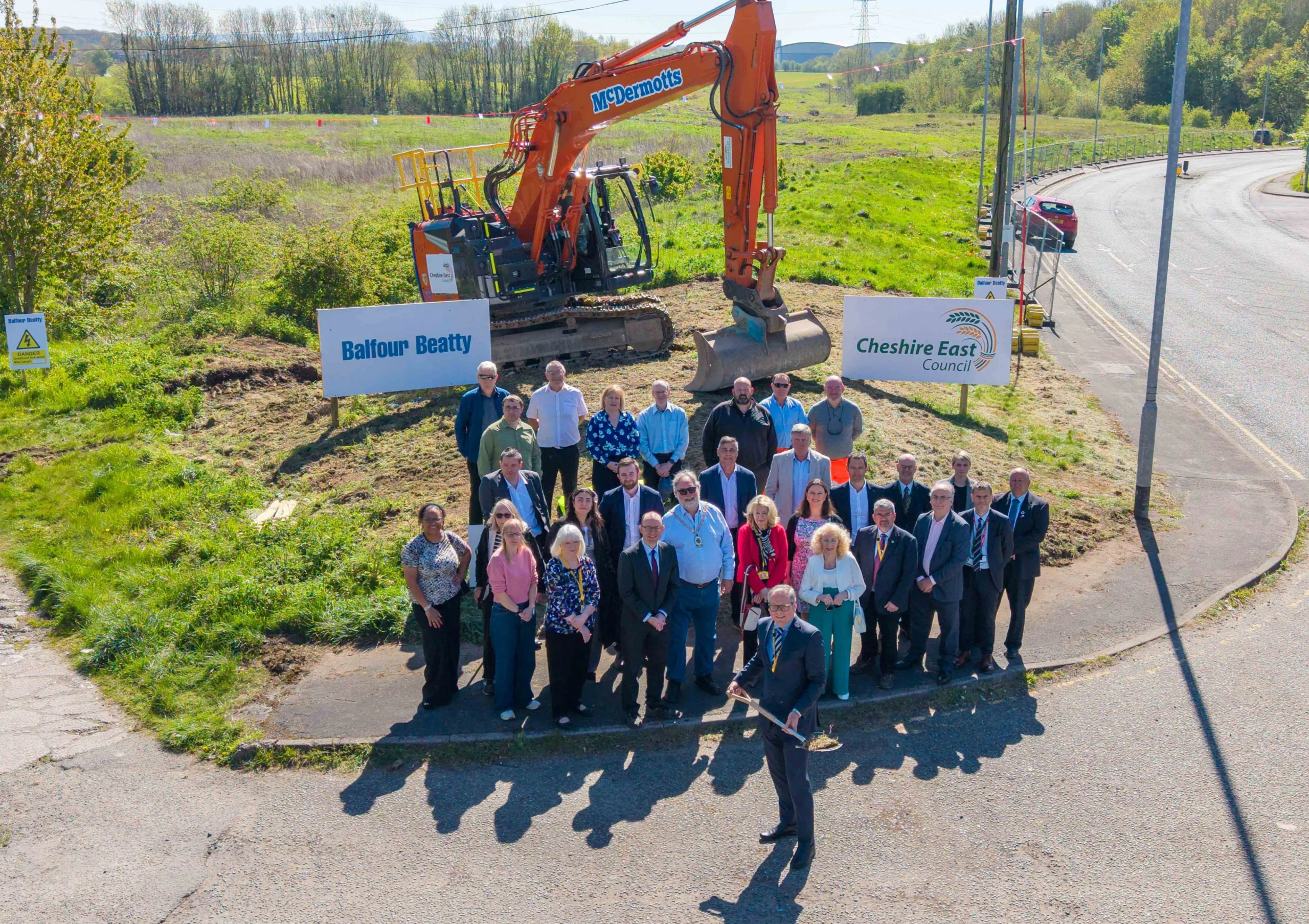
Balfour Beatty has received notice to proceed on the Middlewich Eastern Bypass for Cheshire East Council, clearing the way for main construction to begin in May 2026.
The contract covers a 2.5km carriageway running to the east of Middlewich in Cheshire, together with two major junctions, a new highway bridge over the Trent and Mersey Canal, a bridge over the Sandbach-Northwich railway line, and integrated active travel infrastructure.
The scheme was awarded through the SCAPE framework. Since being appointed preferred bidder, Balfour Beatty has worked with Cheshire East Council on detailed design development, supported by strategic design partner Jacobs UK. The contractor has also been managing key third-party interfaces with Network Rail and the Canal & River Trust, reflecting the complexity of delivering local transport infrastructure across road, rail, waterway, and community access requirements.
The bypass is designed to ease congestion in and around Middlewich town centre and improve journey reliability for local road users. Main construction is expected to run until summer 2028, with the project employing up to 150 people at peak, including apprenticeship and graduate opportunities.
Kay Slade, managing director of Balfour Beatty’s regional civils business, said: “Through early contractor engagement, we have worked closely with the Council and key stakeholders to ensure that the scheme delivers real value to Middlewich and its residents.”
The Middlewich project sits within a familiar pattern for regional road schemes. Local bypasses are often described through congestion relief, but their delivery involves bridges, land access, statutory undertakers, environmental mitigation, active travel provision, public consultation, and interfaces with national infrastructure operators. Each workstream adds pressure to programme, design coordination, and cost control.
The scheme’s development path also reflects the challenge councils face in moving infrastructure from consent to construction. Funding, procurement, design progression, inflation, and governance hurdles can stretch delivery cycles over many years. By the time a contractor receives notice to proceed, market conditions, material costs, and local expectations may have shifted from the assumptions used at earlier planning stages.
Early contractor involvement remains one of the main routes for reducing uncertainty before work begins on site. On Middlewich, Balfour Beatty’s pre-construction role has included design development and management of third-party interfaces. Railway and waterway crossings can become programme-critical if approvals, possessions, temporary works, or access arrangements are not tightly controlled.
The project also shows how active travel has become embedded in mainstream highways delivery. New road infrastructure is increasingly expected to provide cycle and pedestrian links alongside carriageway capacity, while local authorities manage environmental habitats, drainage, and long-term resilience. These features can improve the finished scheme, while increasing the need for integrated design across civil engineering, landscaping, ecology, and transport planning.
Middlewich is not a mega-project, but it reflects much of the UK civils market: technically varied, locally sensitive, heavily interfaced, and dependent on public-sector funding cycles. Its move into construction gives Cheshire East a long-awaited delivery milestone and gives Balfour Beatty another regional transport project in a market where well-managed local infrastructure remains a steady source of contractor workload.