IN Brief:
- Balfour Beatty is progressing bulk earthworks, piling, drainage, utilities, and temporary works across the North Hykeham Relief Road.
- Main piling has started at Station Road, with further piling planned at Wath Lane, Bat Bridge, and the River Witham.
- On-site material processing and the dedicated haul road are intended to remove more than 150,000 construction vehicle movements from surrounding roads.
Balfour Beatty is progressing bulk earthworks, bridge piling, drainage, utilities, and temporary works across the North Hykeham Relief Road as the five-mile Lincolnshire scheme moves through its first full construction season.
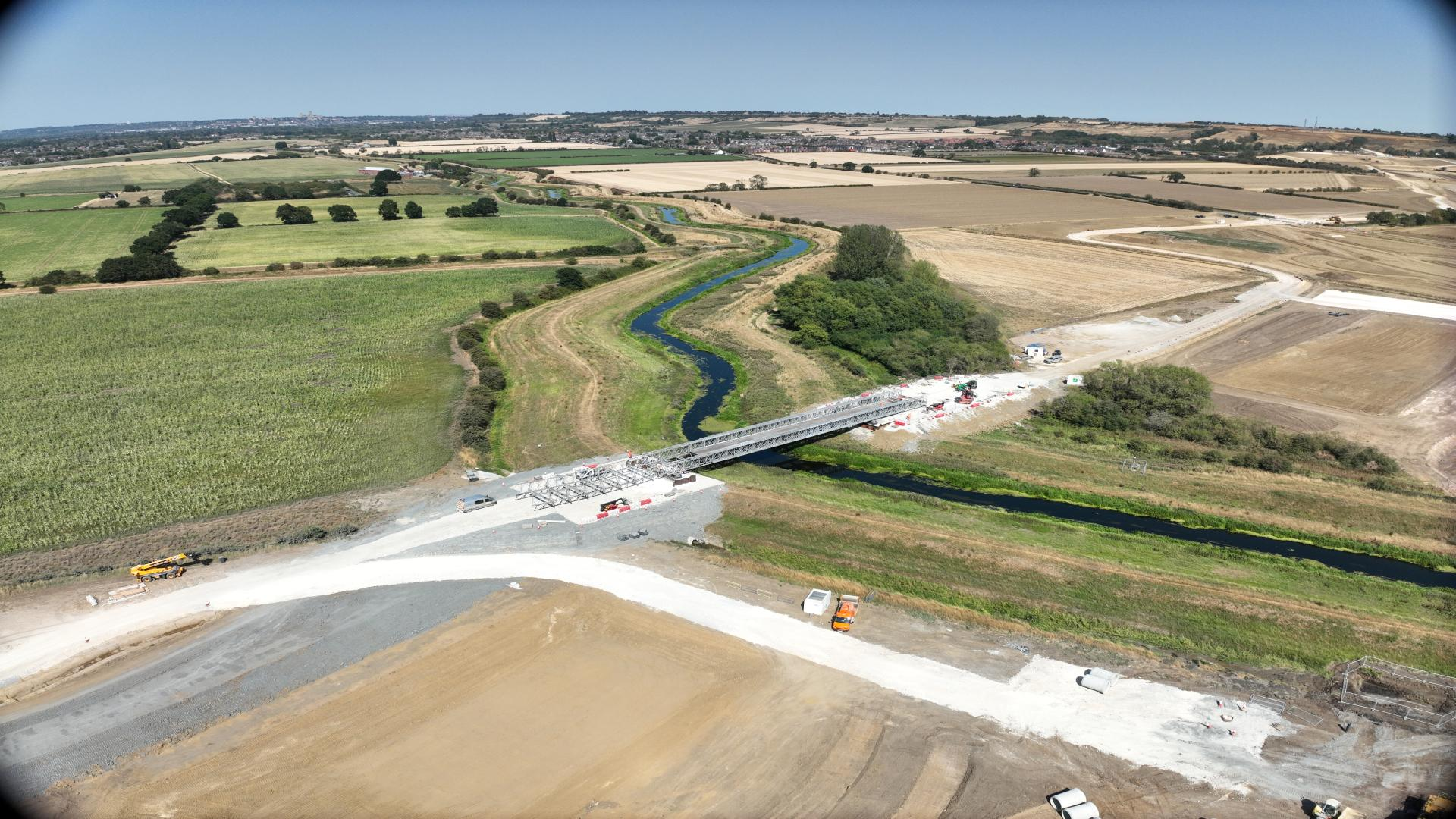
Lincolnshire County Council’s September update shows activity spread across the route between the A46 Pennells Roundabout and the Lincoln Eastern Bypass. Work completed or progressed during August included site clearance, topsoil stripping, haul-road construction, bulk excavation, embankment formation, attenuation ponds, drainage, and construction of the temporary bridge over the River Witham.
The structural programme has also moved beyond trial work. Test piles have been installed and assessed for structures at Station Road, Wath Lane, and the River Witham, while main piling has started at Station Road Bridge. Compound areas at Station Road and Brant Road have developed in parallel, extending the contractor’s operational footprint as work fronts spread along the alignment.
September’s programme continues that shift into heavier civil engineering. Bulk earthworks and embankment construction are due to progress across the scheme, excavation into Lincoln Cliff will continue, and material processing around Grantham Road remains active. Piling is scheduled at Station Road, Wath Lane Accommodation Bridge, Bat Bridge, and the River Witham.
The council is also progressing further utility diversions with National Grid and Anglian Water, restarting demolition of two remaining Station Road properties, completing the Grantham Road plant crossing, and installing satellite compounds. These packages are smaller than the principal structures, but they determine whether plant, materials, and crews can move efficiently between work areas as construction intensifies.
Several earlier utility interfaces have already been cleared. Anglian Water apparatus at South Hykeham Road has been diverted, National Grid electricity diversions across the scheme have been completed, and plant crossings are operating at South Hykeham Road, Brant Road, and Station Road.
Material handling is a substantial part of the construction strategy. Excavated rock is being crushed and screened on site so that suitable material can be reused elsewhere in the project instead of routinely being removed and replaced with imported aggregate. The processing operation has been established close to Grantham Road and Lincoln Cliff, where some of the scheme’s largest earthworks are taking place.
Lincolnshire County Council estimates that the combination of on-site processing and the dedicated construction haul road will remove more than 150,000 construction vehicle movements from surrounding roads over the project. The approach also links excavation more closely with embankment construction, because processed material can be moved directly between work fronts rather than passing through external disposal and supply chains.
That requires careful sequencing. Excavated material has to be assessed, processed, and placed at a rate that matches the earthworks programme, while temporary access routes need to remain usable by heavy plant in changing ground and weather conditions. The haul road is therefore part of the project’s production system rather than simply a way of keeping construction traffic away from public roads.
Drainage is developing alongside the cut-and-fill operation. Several attenuation ponds and ditches were excavated during August, with pipework, headwalls, and outfalls also progressing. Installing these elements early gives the project a controlled route for surface water before later road layers, bridge works, and permanent structures restrict access to parts of the corridor.
The River Witham creates another interface between temporary access and permanent construction. A temporary bridge is being built to carry site movement across the river while the permanent crossing develops, keeping more haul traffic within the construction corridor and reducing dependence on surrounding roads.
Balfour Beatty formally started work on the £138 million construction contract in March 2026 following several years of design development, planning, and enabling preparation. Its scope includes the new dual carriageway and major structures at Station Road and the River Witham. The county council currently projects completion in summer 2029, subject to external factors.
The scheme received a £110 million Department for Transport allocation through the Large Local Majors programme. It is intended to complete the ring road around Lincoln, improve journey reliability, reduce congestion around North Hykeham and Lincoln, and release access to planned housing and employment development.
Construction has now moved beyond mobilisation into a period where several disciplines have to advance together. Piling cannot get too far ahead of access and compounds, earthworks depend on drainage and material handling, and permanent highway construction will ultimately rely on bridges, utilities, and embankments reaching compatible stages.
September’s progress will therefore be measured across the whole corridor rather than through a single headline structure. The project team now has earthworks, piling, drainage, demolition, utilities, materials processing, and temporary access operating concurrently, creating the conditions for permanent carriageway construction to expand as the scheme moves towards its projected 2029 completion.