IN Brief:
- The @one Alliance reports that final works are under way on the £40m Broadholme upgrade.
- Four sequencing batch reactors, supporting inlet pipework, dosing and power systems form part of the documented scheme.
- The upgrade is designed to increase treatment capacity by about 35 million litres per day; full operation is not yet confirmed.
Anglian Water’s @one Alliance is completing the final works on a £40m upgrade at Broadholme Water Recycling Centre near Wellingborough, Northamptonshire. The expanded facilities are intended to provide roughly 35 million litres per day of additional treatment capacity while improving the quality of treated effluent returned to the River Nene. The alliance says the scheme is approaching completion, but has not confirmed that the full upgraded system has entered operational service.
The works serves the Wellingborough, Rushden and Irthlingborough catchment, where the utility has identified both population growth and tighter environmental requirements. Additional treatment capacity and improved phosphorus removal are separate outcomes of the upgrade. Capacity determines the amount of wastewater that can enter and pass through the process, while phosphorus control concerns the concentration of nutrients released to receiving waters. Increasing the hydraulic throughput without suitable treatment and filtration would not achieve the environmental objective, so both types of equipment have been included in the scheme.
The engineering programme has been developed within an operating water recycling centre. In a 2024 project case study, the @one Alliance described the investment as £35m, with Mott MacDonald Bentley acting as principal contractor on its behalf. The alliance’s latest figure is £40m, reflecting the stated value of the upgrade as it nears completion in November 2026. The historical case study identifies four sequencing batch reactors, the main inlet pipeline, chemical dosing, filtration and electrical power upgrades. Those details describe the project design and construction scope, rather than proving that final commissioning has already occurred.
Sequencing batch reactors treat wastewater in a series of controlled stages within the same tanks, rather than moving every stage through a separate continuous-flow vessel. Aeration and settling can be sequenced to allow biological treatment and separation of solids before the treated water is discharged onward. The alliance identified four 35-metre-diameter reactors for Broadholme, each approximately seven metres high, to provide additional full flow to treatment capacity. Their operating cycles and final commissioned performance have not been detailed in the latest update.
The reactor civil works involved a shared 75-by-75-metre base slab and four concrete plinths beneath the tanks. The alliance’s earlier case study records more than 570 cubic metres of concrete for each plinth, with more than 75 concrete mixer journeys per pour using a restricted site access road. Sequencing deliveries through an operational treatment site constrained both the construction programme and vehicle movements. These are documented construction-stage quantities, not new volumes announced in the November completion update.
The glass-coated steel reactors were erected using a top-down method. The contractor assembled an initial ring at ground level and raised it with hydraulic jacks, allowing subsequent rings to be added beneath. Repeating that procedure enabled the full height to be reached while reducing the amount of assembly undertaken at height. The choice also helped organise tank erection within a constrained, operational compound, although the available evidence does not provide a quantified comparison of time or safety performance against other methods.
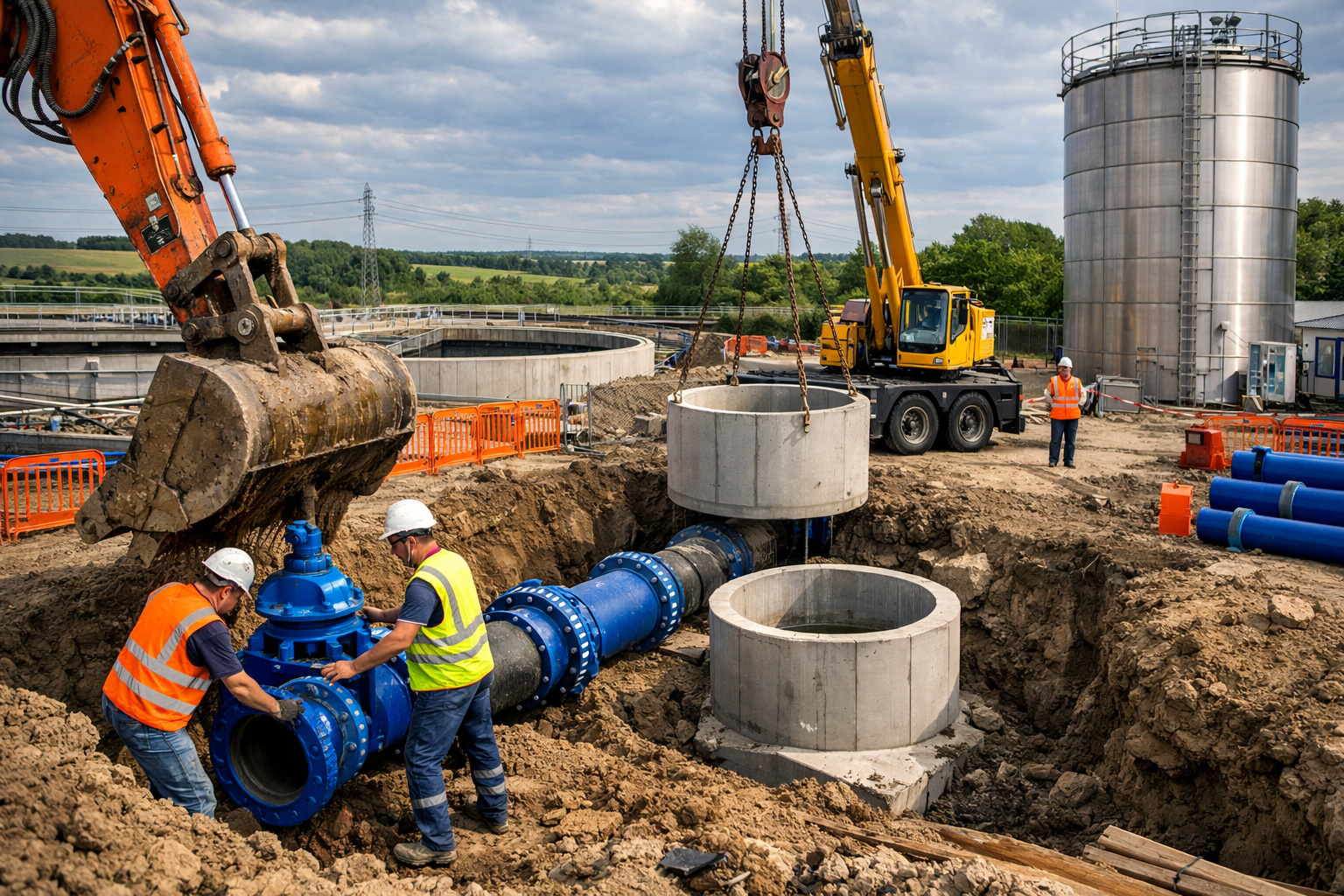
A new 310-metre pipeline, 710 millimetres in diameter and made from high-density polyethylene, was included to carry incoming wastewater from an existing inlet works to the reactor distribution chamber. Fusion-welded joints were used along the run, which follows a route close to an access road used by site tankers. Routing and installation therefore had to account for continued vehicle movements as well as the existing buried services. The pipeline is a necessary hydraulic link between the additional treatment equipment and the pre-existing process.
Phosphorus removal involves a separate chemical dosing package. The documented design included a 60-cubic-metre ferrous dosing installation and filtration equipment intended to improve effluent quality. Chemical dosing promotes the formation of solid compounds containing phosphorus so that those solids can be removed, reducing the phosphorus discharged to receiving waters. The exact final consent conditions and verified discharge figures have not been supplied in the latest project update, so compliance performance cannot be inferred solely from equipment installation.
New mechanical and electrical systems were required to operate the enlarged works. The earlier engineering record describes a power supply upgrade, an additional transformer, a standby generator and associated fuel storage to maintain critical functions during power loss. It also records motor control centre, blower and pipework support structures. Such systems are integral to treating higher wastewater flows: new tanks provide physical capacity, but pumps, aeration equipment, controls and power resilience determine how consistently the process can be operated.
The site is close to lakes connected with the River Nene, including environmentally sensitive water bodies identified in the alliance’s earlier project account. Ecological screening and assessments formed part of the scheme’s preparations. The construction record also describes challenging winter weather and delivery delays for some equipment during the original programme. Those issues are historical and should not be mistaken for new obstacles reported in November 2026, when the contractor’s update concerns finishing the remaining work ahead of operation.
Access improvements also formed part of the construction programme. The alliance previously detailed more than one kilometre of access road renewal, with some operations scheduled overnight because the road was too narrow to maintain a separate safe route for tankers alongside construction activity. Combined with the substantial concrete deliveries and tank assembly, those arrangements illustrate why treatment capacity projects require detailed logistics planning even when most new equipment is contained within an existing utility compound.
The @one Alliance says final works are underway, with the increased capacity intended to support growth across North Northamptonshire and improved treated water quality in the River Nene. The approximately 35 million litres per day is stated as additional design capacity, not a measured output from an already commissioned system. A date for the entire upgraded works to enter service has not been supplied. Completion, process commissioning and confirmation of performance remain the next milestones before the full benefits of the investment can be assessed.