
IN Brief:
- Liebherr’s L 566 H hydrogen-powered wheel loader has entered a multi-year field trial with Georg Grube in Bremerhaven.
- The machine feeds conveyors, moves sand, gravel and rock, and loads vehicles while using a dedicated hydrogen refuelling facility.
- The partners are assessing whether regional hydrogen supply and heavy-duty machine operation can function together reliably and economically.
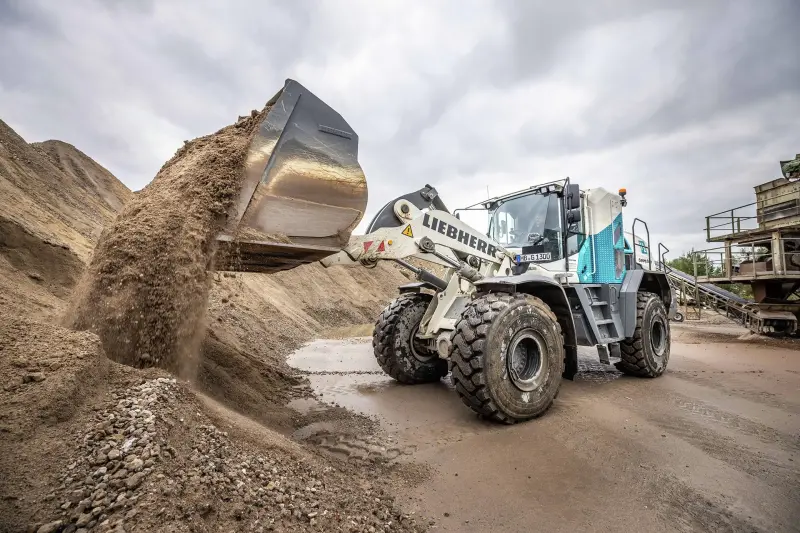
Liebherr has placed its hydrogen-powered L 566 H large wheel loader into everyday bulk handling operations at Bremerhaven’s fishing port in Germany. The prototype is being used by Georg Grube GmbH to move material between stockpiles, supply conveyors and load lorries, replacing duties otherwise undertaken by conventional wheel loaders. The deployment forms part of a multi-year field trial involving Liebherr, Georg Grube and Green Fuels, with refuelling provided through a local hydrogen infrastructure project.
Georg Grube handles sand, gravel, and rock around conveyor systems, stockpiles, and loading areas at the fishing harbour. The machine is being used to feed conveyors, shift material between storage areas, and load lorries, placing the prototype within ordinary bulk handling operations. Those movements vary considerably in bucket load, travel distance, and engine demand. The trial is intended to determine whether hydrogen operation can support such changing duty cycles while delivering the availability expected of the existing equipment fleet.
The L 566 H uses a hydrogen combustion powertrain, a different technical approach from a battery-electric machine or a hydrogen fuel-cell vehicle. Fuel is carried on the machine and consumed in an engine that drives the loader’s working systems. Liebherr is evaluating the technology in a demanding, repetitive application rather than publishing a laboratory performance claim. The manufacturer has not released measured fuel consumption, the prototype’s operating hours, or a like-for-like productivity comparison with diesel units, so those results remain to be established during the trial.
Hydrogen for the project is produced in the Bremerhaven area using electricity generated by wind turbines. An electrolyser operated through HY.City.Bremerhaven converts electricity and water into hydrogen; mobile storage then carries the gas to a dedicated refuelling installation on the Fraunhofer IWES Hydrogen Lab premises. After a working shift, the loader can be refuelled at that site. The process links regional energy production to mobile plant, but also requires storage, transport, and dispensing facilities outside the machine itself.
The availability of that refuelling chain is one reason Bremerhaven was selected for field testing. A loader working regularly on construction or quarry sites would need equivalent access to fuel, whether through deliveries, fixed facilities, or a combination of the two. Fuel production and transport introduce costs and operating constraints that are separate from the performance of the powertrain. The local project can therefore test the interaction between plant and supply infrastructure under defined conditions, rather than determine the economics of hydrogen machinery at every site.
Günther Holzer, technical managing director of Liebherr-Werk Bischofshofen, has described the manufacturer as pursuing different alternative powertrains for different applications. Hydrogen combustion is being evaluated alongside battery-electric solutions, with the selection shaped by operating conditions and the practical availability of energy. In Bremerhaven, the partners can test a machine carrying out regular heavy loading work and a fuel network developed for several regional users. Neither the machine nor that network is being presented as a finished product available for general purchase.
Wolfgang Grube, owner and managing director of Georg Grube, has placed particular emphasis on dependable daily operation. His company joined the trial before a production-ready machine was available so that working experience could inform further development. That practical emphasis makes equipment availability, time away from loading duties, and the ability to complete ordinary handling tasks central considerations. Published information establishes the start of the deployment, but not whether the prototype has already matched the operator’s conventional fleet across a complete operating period.
Green Fuels is involved in the local supply system and the HY.City.Bremerhaven initiative. Its managing director, Andreas Wellbrock, has emphasised that production, storage, transport, dispensing, and end use all need to be connected for the technology to operate. The loader’s refuelling station is located at the Fraunhofer hydrogen laboratory rather than at every work area within the port. That arrangement enables the trial but still requires the machine to leave its operating location for refuelling after a shift.
The deployment is also linked to H2B:IMPACT, a Bremen hydrogen initiative supported by the EU’s Clean Hydrogen Partnership. The wider project is intended to integrate hydrogen production, distribution, and consumption across sectors including construction and port logistics. Experience from the wheel loader will contribute to assessing one application within that larger system. Commercial uptake will depend partly on sufficient demand for shared fuel infrastructure; a single prototype is unlikely to generate the utilisation needed to support a wider refuelling network on its own.
Heavy loading duties differ from work performed by compact plant or stationary industrial equipment. Cycle intensity, machine movement, shift duration, and the space needed for fuel handling all influence the suitability of a particular powertrain. In a port, those constraints sit alongside existing conveyor, storage, and vehicle operations. The Bremerhaven test is deliberately conducted within that working environment, where interruption to a loader can affect the movement of material through other equipment rather than merely delay a demonstration run.
The pilot is expected to continue for several years, allowing Liebherr, Georg Grube, and Green Fuels to assess both the prototype and its supporting supply arrangements through repeated operations. No production launch date or verified whole-life cost comparison has been announced for the L 566 H. The useful next evidence will be sustained machine availability, fuel logistics performance, and operational results from the heavy bulk handling duties now under test.