IN Brief:
- Jones Bros has started the third phase of coastal protection work at Old Colwyn for Conwy County Borough Council.
- The £4m project includes 14,000 tonnes of rock armour and raising a further 160m of sea wall and promenade by approximately 1.5m.
- Up to 30 people will work on the programme, which includes access improvements and is due for completion in late 2027.
Jones Bros Civil Engineering UK has begun the third phase of coastal defence improvements at Old Colwyn in North Wales under a £4m project for Conwy County Borough Council. The works combine rock armour, higher sections of sea wall and promenade, replacement pedestrian access, and alterations to an outfall on a frontage exposed to severe storms and overtopping.
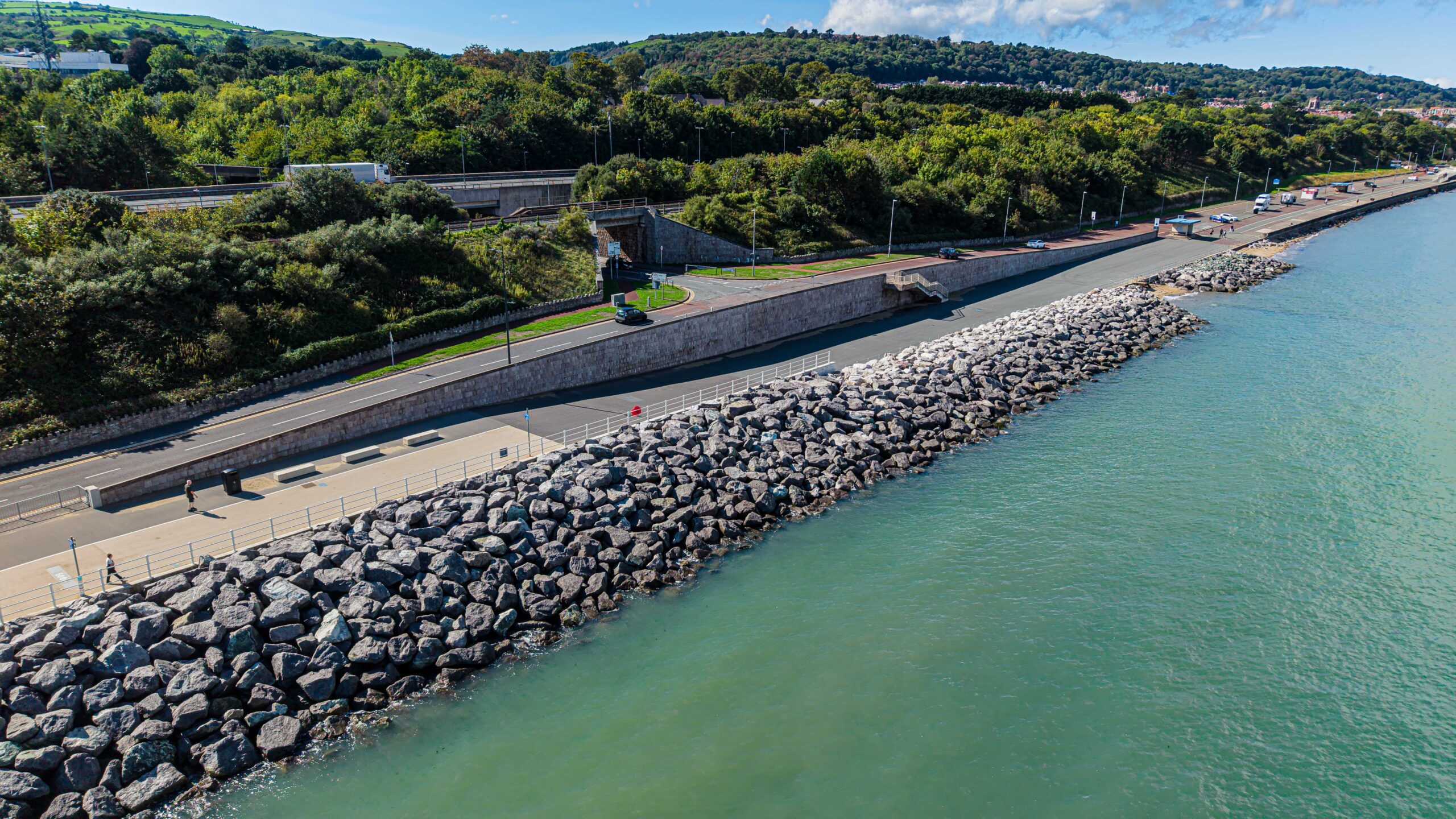
The contractor will procure approximately 14,000 tonnes of rock armour to reinforce a 100m section of coastline and intends to source the stone from North Wales quarries where possible. Along a further 160m, the existing sea wall and promenade will be raised by approximately 1.5m. The separate lengths reflect different types of intervention within the same phase rather than a single uniform treatment along the whole waterfront.
Old Colwyn’s seafront occupies a critical position between the sea and transport infrastructure. The promenade helps protect the A55 trunk road and the London–Holyhead railway line, both of which are important routes across North Wales. During large storms, water can overtop the existing defences and force the promenade to close. The deterioration of the historic coastal structures increases the consequences of future events if no improvement is made.
Rock armour is installed as a mass of large, irregular stones on an exposed frontage, allowing the protective layer to absorb and dissipate some of the energy of incoming waves. Stone size, grading, placement, and support conditions influence its performance, although detailed cross-sections and design parameters have not been made public for this phase. The specified 14,000 tonnes establishes a substantial procurement and lifting operation within the relatively short 100m section, with the contractor seeking North Wales quarries where practicable.
Raising the wall and promenade addresses a different aspect of exposure: water reaching or crossing the crest of the existing defence. Increasing the level by approximately 1.5m over the identified 160m section is intended to improve the coastline’s resistance to storm conditions. The project combines this elevation change with protection at the seaward edge, although no quantified reduction in overtopping frequency or future flood risk has been supplied.
Existing pedestrian entry points will be demolished and replaced by perpendicular stairs and crossover steps, and an outfall will be extended. These interventions sit alongside the wall and promenade raising, creating interfaces between the marine structure, public access routes, and surface-water drainage. Conwy County Borough Council has identified accessibility and the condition of the promenade among the benefits sought, although the published project description does not give detailed gradients or construction drawings for the replacement access points.
Up to 30 people, including apprentices and subcontractors, are expected to work on the project. The programme must accommodate deliveries of substantial quantities of stone, plant operations on a constrained coastal frontage, and continued management of public access around the works. Jones Bros said it has put measures in place to limit disruption for residents, businesses, and promenade users, and an on-site information cabin will provide project updates.
Sam Roberts, project manager at Jones Bros, said: “Our recent developments in Kinmel Bay and Penrhyn Bay put us in a strong position, as we have existing relationships with local suppliers and the experience to deliver these vital improvements.” The contractor has undertaken other marine and flood defence projects on the North Wales coast, giving the current team experience of coastal construction and material procurement in the region.
The Old Colwyn contract follows previous phases of work along the coastal frontage, while Jones Bros has also completed marine protection schemes at Kinmel Bay and Penrhyn Bay. The contractor’s experience is particularly relevant to sourcing and placing large volumes of stone and managing work on an open seafront. At Old Colwyn, coastal protection and public access alterations form one programme: a higher wall must be integrated with the steps, crossings, and drainage connections used by the promenade.
The scheme is being delivered on a frontage where the promenade can be closed during severe weather, and where the protected road and railway remain operational. The release identifies new access points, an outfall extension, and a raised crest, but does not provide final construction sequencing or a quantified reduction in future overtopping. Those details should not be inferred from the stated wall height alone; performance will depend on the completed arrangement across the different sections of coastline.
Councillor Mike Priestley, Conwy County Borough Council’s cabinet member for Environment, Roads & Infrastructure, said: “These improvements are about far more than coastal defence. They form part of a wider regeneration vision that will help protect vital infrastructure, improve accessibility, enhance the promenade experience, and ensure this stretch of coast can be enjoyed safely for generations to come.” The council regards the works as part of a continuing investment in the seafront rather than a standalone emergency repair.
Founded in the 1950s, Jones Bros employs approximately 570 people and delivers work across highways, reservoirs, flood and marine defence, waste management, and renewable energy construction. Its own plant fleet and apprenticeship scheme are part of the company’s delivery arrangements, with apprentices among the workforce identified for Old Colwyn. The contractor has said it will seek local suppliers for rock armour where possible; no final quarry allocation or delivery schedule has been confirmed.
The third-phase works are programmed for completion in late 2027. The stated construction scope encompasses rock armour installation, raising parts of the sea wall and promenade, replacement access structures, and the extended outfall. The completed works are intended to protect an exposed seafront that provides a buffer between the sea and the A55 and railway infrastructure.