IN Brief:
- Wills Bros will install 12 precast concrete beams for Guay Overbridge on the Tay Crossing to Ballinluig A9 dualling scheme.
- The largest beams measure up to 33.5m and weigh up to 84 tonnes, requiring specialist crane lifts beside and above the existing road.
- Five overnight closures are scheduled from 30 November to 5 December, with controlled traffic windows and maintained emergency access.
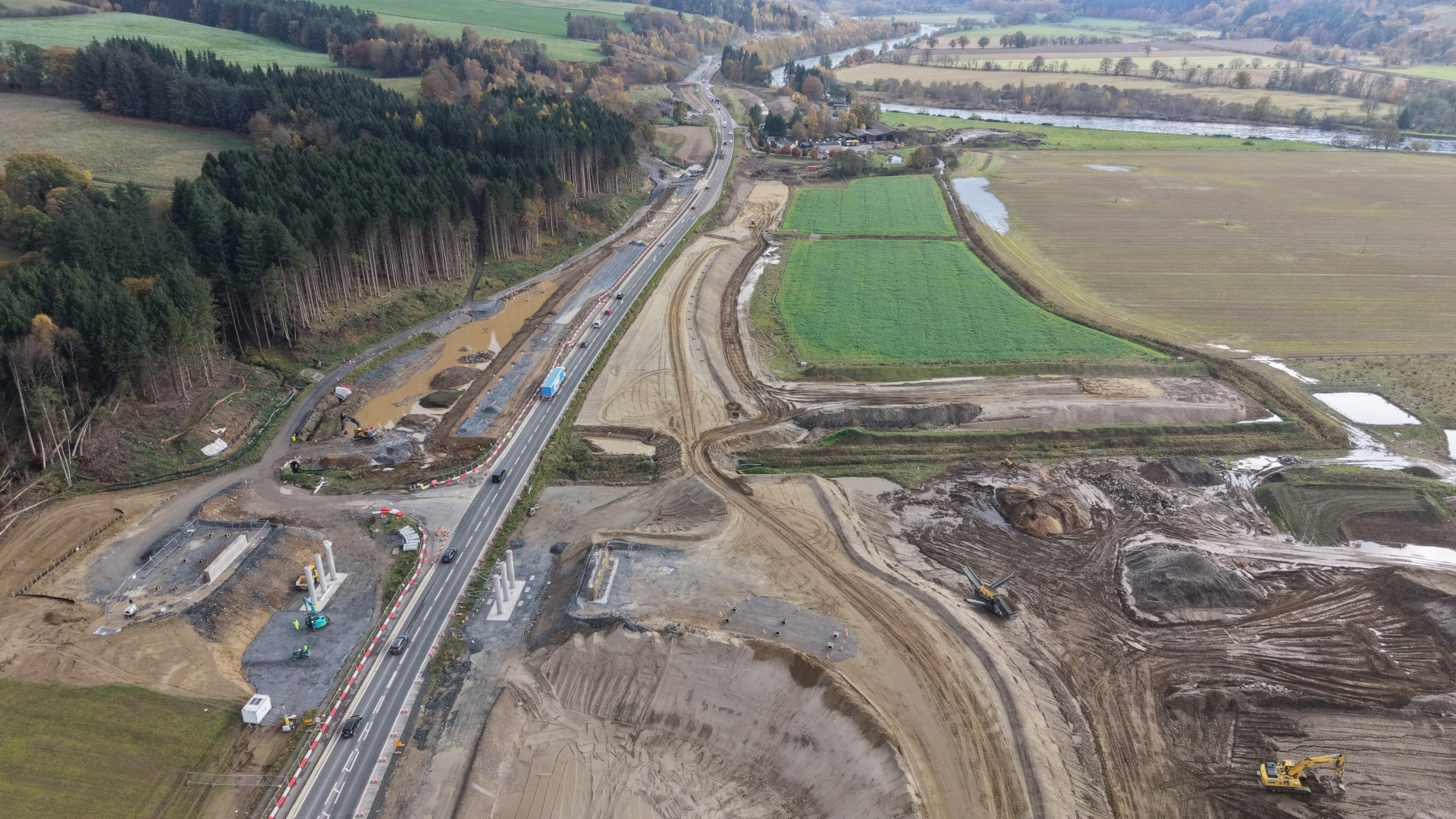
Transport Scotland is preparing for a major bridge construction operation on the A9 Tay Crossing to Ballinluig dualling scheme, where contractor Wills Bros Civil Engineering will install 12 precast concrete beams to form the first structural stage of the new Guay Overbridge deck. The largest units will measure up to 33.5 metres in length and weigh as much as 84 tonnes.
The installation will require specialist crane operations over and beside the existing A9, with the road closed for five nights from Monday 30 November until the morning of Saturday 5 December 2026. The beam lifts will establish the supporting structure for a future crossing intended to preserve local access for residents, businesses, and landowners once the dual carriageway is in operation.
The bridge is part of the 8.2km Tay Crossing to Ballinluig project, which will introduce dual carriageway, left-in/left-out junctions, side roads, and new crossings over the widened alignment. Wills Bros received the main construction contract in July 2025. Transport Scotland estimates the total scheme cost at £257m at second-quarter 2025 prices; that figure covers the wider project and should not be confused with the separately awarded construction contract, valued at approximately £152.7m.
A crane will place the precast beams onto their intended supports to establish the initial deck structure. Lifting a unit measuring up to 33.5 metres and weighing as much as 84 tonnes requires a controlled operating area, planned crane positioning, and coordinated delivery movements. The available project information does not identify the crane model, lift radius, temporary support arrangement, or individual lift sequence, so those engineering parameters cannot be stated as confirmed facts.
The contractor has said the road closure is necessary because the precast units must cross or sit immediately beside the live carriageway during placement. Separating traffic from the crane’s working area is a fundamental constraint when a suspended load is being moved into position. Maintaining a clear boundary also gives the delivery team more control over the physical space needed for lifting, alignment, and subsequent deck works.
Closures are scheduled between the Tay Crossing, also known as Jubilee Bridge, and the temporary roundabout at Kindallachan, from 9pm until 5am on each of the five nights. Two traffic amnesty periods will be provided each night, from 11pm to midnight and from 2am to 3am. Lifting will stop during these intervals and vehicles will be allowed through the works under a 30mph speed restriction.
Access for emergency services will be maintained throughout. Traffic Scotland has identified the A96 as an alternative route for drivers travelling from the north and the A90 for those approaching from the south. The road is expected to be open before 9pm and after 5am on the affected dates, although the works are weather dependent and the published schedule may change.
The two amnesty periods separate traffic movements from active lifting operations: lifting must stop, vehicles pass through under temporary controls, and work can resume only when the site is again secured for construction. That arrangement gives the public two planned opportunities to traverse the closed section without allowing traffic under suspended beams. Weather conditions could still alter the sequence or require the overnight programme to be rescheduled.
Guay Overbridge is one part of a larger civil engineering programme in which local routes have to remain connected as the A9 is widened. Where a new dual carriageway changes the alignment of existing access roads, structures such as overbridges are necessary to carry those movements across the upgraded route. Completion of the precast beams will not itself amount to opening the crossing: further deck, surfacing, parapet, and approach works will remain to be delivered.
The project also follows the River Tay corridor through ground and access constraints that cannot be removed by widening the existing road alone. The overbridge is intended to maintain routes between local properties and the reconfigured road network, while separate junctions and side roads connect traffic to the dual carriageway. Its precast beams provide the principal spanning elements; deck finishing, edge protection, and connections to the approaches are separate construction activities.
Scheduling the operation overnight reduces its impact on normal daytime use of the A9, but there will still be restrictions for freight and local journeys between 9pm and 5am. The authority has specified the closure limits and traffic amnesties in advance; it has not published a beam-by-beam lifting timetable. Drivers and delivery operators will therefore need to use the advertised restrictions rather than assume a particular lift will be completed on a specific night.
Once the 12 beams have been installed, the bridge will still require subsequent deck and approach construction before it can carry traffic. The wider Tay Crossing to Ballinluig dualling section is planned to become operational by the end of 2028; that programme target is not a confirmed opening date for the individual overbridge. The immediate milestone remains the five-night lifting operation beginning 30 November.