IN Brief:
- The 320-metre Westbury viaduct is the longest HS2 viaduct in the Brackley area.
- Reinforced concrete above and below the steel beams creates a double composite box structure that uses concrete and steel more efficiently.
- The 2,695-tonne steel structure was assembled beside the route and slid across its piers before the deck was cast.
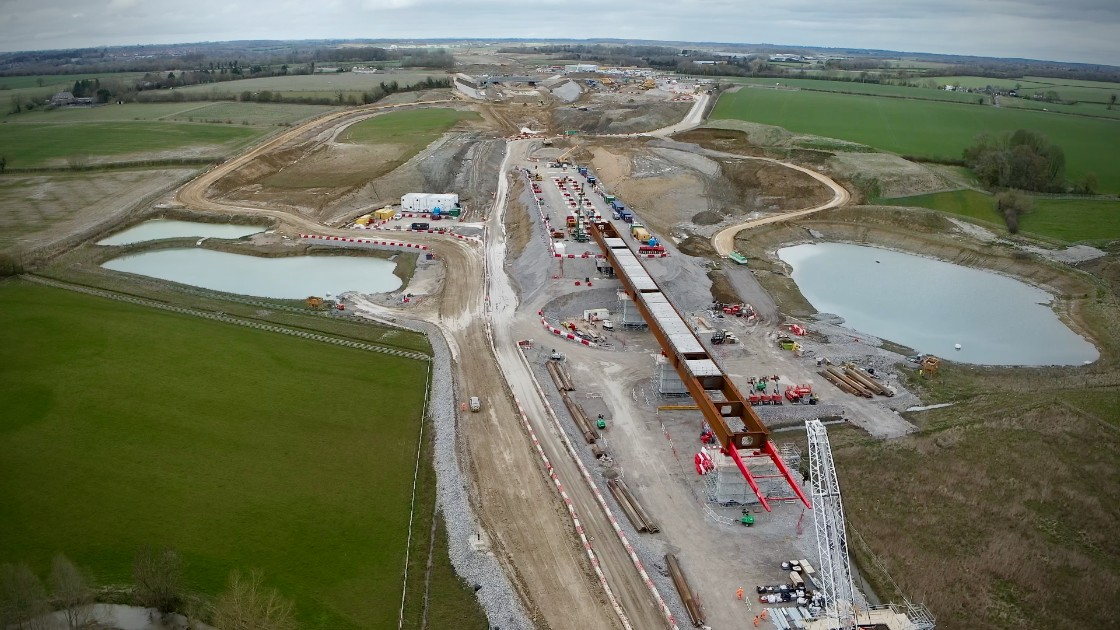
HS2 has completed the 320-metre Westbury viaduct near Brackley, bringing the double composite structure to completion after a construction sequence that combined launched steelwork with concrete slabs above and below the main beams.
The viaduct is the longest HS2 crossing in the Brackley area and carries the railway across the floodplain of the River Great Ouse. Rather than using a predominantly concrete span or steel beams supporting a conventional concrete deck, the design places reinforced concrete on both sides of the steel box structure, allowing the materials to share structural loads more efficiently.
HS2 says the approach, inspired by viaducts on the French TGV network, reduces the quantity of concrete and steel required compared with a more traditional design. The completed steel beams weigh 2,695 tonnes and were assembled at the northern abutment before being moved across the alignment between March and October 2024.
The launch avoided assembling the main steelwork span by span across the floodplain. Instead, sections were joined in a controlled work area beside the route before the growing deck structure was progressively pushed over the concrete piers. Sliding pads with a low-friction coating sat between the steelwork and temporary bearings during the operation, limiting resistance as the structure moved forward.
Once the steel beams reached their final position, travelling formwork was used to cast the upper concrete deck in 42-metre sections. The formwork advanced along the viaduct after each pour, allowing the deck to be constructed progressively without continuous falsework beneath the whole 320-metre crossing.
Concrete slabs beneath the steel beams form the lower part of the double composite box. Their position changes how the section behaves under bending, making more effective use of the concrete and steel rather than adding material simply to increase the depth or mass of the structure.
Prefabricated parapets were installed after the upper deck was completed. The finished viaduct remains relatively low across the landscape because its principal obstacle is the floodplain rather than a motorway, deep valley or existing railway requiring substantial clearance beneath the deck.
Arman Yarali, project sub agent for EKFB, said: “This viaduct showcases the innovation, technical expertise and collaboration behind the build. Its double composite design has created a lighter, more efficient structure that uses less concrete.”
Westbury is the first of five HS2 viaducts being delivered using the same structural method. Eiffage Metal led manufacture and installation of the beams, with Infrasolutions carrying out specialist deck finishing works.
Repeating the design across several structures gives the delivery team an opportunity to carry fabrication details, launch procedures, temporary bearing arrangements and formwork sequences from one site to the next. Individual crossings still require different pier positions, foundation solutions and site logistics, but standardising the underlying construction method can reduce the amount of engineering that has to be developed afresh for each viaduct.
The launch method also concentrates a substantial proportion of steel assembly at the abutment. Welding, dimensional checks and inspection can therefore take place in a defined work area before completed sections move out over the crossing, although the operation still depends on temporary bearings and launch equipment carrying significant forces as several thousand tonnes of steel move across the piers.
HS2 is constructing more than 500 bridges and other crossing structures between London and Birmingham, from small road bridges to the Colne Valley Viaduct. Material reductions that can be repeated across several structures therefore affect more than embodied carbon in an individual bridge: lower structural mass can also influence fabrication volumes, transport movements and loads transferred into piers and foundations.
Work around Westbury is continuing after structural completion, including drainage, landscaping and habitat work across the floodplain. A balancing pond is also being constructed beside the viaduct as the surrounding site moves from heavy structural work towards its final configuration.
The completed civil structure will later receive the railway systems required for HS2 operation. Track formation, drainage and associated equipment still have to be integrated with a bridge whose principal steel and concrete elements are now finished, moving Westbury from major bridge construction into the next stage of railway delivery.