IN Brief:
- Hillbeck Homes was fined £300,000 and ordered to pay £9,284.05 in costs after a labourer suffered serious spinal injuries.
- The stairwell opening was neither securely covered nor protected at its edges when the worker fell one storey onto concrete.
- HSE identified failures in planning, supervision, and physical fall prevention measures on the four-home construction site.
Hillbeck Homes (Sowerby Bridge) Ltd has been fined £300,000 after a temporary labourer suffered serious spinal injuries when he fell through an unprotected stairwell opening at a four-home development in Sowerby Bridge.
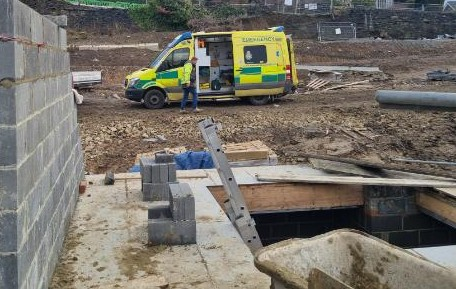
The incident happened in January 2024, during Joseph Tuck’s second week working on the site for a scaffolding company. The 24-year-old stepped backwards through an opening intended for a staircase that had not yet been installed and fell one storey onto concrete.
The opening had previously been covered by loose scaffold boards, but those boards had been removed and the opening was not securely covered. Its edges were also unprotected. There was no alternative means of accessing the lower level, and emergency teams had to rescue Tuck after he lost consciousness.
He sustained serious spinal injuries that prevented him from working for months and has not returned to a physical job. The Health and Safety Executive investigated the incident and identified failures in the planning and supervision of work at height and in the measures used to prevent falls.
Hillbeck Homes was found guilty on three charges. Leeds Magistrates’ Court fined the company £300,000 on 16 September 2026 and ordered it to pay £9,284.05 in costs.
The immediate technical failure is uncomplicated. A floor opening large enough for a person to fall through should either be securely covered with a cover strong enough to prevent a fall, or protected with suitable edge protection. Where access to a lower level is required, that route has to be deliberately designed rather than created by leaving a hazardous opening in the working floor.
The case matters because stairwells are predictable construction features rather than unusual hazards. Their location is known from the drawings, their condition changes as the building progresses, and the risk is present before the permanent stair is installed. Temporary protection should therefore be part of the work sequence, with responsibility for installing, inspecting, maintaining, and eventually removing it clearly allocated.
Loose boards are a weak control because they can be moved for access, materials handling, or convenience and may not be replaced correctly afterwards. A control that relies on every operative remembering to reposition temporary material after each intervention is less reliable than a secured cover or fixed edge protection that remains in place unless formally altered.
Construction sequencing can make these openings particularly vulnerable. Different trades may need access to the same area at different times, and temporary protections can be disturbed as scaffolding, structural work, services, and internal construction progress. Inspection therefore has to remain a continuing site management task rather than a one-off action completed when the opening first appears.
That responsibility also needs to survive changes between trades and shifts. A protection measure can be satisfactory at the morning inspection and unsafe later if it is removed for access or materials handling. Site controls therefore need a clear process for authorising changes, reinstating protection, and checking the opening before the area is returned to normal use.
HSE guidance requires work at height to be properly planned and appropriately supervised, with suitable measures used to prevent and mitigate falls. The hierarchy is familiar across the sector: avoid work at height where reasonably practicable, prevent falls where work at height cannot be avoided, and minimise the distance and consequences of any fall where prevention cannot eliminate the risk.
Floor openings sit firmly in the prevention category. Guardrails, secured coverings, and appropriate access arrangements are established controls, and their cost is negligible compared with the consequences of a fall. The difficulty is not a lack of technical options but maintaining control as the site condition changes and several subcontractors move through the same work area.
The employment arrangement also underlines the need for site management to think beyond directly employed labour. Tuck was working as a temporary labourer for a scaffolding company, but the dangerous condition existed within the wider construction site. Temporary workers and subcontractors still rely on the site’s collective controls, inductions, supervision, and physical protections to make the workplace safe.
The useful point for contractors is less the size of the fine than the basic nature of the failure. The opening was known, the fall distance was obvious, and simple physical controls were available. Work at height incidents can become complicated in investigation, but this one reduces to a familiar construction discipline: if a floor opening can take a person, it has to be treated as a fall risk every minute it remains open.