IN Brief:
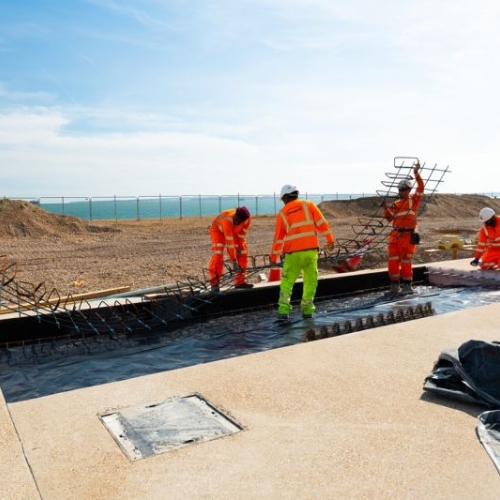
- Basalt-fibre reinforcement mesh has been installed ahead of a concrete pour on Southsea Coastal Scheme Frontage 5 East.
- VolkerStevin says the non-corroding material can reduce CO₂ emissions by more than 60% compared with conventional steel reinforcement.
- The £185m-plus coastal programme is upgrading 4.5km of seafront to reduce flood risk for more than 10,000 homes and around 700 businesses.
VolkerStevin has installed basalt-fibre reinforcement mesh in the new Southsea promenade, using the corrosion-resistant material ahead of a concrete pour on Frontage 5 East of Portsmouth’s coastal defence programme.
The installation forms part of continuing work between Speakers’ Corner and South Parade Pier, where the contractor is building a raised promenade and associated sea-defence infrastructure. Recent activity has included installing shutters for the promenade, progressing the pier capping beam, backfilling and compaction, and preparing a new vehicle access ramp to the beach.
Basalt-fibre reinforcement is being used in place of conventional steel reinforcement in part of the promenade construction. The fibres are produced from basalt rock and do not corrode in the same way as steel when exposed to saltwater. VolkerStevin says the material is lightweight, strong, and highly resistant to the marine environment, and claims the reinforcement can reduce CO₂ emissions by more than 60% compared with conventional steel reinforcement.
The choice is well suited to the durability demands of coastal concrete structures, where chloride exposure is a principal risk for conventional reinforced concrete. Salt reaching steel reinforcement can contribute to corrosion, expansion, and cracking over time, creating an inspection and maintenance burden long after the original construction contract has finished. A non-corroding reinforcement system changes that deterioration mechanism, although long-term performance still depends on correct design, detailing, installation, and concrete quality.
Southsea gives the material a sizeable live-project application rather than a laboratory or demonstration setting. The wider coastal scheme extends for around 4.5km from Old Portsmouth to Eastney and is valued at more than £185m. It is designed to reduce flood risk for more than 10,000 homes and around 700 businesses while replacing ageing sea defences and reshaping sections of public realm along the seafront.
Frontage 5 East began in October 2025 and covers the section between Speakers’ Corner and South Parade Pier. The existing promenade closed in March 2026 for the main sea-defence works and is expected to remain closed until 2027. The design includes a raised promenade, continued stepped revetment, ramped beach access, changes to the cycle lane and highway, terraced planting, new seating and lighting, and refurbishment of Grade II listed light columns.
The primary defence for this part of the seafront also relies on beach material. More than one million tonnes of shingle was imported in late 2025 to widen the beach between Speakers’ Corner and St George’s Road, giving the scheme a mass-material element before the reinforced concrete promenade and associated structures are completed. That combination of beach management, hard defence, and public-realm construction makes material durability a design issue alongside buildability and appearance.
Basalt-fibre products offer a different balance of properties from steel. Lower weight can simplify handling on site, particularly where mesh has to be moved and positioned manually, while the absence of steel corrosion is attractive in aggressive environments. Alternative reinforcement is not a direct material substitution in every application, however; structural behaviour, anchorage, stiffness, fire performance, standards, and design assumptions still have to match the element being built.
The Southsea installation is therefore notable as part of a major publicly funded coastal asset with a long service-life requirement. Flood-defence structures are expected to remain functional through repeated exposure to seawater, storms, and changing climate conditions, so maintenance liabilities can become as important as the initial embodied-carbon calculation.
The scheme is being delivered in stages, allowing different construction approaches and materials to be applied to individual frontages. Earlier sections have used stepped and rock revetments, concrete units, beach recharge, and raised public spaces, while later works continue eastwards. Frontage 5 East connects the completed western sections with works around South Parade Pier and Canoe Lake as the programme progresses.
VolkerStevin’s basalt reinforcement will be encapsulated within the promenade concrete, so its performance will be judged over decades rather than during construction. The immediate test is whether the mesh can be detailed, handled, and installed efficiently enough to suit normal site sequencing while delivering the durability and carbon benefits claimed for it.
With the remaining eastern frontages still under construction, Southsea provides a practical reference for non-metallic reinforcement in marine civil engineering. If the material performs as intended, the case for wider use will rest on whole-life durability and maintenance as much as the carbon saving recorded at installation.