IN Brief:
- Esh secured £27,470 through YORhub’s YOR4Good mechanism for improvements at Spen Bottoms.
- A new footpath and anti-slip sleeper staircase were delivered during a two-week programme.
- The work supports wider ambitions for access, biodiversity and recreation around the green space.
Esh Construction has completed a £27,470 programme of footpath and staircase improvements at Spen Bottoms in Cleckheaton, using funding secured through YORhub’s YOR4Good social-value mechanism. The two-week project replaced deteriorated access infrastructure and cleared overgrown vegetation to improve the route between the town centre, viaduct and surrounding woodland.
Spen Bottoms, also known locally as Mann Dam, covers around 30 hectares of green-belt land close to Cleckheaton town centre. Sections of woodland had become overgrown, while an existing set of steps connecting the viaduct with the main green space was in poor condition and required replacement.
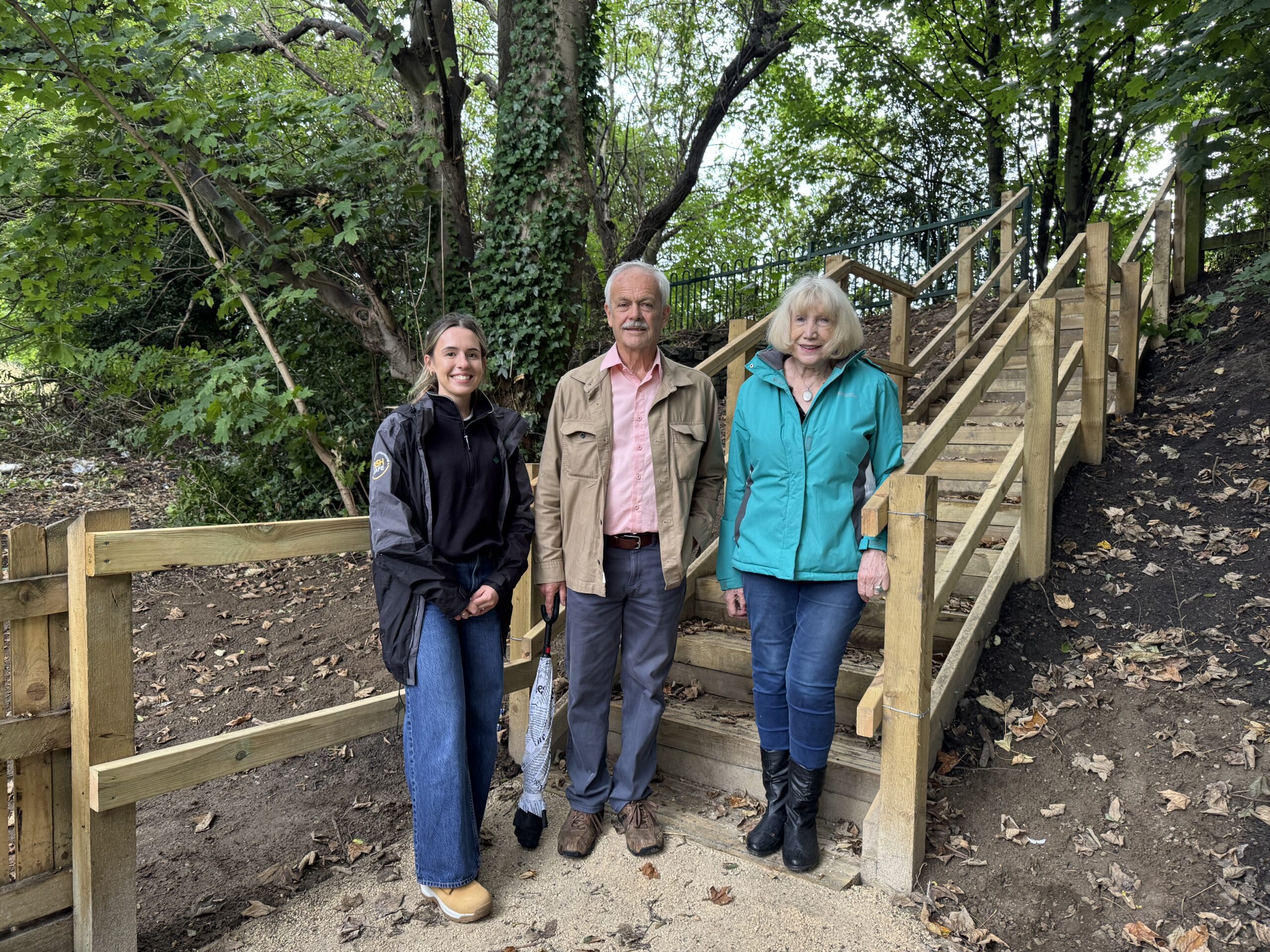
Esh constructed a new path using locally sourced materials and installed a replacement staircase formed with anti-slip railway sleepers. Vegetation was also cut back around the route to improve access and visibility.
The work was carried out for local groups including Spen Valley Civic Society and Friends of Spen Beck/Mann Dam, both members of the wider Spen Bottoms Partnership Group. The package is relatively small in construction terms, but it addresses a specific access problem identified by organisations involved in the longer-term management of the site.
Funding came through YORhub’s YOR4Good mechanism as part of Esh’s social-value commitments on the A638 Dewsbury to Cleckheaton Sustainable Travel Corridor. Esh is delivering that £6.4m programme for Kirklees Council to improve active-travel provision along a six-mile route in West Yorkshire.
The link between the two projects gives the Spen Bottoms work a different commercial structure from a conventional standalone public-realm contract. The contribution attached to the larger framework project has allowed a small community package to draw on the contractor’s civil-engineering capability without requiring an entirely separate major procurement exercise.
Rachel Hanlon, social value coordinator at Esh Construction, said the company wanted its commitments to extend beyond its main construction sites and allow civil-engineering expertise to be applied to projects benefiting the surrounding communities.
The physical scope remained deliberately focused. This was not a major regeneration programme: the construction team repaired a specific pedestrian connection, replaced unsafe infrastructure and cleared vegetation around an existing route. Its effect is consequently local rather than transformational.
That narrow scope also reduces some of the risks that can undermine small public-realm interventions. The project addresses a route that is already used and sits within a wider plan for the area, rather than introducing a standalone feature without an established purpose or connection to surrounding paths.
Kirklees Council’s longer-term ambitions for Spen Bottoms cover biodiversity, accessibility, recreation and links between the green space, Spen Valley Greenway and Cleckheaton town centre. Local partnership groups have also identified access and path condition as priorities for making greater use of the site.
The materials used for woodland paths and steps still require practical consideration despite the modest budget. Drainage, surface grip, vegetation, moisture and seasonal ground movement can all affect durability, particularly where routes sit below trees and receive heavy pedestrian use throughout the year.
The anti-slip sleeper staircase provides a more robust replacement for the deteriorated steps between the viaduct and main green area, while the new path formalises another part of the route. Ongoing maintenance will determine whether those improvements remain effective once vegetation regrows and the surfaces experience repeated winter conditions.
David Shepherd, executive director of place at Kirklees Council, said the path and staircase would improve access and that the surrounding woodland work would support the area for residents, visitors and wildlife. Local community groups have similarly emphasised the importance of the route as a connection into the wider green space.
YOR4Good is designed to turn social-value commitments attached to larger construction frameworks into local projects and benefits in kind. The Spen Bottoms package provides a straightforward example: a contractor already working for the local authority has applied its delivery capability to an identified community asset using funding generated through the wider programme.
The £27,470 value should be kept in proportion to the main A638 contract and to larger public-realm programmes, but small interventions can still resolve practical defects that would otherwise remain outside major capital schemes. Here, the outcome is measurable — a deteriorated staircase has been replaced, a footpath has been constructed and an overgrown route has been reopened more clearly.
With the two-week works complete, responsibility returns to the council and local partnership groups pursuing the wider Spen Bottoms ambitions. Further improvements will depend on funding and delivery of that broader programme; Esh’s package closes one immediate access problem rather than attempting to substitute for it.