IN Brief:
- Phase 2 will provide 113 one-, two-, and three-bedroom homes, all for council rent.
- Construction follows completion and opening of the replacement Atheldene Health Centre and pharmacy.
- Wandsworth Council records the residential phase as under construction with anticipated completion in autumn 2030.
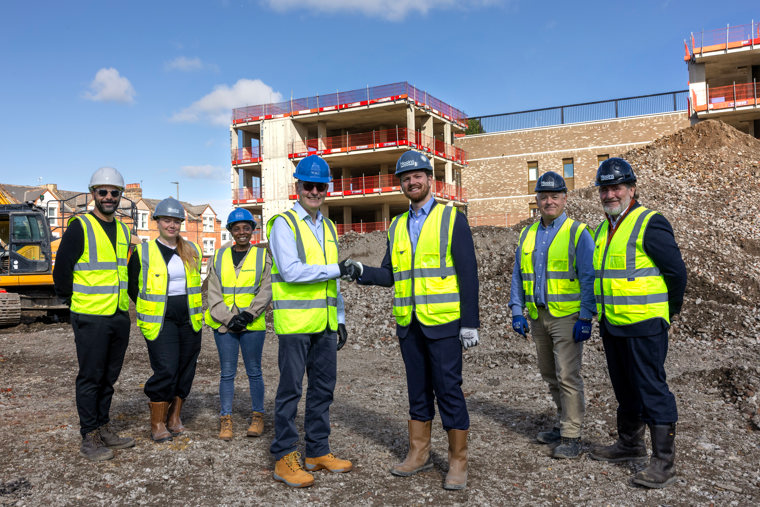
Higgins Partnerships and Wandsworth Council have started construction of 113 council-rented homes at Garratt Lane in south-west London, moving the residential element of the wider Garratt Lane and Atheldene regeneration into delivery.
The second phase will provide one-, two-, and three-bedroom flats, all for council rent, alongside commercial space and shared amenity areas. Wandsworth Council records the mix as 23 one-bedroom, 74 two-bedroom, and 16 three-bedroom homes.
The construction start follows completion of the replacement Atheldene Health Centre and pharmacy. The three-storey healthcare building was delivered first so the former Brocklebank Health Centre site could be released for the next residential phase without interrupting local healthcare provision.
That sequence is central to the wider regeneration strategy. Rather than closing an operating facility and leaving a gap in provision while housing construction progressed, the replacement building was completed and opened before the development footprint moved into its next use.
For the construction team, that decision also reduced the number of competing activities on the main residential site. Demolition, access, retained services, and new foundations can now be planned around an operational health centre rather than a temporary healthcare arrangement sharing the same work area.
Wandsworth Council lists the Garratt Lane residential phase as under construction, with a start in autumn 2026 and anticipated completion in autumn 2030. The development also includes cycle parking, residential car parking, refuse storage, commercial units, plant, outdoor amenity space, and landscaping.
Higgins and the council returned to planning with a revised approach that increased affordable housing on the principal Garratt Lane phase to 100 per cent. The current construction programme therefore represents both a new physical stage and a change in the tenure outcome compared with earlier versions of the wider masterplan.
Technical approvals have continued in parallel. Planning records through 2026 cover matters including materials, water efficiency, overheating measures, and other condition-discharge work required before individual elements can progress without qualification.
Such approvals are less visible than breaking ground, but they determine whether construction can maintain momentum once excavation, piling, structure, and envelope activities overlap. A delayed material approval or unresolved technical condition can hold up a specific work package even when the wider site is officially under construction.
The urban location creates its own delivery constraints. Construction traffic, plant, and material deliveries will share the surrounding road network with residents, businesses, and people using the completed healthcare facility, leaving limited scope for poorly sequenced vehicle movements.
Logistics planning will therefore remain active throughout the programme rather than being fixed at mobilisation. As structure, façades, building services, fit-out, and landscaping progress, the type and volume of deliveries will change, requiring access arrangements to evolve while neighbouring facilities remain operational.
A four-year construction period also increases the importance of phasing. Residential blocks rarely progress as a single linear operation, with structural work continuing in one area while services, internal finishes, and external works advance elsewhere.
Maintaining separation between those activities is particularly important where completed or occupied facilities sit alongside the site. Temporary pedestrian routes, vehicle controls, hoarding, dust management, and noise restrictions have to protect local access without creating unnecessary constraints for contractors.
The council-rent tenure influences longer-term design decisions as well. Wandsworth Council will retain responsibility for the homes after completion, so maintainability, material durability, energy performance, communal spaces, and access to plant affect operating cost beyond practical completion.
That places whole-life considerations directly alongside the normal construction priorities of capital cost and programme. A product that is cheaper to install but more difficult to maintain can transfer cost to the council for years after the principal contractor has left the site.
The project sits within the Homes for Wandsworth programme and forms part of a regeneration area in which earlier housing and the replacement health centre have already been delivered. The current phase therefore has to connect physically and operationally with infrastructure that is no longer a construction site.
Higgins is also carrying employment, training, and community commitments through the programme in partnership with the council and local organisations. On a four-year public-sector development, those activities will run alongside the main construction sequence rather than being confined to a short mobilisation exercise.
The groundbreaking marks the transition from planning and technical approvals into sustained residential construction, but the project’s more demanding task is maintaining that programme until autumn 2030 while established community facilities remain in use around it.
With 113 homes now recorded as under construction, Garratt Lane has moved beyond the policy objective of additional council housing and into the practical work of delivering it — foundations, structure, services, logistics, and phased handovers across a constrained live neighbourhood.