IN Brief:
- ECITB has committed £250,000 of Regional Skills Hub funding to the Cumbria Robotics Operations Skills Centre.
- CROSS has already secured £1 million through UKAEA’s FOSTER programme and aims to train 650 learners by 2030.
- Apprenticeship and modular training will focus on deploying robotics in nuclear, clean-energy, and wider engineering-construction environments.
The Engineering Construction Industry Training Board (ECITB) has awarded £250,000 to the Cumbria Robotics Operations Skills Centre, adding further funding to a specialist facility intended to train workers to deploy robotics across nuclear, clean-energy, and engineering-construction environments.
The Cumbria Robotics Operations Skills Centre, known as CROSS, is based at Lakes College in West Cumbria and is due to open officially later this year. It has been developed through a partnership involving the UK Atomic Energy Authority, the National College for Nuclear and Clean Energy, the Robotics and Artificial Intelligence Collaboration, Sellafield, its supply chain, and Lakes College.
The project had already secured £1 million through UKAEA’s FOSTER programme before the latest ECITB award. That support includes robotics equipment for the training facility, while the new funding will contribute to curriculum development, short modular courses, teaching resources, and expansion of the programme beyond its initial nuclear focus.
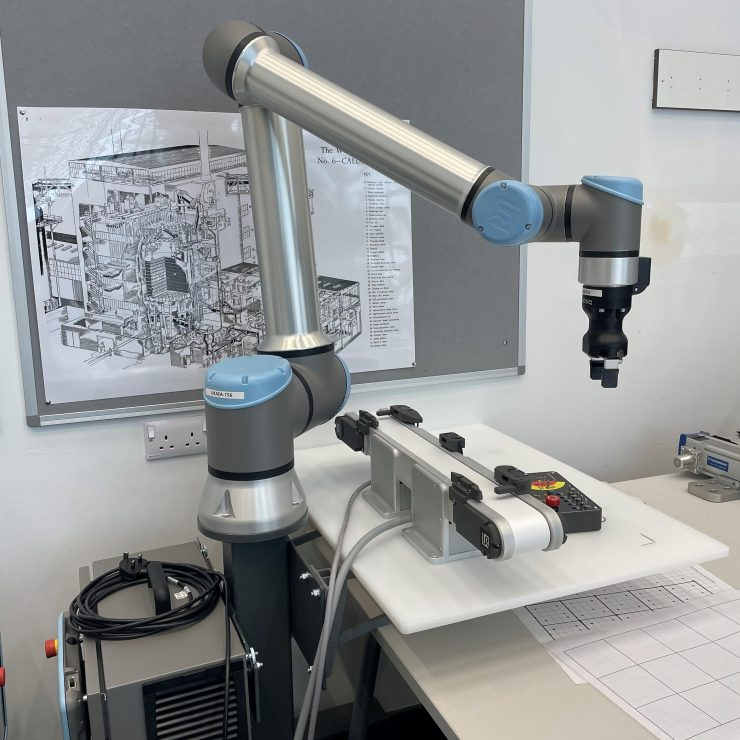
UKAEA said when CROSS was launched in April that more than £700,000 of equipment had already been provided through FOSTER. The facility is intended to offer hands-on training in a physical robotics environment rather than limit learners to classroom instruction or software simulation.
CROSS aims to train 650 learners by 2030. Lakes College is the lead ECITB-approved training provider, while the National College for Nuclear and Clean Energy is leading curriculum design and housing the centre within its northern hub.
The first training routes will include apprenticeships, with Sellafield expected to supply a substantial initial intake. Modular programmes are also planned so existing employees can develop specific robotics capabilities without having to enter a complete multi-year apprenticeship.
That structure reflects the way automation is entering engineering construction. A plant, nuclear site, or decommissioning programme does not simply require a workforce capable of operating one proprietary robot; deployment depends on technicians who understand the task, the hazards around it, the sensing and control systems, maintenance requirements, and how the equipment fits into an existing operating procedure.
Nuclear work provides an unusually strong case for remote and robotic systems because many activities take place around radiation, contamination, restricted access, or complex structures. Reducing direct human exposure can improve safety and allow inspection or intervention in locations that are difficult to reach using conventional methods.
The technology still has to work outside a demonstration cell. Robots used on live industrial sites need reliable communications, appropriate end effectors, usable control interfaces, robust power systems, safe recovery procedures, and operators who can recognise when the machine is approaching its limits.
CROSS is designed around that gap between technology development and routine deployment. Learners will use equipment representative of systems already being developed for nuclear and fusion applications, giving training a closer relationship with the machinery likely to appear in operational environments.
UKAEA’s 2026–2030 strategy identifies the rollout of the CROSS robotics apprenticeship programme as part of its skills plan, specifically targeting technicians working in remote handling and robotics for nuclear facilities. The programme therefore sits within a longer workforce strategy rather than being treated as a one-off training-centre investment.
The wider RAICo network provides another part of that pipeline. Its Whitehaven operation supports robotics and artificial-intelligence development for nuclear decommissioning and fusion engineering, creating a route through which new systems can be developed, demonstrated, tested, and eventually supported by workers trained to deploy them.
That connection between equipment and skills is becoming increasingly important as industrial robotics moves into less structured environments. Manufacturing robots have traditionally operated in fixed cells around repeatable products, while construction, decommissioning, maintenance, and inspection often involve variable geometry, legacy assets, difficult access, and changing site conditions.
Training therefore has to include judgement as well as machine operation. Technicians need to determine whether a robotic method is appropriate, establish how the task should be prepared, control the system safely, interpret the data it produces, and recover the machine if the planned operation does not proceed as expected.
ECITB’s funding comes through its Regional Skills Hubs programme, which has committed more than £3 million to expanding training capacity in industrial clusters. Individual grants range from £50,000 to £500,000 and require eligible projects to attract matched support from industry partners.
The board said it had committed £1.6 million through the initiative at the time of the CROSS award, with those projects drawing £14.4 million in matched investment. Existing hubs cover areas including Scotland, Teesside, and Humberside, placing the Cumbria project within a broader attempt to strengthen technical training around major engineering-construction centres.
The emphasis on modular courses could extend the centre’s reach beyond apprentices entering the industry. Experienced mechanical, electrical, controls, maintenance, or project personnel can require robotics capability as systems are introduced into existing facilities, and short targeted programmes provide a route to upskill those workers without removing them from industry for long periods.
Although nuclear work provides the immediate demand, ECITB intends the training content to expand into other engineering-construction sectors. Remote inspection, manipulation, surveying, hazardous-area work, and repetitive material-handling tasks appear across energy, process plants, heavy industry, and major infrastructure, even where the equipment and safety requirements differ from those at Sellafield.
The centre’s value will consequently depend on whether its training remains connected to actual industrial deployment rather than becoming technology tuition in isolation. The partners behind CROSS include operators, training providers, robotics developers, and public engineering bodies precisely to keep those two sides of the programme connected.
Funding has now moved the project beyond the April launch into delivery. Equipment is in place, apprenticeship and modular training routes are being developed, and ECITB has added the resources needed to broaden the curriculum.
By 2030, CROSS intends to have trained 650 people. The more telling measure will be how many of those workers are subsequently able to take a robot out of a training facility and make it perform useful, repeatable work on an industrial site.