IN Brief:
- Stage 3B of Dover Western Docks Revival has created ten hectares of new port land.
- Nearly 900,000 cubic metres of infill was placed alongside drainage, utilities, roads, soil improvement, and a stormwater pumping station.
- Completion leaves a serviced platform for later development under the Port of Dover’s long-term masterplan.
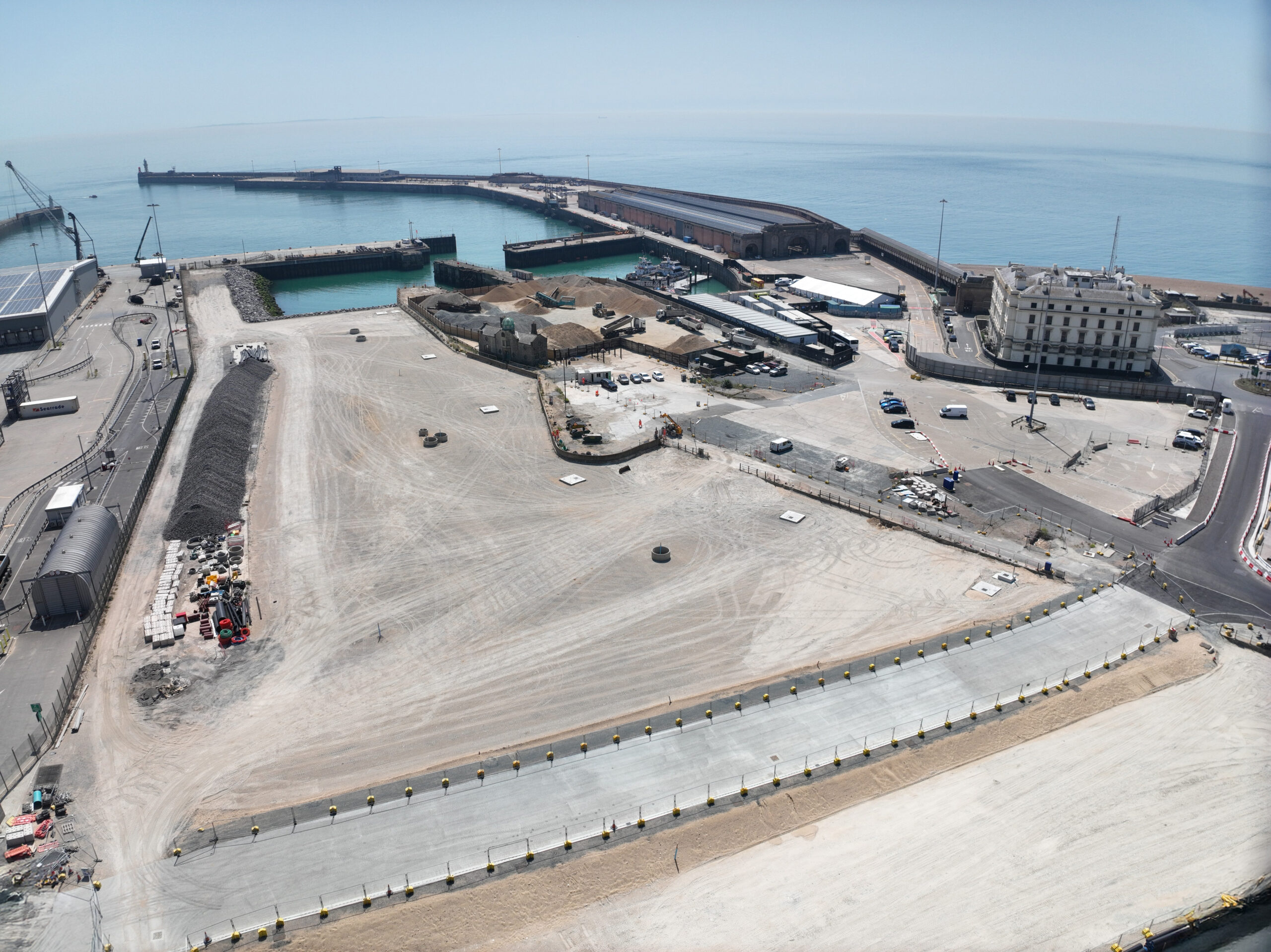
McLaughlin & Harvey and Boskalis Westminster have completed the £53m Stage 3B reclamation package at Dover Western Docks, creating ten hectares of new land for future development inside one of the UK’s busiest operational port environments.
The project began in 2024 and reclaimed areas within the Wick Channel, Tidal Basin marinas, and Granville Dock. Nearly 900,000 cubic metres of infill was placed to raise the dock bed to approximately 0.5m below the level of the existing quay walls, turning former water space into an engineered platform.
Before bulk fill could be placed, pontoons, gangways, and associated marina equipment were removed from the Tidal Basin and Granville Dock. The works also included demolition of parts of the existing quay structures, including the North Pier and Ferry Jetty, followed by construction of new roads, utility infrastructure, drainage, and a stormwater pumping station.
McLaughlin & Harvey acted as principal contractor, while Boskalis Westminster provided specialist marine, reclamation, and soil-improvement capability. The package therefore combined demolition, marine construction, high-volume material placement, ground treatment, drainage, temporary works, and land-side infrastructure within a port that remained operational throughout.
Reclaimed land opens the next development stage
The completed surface is only the visible end of the reclamation process. Ground stability, settlement behaviour, drainage, and future load capacity determine whether reclaimed land can support later buildings and infrastructure without transferring unresolved engineering problems into subsequent contracts.
Creating ten hectares within the Western Docks gives the Port of Dover additional flexibility in an estate already occupied by cruise facilities, cargo operations, marina infrastructure, and border-processing functions. Developable port land is inherently constrained, particularly where existing operations cannot simply be displaced while construction takes place.
The Stage 3B package addressed that constraint by manufacturing land rather than relying on conventional redevelopment. Once the dock areas had been filled, improved, drained, and serviced, the port gained a development platform on which future uses can be planned without repeating the highest-volume marine enabling works.
The new land forms part of the wider Western Docks Revival and supports the Port of Dover’s 2050 masterplan. That long-term programme considers the Eastern Docks, Western Docks, and waterfront as a connected estate, with future changes expected to accommodate higher trade volumes, revised border processes, new technology, and changes in port operations.
The masterplan does not predetermine the precise buildings or operating assets that will occupy the newly reclaimed area. Stage 3B instead performs the less glamorous but more fundamental task of providing formed, serviced ground from which later packages can proceed.
Construction inside a working port also imposes delivery constraints that do not apply to a vacant development site. Marine access, vessel movements, tides, environmental controls, ageing quay structures, haul routes, public access, and tenant operations all influence sequencing. Temporary works and logistics can therefore carry as much programme importance as the permanent civil engineering.
McLaughlin & Harvey says the project was completed with minimal disruption to the public and port tenants. That requirement shaped a programme in which demolition, infill, soil improvement, and infrastructure installation had to be coordinated around adjoining port activity rather than undertaken behind a completely isolated site boundary.
Completion also changes the nature of future construction risk. Later contractors will inherit a formed platform with drainage, utility, and road infrastructure already installed instead of beginning with marine demolition and bulk reclamation. Ground performance and interfaces still need to be understood, but a substantial portion of the enabling burden has now been removed.
Dover’s regeneration has developed through successive packages rather than a single uninterrupted build. Earlier phases delivered cargo and marina infrastructure, while Stage 3B creates capacity for the next round of investment. That sequencing allows the port to keep trading while parts of the estate are progressively reconfigured.
The £53m contract has now finished the reclamation phase, leaving ten hectares of engineered land whose eventual value will depend on what the port chooses to build on it. The next major construction opportunity is therefore no longer beneath the waterline, but in the buildings and operational infrastructure that follow.