IN Brief:
- The Stoke Ferry to Didlington scheme is installing more than 8km of 225mm polyethylene water main.
- Open-cut installation is being combined with horizontal directional drilling beneath roads and environmentally sensitive locations.
- Once complete, the new connection will allow up to 1.5 million litres of water per day to be transferred through the network.
Anglian Water is progressing construction of an 8.3km water-transfer pipeline between Stoke Ferry and Didlington in Norfolk, combining open-cut installation with horizontal directional drilling to increase flexibility across the potable-water network.
The scheme is being delivered through Anglian Water’s @one Alliance and will install more than eight kilometres of 225mm polyethylene main. Once commissioned, the new connection will provide capacity to transfer up to 1.5 million litres of water per day.
The alliance’s current public project update describes the programme as a £6.7m investment. Construction is now under way following enabling, archaeological, and ground-investigation activity along the predominantly rural alignment.
The route requires a mixture of construction methods because roads, watercourses, agricultural land, drainage infrastructure, and existing water assets create different constraints along its length. Open-cut pipe installation is being used where conventional excavation provides the most efficient solution, while horizontal directional drilling is being used at more sensitive crossings.
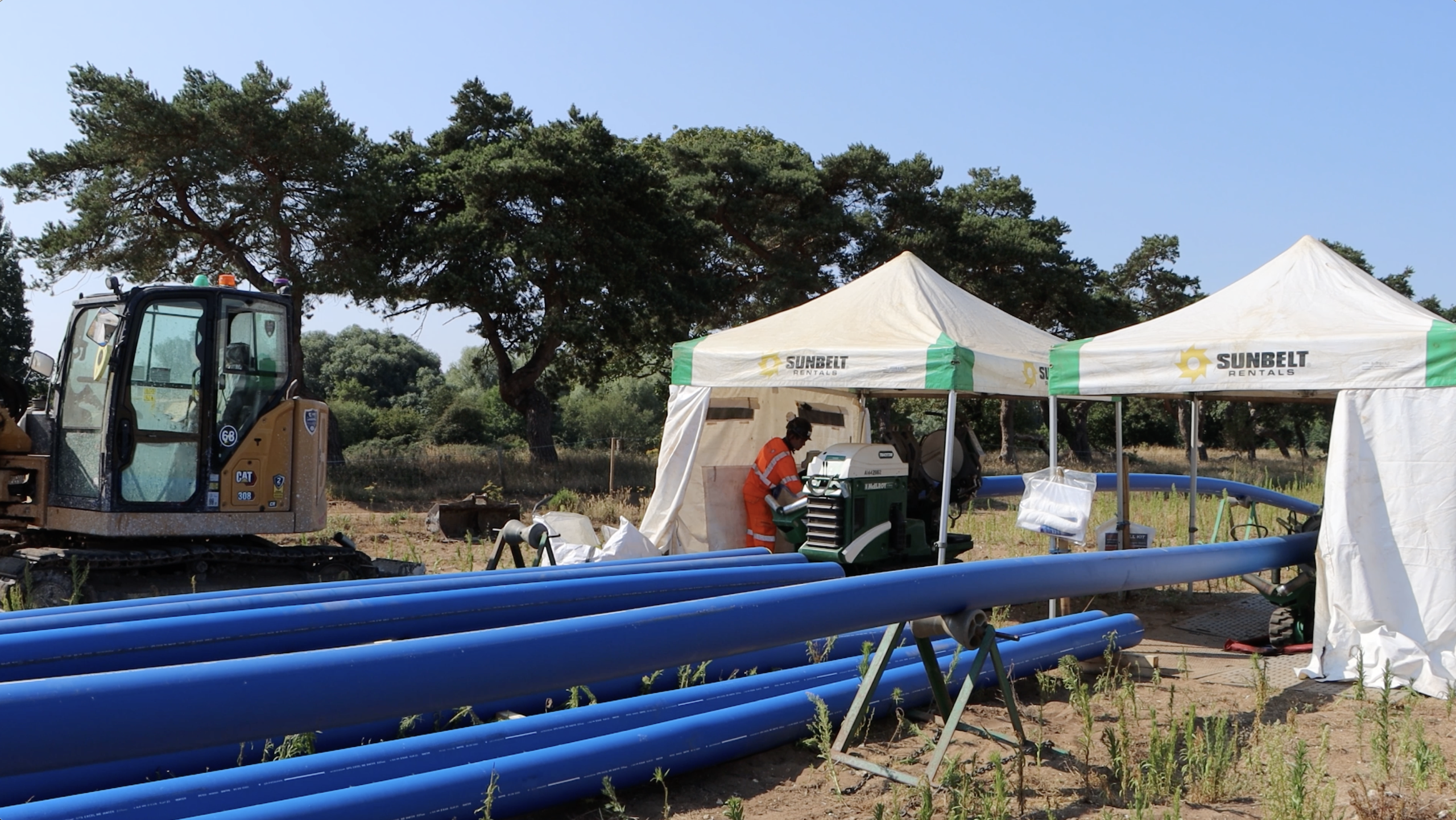
HDD allows the pipeline to pass beneath roads and environmental features without excavating a continuous trench across the surface. A bore is drilled between entry and exit points before the welded polyethylene pipe is pulled through the completed alignment.
The method can reduce disruption but does not remove construction complexity. Drilling geometry, ground conditions, entry and reception compounds, drilling-fluid management, pipe-string preparation, existing services, and pull forces all have to be controlled before the crossing can be completed successfully.
The @one Alliance public update identifies nine HDD crossings beneath roads and environmentally sensitive areas. The remainder of the route combines conventional trenching with the specialist connection and network works needed to integrate the new main into existing Anglian Water infrastructure.
The supplied project case study describes early trial holes and boreholes along the proposed alignment together with archaeological trial trenching. Those investigations allowed the delivery team to establish ground conditions and evaluate archaeological risks before the main pipeline programme reached the relevant sections.
That early work is particularly important on a linear project because unidentified constraints can affect several kilometres of programme rather than a single building footprint. Ground changes, utilities, land access, or environmental restrictions can all alter installation rates and the sequence in which separate crews are deployed.
Construction began in May 2026 and is progressing through multiple workfronts. Temporary compounds and site access have been established, with open-cut sections moving through welding, excavation, pipe installation, backfilling, testing, and reinstatement.
The supplied technical case study also identifies connections into existing mains at Gibbet Lane, Gooderstone Road, and Watermill Lane, alongside flow monitoring, a non-return valve, and pressure-control modifications elsewhere on the network.
An under-pressure drilling connection is planned on the existing strategic main at Gibbet Lane. That type of interface allows work to be undertaken on an operating asset without relying on the same shutdown arrangements that would accompany a conventional cut-in, although specialist planning and control are required.
Different polyethylene specifications are being used according to installation method. Higher-strength pipe is specified through drilled sections where installation loads differ from those in open trench, allowing each part of the route to be designed around its actual construction condition.
Mott MacDonald Bentley is identified in the supplied case study as principal contractor, with G&V working across open-cut and HDD mains laying. The wider supply chain covers pipe and fittings, archaeology, land services, traffic management, aggregates, muckaway, metering, and specialist connection activity.
The project also has a substantial land-management component. Linear construction crosses multiple agricultural holdings, requiring access arrangements, reinstatement, hedgerow management, and coordination with landowners whose crops or day-to-day operations may continue beside the works.
Road crossings bring a separate community interface. Temporary traffic-management arrangements and closures are required at parts of the route, with customer and parish communications forming part of the programme rather than being treated as activity outside construction delivery.
The engineering objective is greater resilience within Anglian Water’s existing system. Population growth, climate effects, and environmental restrictions increase the value of being able to move available water between existing assets when demand or resource conditions change.
The new main does not create another raw-water source. Its contribution is flexibility: water available within one part of the system can be transferred towards another area rather than leaving individual supply assets constrained by the connections around them.
Testing and commissioning can progress as sections are completed, while reinstatement follows behind the main laying crews. Once the final connections and controls are operational, most of the physical construction will disappear beneath reinstated roads, fields, and crossings.
The result will be comparatively unobtrusive infrastructure providing another 1.5 million litres of daily transfer capacity. For an operational water network, that buried flexibility is the point — the project is intended to become most useful when supply conditions are difficult, rather than remain visible once construction has finished.