IN Brief:
- £800,000 of Brotherton bridge work will run alongside 1.4km of track renewal at Sherburn over the August bank holiday.
- From 19 September to 4 October, Huddersfield TRU works will cover platforms, track, drainage, access, and electrification.
- A further 38-day Huddersfield closure is planned after the final Christmas Eve service.
Network Rail is preparing two substantial railway construction programmes in Yorkshire, beginning with bridge and track renewals around Brotherton and Sherburn in Elmet before a separate intensive phase of TransPennine Route Upgrade work begins around Huddersfield in September.
The first package centres on an £800,000 renewal of Brotherton bridge near Knottingley during the August bank holiday. Engineers will replace the track-support system on the structure over the River Aire with modern fibre-reinforced components, alongside repair and repainting work already being carried out while scaffolding remains in place.
The crossing has carried rail traffic since the mid-19th century, although its superstructure was replaced in 1903. Combining structural maintenance with track-support renewal during a planned possession allows several interventions to be completed in the same access window rather than returning repeatedly to an operational railway.
The same bank-holiday programme includes 1.4km of track renewal at Sherburn in Elmet between 29 and 31 August. Northern and TransPennine Express services will be affected while the bridge and track works are completed.
Neither job forms part of the main Huddersfield construction blockade that follows several weeks later. From 19 September to 4 October, TransPennine Route Upgrade teams will work around the clock on a separate package covering station reconstruction, track, drainage, access infrastructure, and electrification.
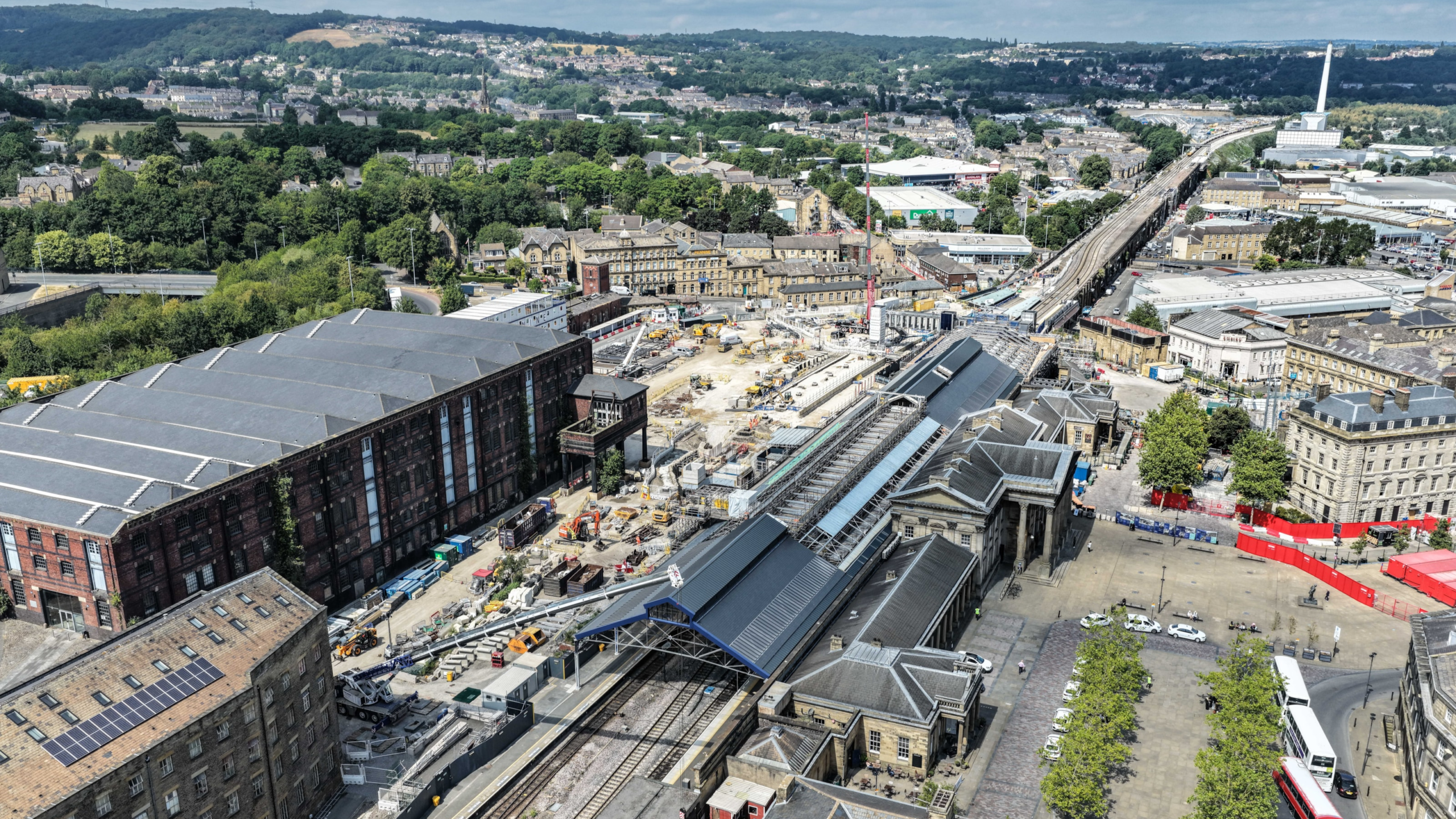
At Huddersfield station, the existing subway will be extended towards platforms 4, 5 and 6 as the station is remodelled for longer trains. Work will continue on the historic Euston-style roof, combining restoration of retained railway architecture with extensive changes to the operational railway beneath it.
Deighton will receive a new footbridge and lifts to provide step-free access. Across the wider section, teams will renew track and drainage, install additional track to increase capacity, and continue overhead line equipment work required for future electric services.
The possession will close Huddersfield and Slaithwaite stations throughout the 16-day period. Mossley, Greenfield, and Marsden will also close on the weekends of 19–20 September and 3–4 October, requiring passenger services to use alternative arrangements and diversionary routes.
More than £100m has been invested in those diversionary routes, illustrating the amount of enabling work required before a long blockade can take place on a strategic inter-city railway. Capacity, signalling, stations, and other infrastructure beyond the immediate worksite have to be capable of supporting altered service patterns while the core route is unavailable.
The Huddersfield work forms part of a programme extending across roughly 70 miles and more than 70 active worksites. About a quarter of the TransPennine route is currently electrified, with the wider upgrade intended to deliver full electrification, additional track at key locations, digital signalling, and improvements at all 23 stations.
Network Rail says around 5,000 people are already employed on the programme, 85% of them living within 40 miles of the route, with around 8,000 jobs expected to be supported over its duration. The workforce spans civil engineering, track, electrification, signalling, stations, plant, logistics, and specialist railway disciplines.
Freight capacity is being expanded alongside passenger infrastructure. The programme includes provision for 15 additional freight paths and work to accommodate larger freight movements, with widened tunnels and other infrastructure changes intended to increase the route’s usefulness beyond passenger services.
Long possessions are becoming a defining feature of the Huddersfield phase because major station reconstruction and track remodelling cannot be carried out efficiently through short overnight access. Concentrating work into multi-day closures gives contractors continuous access to complete structural, track, services, and systems work in a sequence that would otherwise be broken into many smaller interventions.
That approach transfers disruption from repeated short closures into fewer but much longer blockades. It also places greater pressure on programme certainty because a delayed activity can affect everything scheduled behind it, from track installation and electrification to testing and reopening the railway.
A further 38-day Huddersfield closure is planned after the final service on Christmas Eve, continuing the intensive construction sequence into the winter. By then, the August Brotherton and Sherburn renewals will be complete, but the much larger TransPennine programme will still be working through station, track, and electrification milestones.
The two Yorkshire work packages operate at very different scales, yet both are constrained by the same basic problem: engineering work has to be fitted around a railway expected to return to service at a predetermined time. On a Victorian bridge that means squeezing renewal into a bank-holiday possession; at Huddersfield it means closing a strategic route for weeks at a time because the job has outgrown the overnight window.