IN Brief:
- GEDA has launched a battery powered rack and pinion lift for wind turbine towers.
- The SH 250 W carries 250kg or two people at speeds reaching 24 metres per minute.
- Regenerative operation, optional inductive charging, and early installation reduce reliance on tower power.
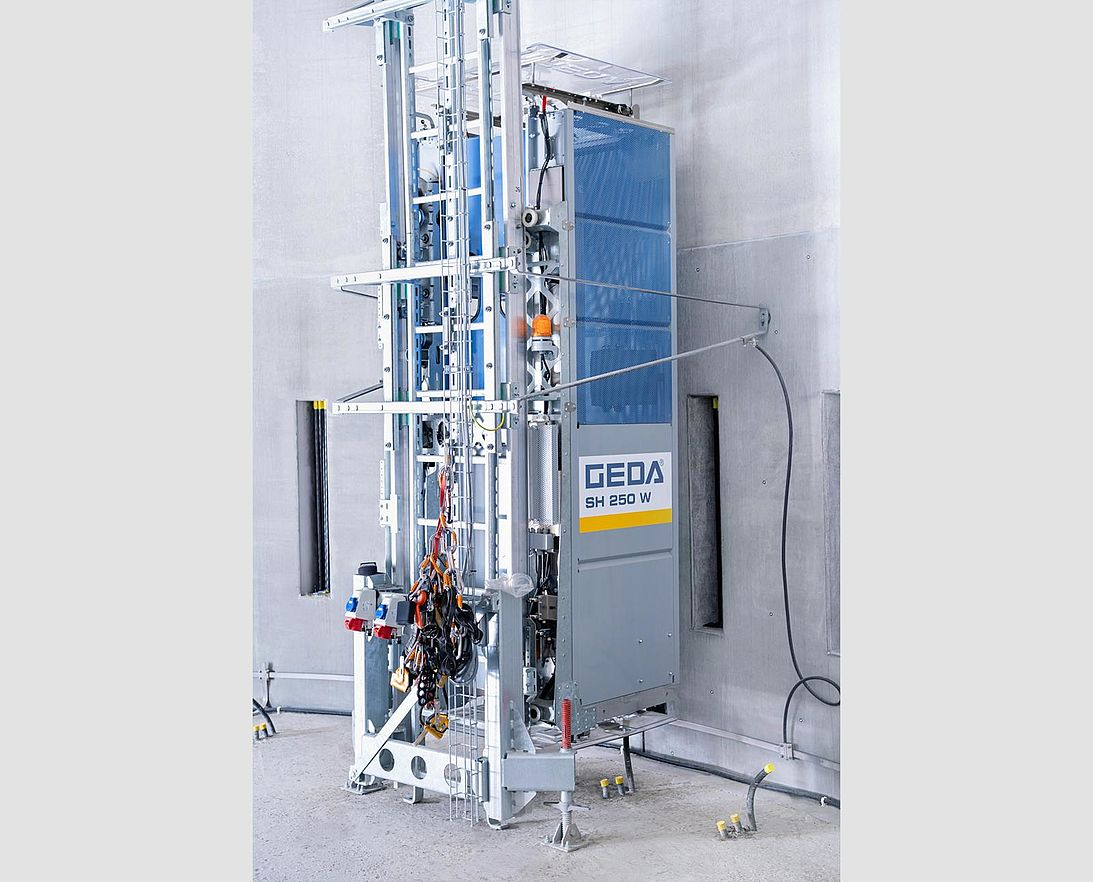
GEDA has launched a battery powered rack and pinion lift designed to provide personnel and materials access during wind turbine construction and later operation.
The SH 250 W has a rated capacity of 250kg or two people and can serve heights of up to 210 metres. Its maximum travel speed is 24 metres per minute.
Because the lift can be installed before permanent electrical systems at the turbine head are available, it can support tower assembly, internal installation, inspection, and commissioning without relying on an early high level power connection.
Energy generated while the car descends is returned to the battery through a regenerative drive. GEDA also offers optional inductive charging, allowing the unit to recharge without a conventional exposed plug connection.
The platform measures approximately 0.6 metres by 0.9 metres and has an internal height of 2.13 metres. Its compact dimensions are intended to suit the constrained internal geometry of modern wind turbine towers.
Touchscreen controls, remote maintenance capability, and several safety systems are included. Rack and pinion operation provides a mechanically guided route through the tower rather than relying on suspended ropes across the full travel distance.
Access becomes increasingly demanding as turbine heights rise. Construction teams must move electricians, mechanical technicians, inspectors, tools, and replacement parts through a tall vertical structure while other installation and commissioning work continues.
Repeated ladder climbing is slow and physically demanding, especially over long shifts. Temporary lifting systems may also conflict with other work or remain unavailable until later stages of tower assembly.
Taller turbines increase access demands
Onshore and offshore wind projects are using taller towers to reach stronger and more consistent wind conditions. UK developments including the Twyn Hywel wind farm are progressing as renewable generation expands across increasingly complex sites.
Greater tower height affects cranage, component transport, erection sequencing, temporary works, rescue planning, communication, weather limits, and the time required for workers to reach their task.
A lift installed early in construction can reduce unproductive climbing and allow technicians to arrive at work areas with less fatigue. Commissioning teams may need to move repeatedly between the tower base, intermediate equipment, and the nacelle as electrical and mechanical systems are tested.
Emergency planning remains essential because a lift does not remove the need for independent evacuation and rescue arrangements. Projects must account for power loss, mechanical faults, fire, medical incidents, and obstruction within the tower.
Battery condition becomes part of temporary works management. Charging cycles, temperature, storage, maintenance, expected daily use, and contingency arrangements must be assessed so that the lift remains available when construction teams depend on it.
Regenerative operation is well suited to vertical transport because the descending car can return energy to the battery rather than dissipating it entirely as heat. Actual endurance will depend on payload, travel pattern, ambient conditions, battery capacity, and the number of movements completed during each shift.
Remote diagnostics can reduce downtime where turbines are constructed far from service centres. Fault information can be reviewed before an engineer travels to site, improving the likelihood that the required components and tools arrive during the first visit.
Permanent service lifts are already common within modern turbines, but access during construction can remain fragmented before the final system is commissioned. Equipment able to support both construction and operation may reduce duplication and provide continuity across handover.
That transition requires clear responsibility for inspection, certification, maintenance records, and transfer from the installer or principal contractor to the operator. Construction use can create wear before the asset enters normal service, making condition assessment at handover essential.
The SH 250 W also reflects the wider electrification of construction equipment. Battery systems are moving into cranes, access platforms, compact plant, tools, and temporary site systems where charging arrangements and working cycles support them.
Wind projects provide a suitable application because electrical infrastructure is integral to the completed asset, yet the permanent supply may not be available during early construction. A self contained lift can bridge that period without waiting for tower head connections.
GEDA’s new system will be assessed through reliability, battery endurance, installation speed, maintenance demand, and performance within working towers. Its practical value lies in reducing the time and physical effort required to move people through structures extending more than 200 metres above their foundations.