IN Brief:
- Fischer’s new FBS 4 and FBS 5 screws target electrical, plumbing, heating, ventilation, and air conditioning work.
- Expansion free anchorage permits close spacing and reduced distances from concrete and masonry edges.
- Five zinc plated versions cover cable clips, ducts, mounting rails, sockets, cabinets, and secondary fixtures.
Fischer has introduced two concrete screw ranges for electrical, cable management, plumbing, heating, ventilation, and air conditioning installations.
Designed for direct installation into concrete and dense masonry, including solid sand lime brick, the FBS 4 and FBS 5 products can be driven using a cordless screwdriver, impact driver, or hand tool and removed where an installation later needs alteration.
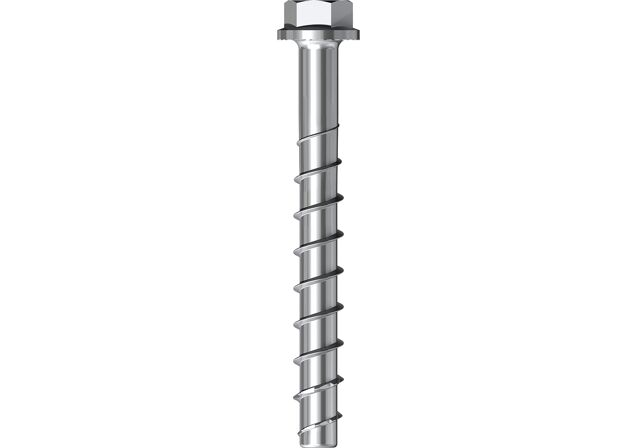
A serrated thread geometry cuts into the base material as the screw enters the drilled hole. The thread flanks then form a mechanical interlock with the substrate, transferring load without a separate plug or expansion sleeve.
Because the fixing action is expansion free, the screws can be positioned at smaller edge distances and closer spacing than some conventional anchors. That characteristic is useful in congested service zones, narrow concrete elements, and locations where several cable or pipe supports must fit within a restricted area.
Two anchorage depths allow installers to adjust the fixing to different loads and site conditions. The alternative depths can also bridge non structural surface layers, including plaster, while maintaining the required embedment into the underlying base material.
The range has been assessed for fire resistance up to R120, giving designers and installers additional evidence when specifying fixings for services that must remain securely supported during a fire.
Five zinc plated steel versions are available. The FBS 4/5 P uses a pan head with Torx drive, while the FBS 5 US has a hexagonal head and integrated washer. The FBS 5 SK provides a countersunk head, and the FBS 5 M6 incorporates a threaded stud connection.
A dedicated FBS 4 cable clip screw combines a countersunk head with a Torx drive for rapid fixing of clips. Other intended applications include cable ducts, mounting rails, surface mounted sockets, wall cabinets, and lighter secondary installations.
Removal can simplify maintenance, replacement, and temporary installation work, while allowing components to be repositioned without leaving a permanent projecting anchor, subject to the manufacturer’s installation and reuse requirements.
Small fixings carry significant compliance duties
Building services fixings receive less attention than major plant or structural components, yet their failure can obstruct escape routes, damage other systems, and expose occupants or emergency personnel to falling cables, ducts, and equipment.
Fire investigations have shown how unsupported wiring can fall from ceilings and walls after plastic clips soften. Electrical installations therefore require suitable measures to prevent premature collapse, increasing demand for metal support systems and fixings with clear performance evidence.
Selection cannot be separated from the substrate because concrete strength, cracking, reinforcement, masonry type, edge distance, embedment, drill hole quality, and applied load all influence performance. A product suitable for dense masonry may not be appropriate for lightweight block or hollow material.
Site conditions introduce further variation. Incorrect drill diameter, inadequate cleaning where required, damaged threads, excessive torque, shallow embedment, and poor alignment can reduce capacity even when the specified product is suitable.
Direct concrete screws reduce installation stages by removing the need for a separate anchor body. Across repetitive service installations, where hundreds or thousands of supports may be required, the accumulated labour saving can become commercially significant.
Faster installation must still be balanced against inspection and correct setting. The base material must match the design assumption, and installers need to follow the specified hole diameter, embedment, spacing, and edge distance.
Mechanical and electrical packages are becoming more congested as buildings accommodate increased ventilation, controls, sensors, fire systems, data infrastructure, and low carbon technologies. Coordination models can define service routes, but installers still encounter local conflicts with reinforcement, existing systems, tolerances, and access.
A range of head forms and connection types gives contractors greater scope to standardise around one fixing family. Pan heads, washers, countersunk heads, and threaded studs serve different components while retaining a common installation principle.
Standardisation can simplify stock management and training, although it should not lead to indiscriminate use. Design loads, fire requirements, corrosion exposure, and maintenance expectations can vary between areas of the same building.
Zinc plated products are generally suited to dry internal conditions unless specific evidence confirms wider use. External, humid, chemically aggressive, or coastal environments may require stainless steel or enhanced coatings to protect long term capacity.
Documentation is also becoming more important as project teams assemble evidence for building safety, quality assurance, and handover. Product identification, approval data, installation instructions, inspection records, and fire performance claims need to remain connected to the locations where the fixing has been installed.
Fischer’s FBS 4 and FBS 5 ranges provide another compact option for service installations in concrete and dense masonry. Reliable performance will depend on appropriate specification and disciplined installation, particularly where supported systems contribute to fire safety or safe access.