IN Brief:
- The seven-year road maintenance and renewal programme is valued at up to £120m.
- More than 135 bridges, tunnels, retaining walls, and associated structures are included.
- Routine maintenance begins immediately, with major structural interventions starting in 2027.
Balfour Beatty has been appointed sole contractor for a seven-year maintenance, renewal, and structural improvement programme covering Leeds Inner Ring Road.
Valued at up to £120m, the programme will be delivered through the Leeds Contractors Major Works Framework, which the contractor joined in 2023. Planned maintenance is due to begin immediately, while the first major structural interventions are scheduled to start during 2027.
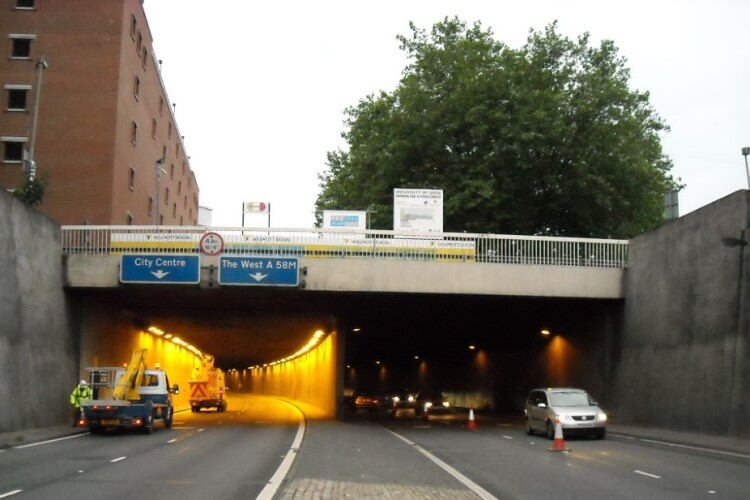
Leeds Inner Ring Road extends for approximately 2.5 miles and carries more than 83,000 vehicles each day. Along the route are more than 135 structures, including bridges, viaducts, road tunnels, retaining walls, and a pedestrian bridge, many of which must remain operational while repairs and strengthening proceed.
Annual maintenance activity will be combined with larger design-and-build packages intended to extend the service life of four bridges and viaducts, three tunnels, and one footbridge. Inspection, concrete repair, waterproofing, drainage, bearings, joints, parapets, corrosion protection, and structural strengthening are all likely to feature across the programme.
Because the route forms part of the city’s principal transport network, delivery will require close coordination with bus services, freight movements, emergency access, local businesses, and surrounding residential streets. Lane closures, overnight possessions, temporary diversions, and weekend working will need to be sequenced so that the network remains usable throughout the seven-year period.
Tunnel packages will bring an additional set of technical and operational demands. Ventilation, lighting, fire systems, drainage, communications, emergency access, and worker protection must be managed alongside the structural fabric, while access windows may be considerably shorter than those available on an open highway site.
Bridge and viaduct works can be equally difficult to define before construction begins. Surveys provide an initial picture, although hidden corrosion, failed waterproofing, reinforcement damage, previous repairs, and defective drainage frequently become clearer only after finishes and surfacing have been removed.
By combining routine work with major interventions under one long-term arrangement, Leeds City Council can sequence investment according to asset condition, safety priorities, traffic constraints, and available funding. Information gathered during early packages can also be applied to later structures, reducing the loss of knowledge that occurs when each repair is procured separately.
Long-term maintenance replaces fragmented intervention
Across the UK, ageing transport infrastructure is creating a sustained programme of renewal that sits alongside higher-profile new-build projects. Bridges, tunnels, retaining walls, and elevated roads constructed several decades ago are now exposed to accumulated deterioration from traffic loading, water ingress, road salts, freeze-thaw cycles, and repeated maintenance interventions.
Where inspection and repair are deferred, contained defects can develop into much larger structural problems. Failed joints may allow water and chlorides to reach reinforcement, blocked drainage can accelerate concrete deterioration, and worn bearings can transfer loads into parts of a structure that were not designed to carry them.
A seven-year contract gives the client and contractor an opportunity to develop common methods, standard details, and repeatable traffic-management arrangements. Specialist concrete repair contractors, access providers, waterproofing companies, testing laboratories, structural engineers, and materials suppliers may also gain greater visibility of the likely workload.
That continuity does not remove commercial uncertainty. The condition of each asset will differ according to construction detail, exposure, previous repairs, drainage performance, and loading history, so the cost and scope of later packages may change as intrusive investigations progress.
Attempting to transfer all unknown-condition risk into a fixed price can produce inflated tenders or disputes once defects are exposed. A programme-based arrangement allows foreseeable maintenance to be priced with greater certainty while providing a route for managing deterioration that could not reasonably have been identified before access became available.
The award adds to a Balfour Beatty pipeline increasingly weighted towards long-duration programmes across transport, energy, and defence infrastructure. Such frameworks can provide more predictable revenue, although margin performance still depends on survey quality, efficient possessions, disciplined change control, and consistent productivity.
Environmental performance will be influenced by the repair strategy adopted for each structure. Extending the life of an existing bridge or tunnel can avoid much of the material consumption, demolition waste, and disruption associated with replacement, but repeated short-lived repairs can erode those benefits.
Durability therefore depends on preparation and workmanship as much as product specification. Concrete repairs require sound edges, clean reinforcement, appropriate primers and repair materials, controlled curing, and compatible waterproofing, while inaccessible defects can undermine otherwise well-executed surface treatment.
Traffic management will account for a substantial proportion of both cost and programme risk. Crews may need to mobilise and demobilise within narrow possession windows, and a delayed closure or incomplete work stage can affect the following day’s traffic before it affects the contractor’s own productivity.
Coordination with other planned city works will also be essential. Utility interventions, development traffic, public transport changes, events, and separate highway schemes can all alter the capacity available for closures and diversions.
Planned maintenance begins immediately, giving Balfour Beatty and the council time to refine surveys and prepare the first major interventions before 2027. By the programme’s expected conclusion in 2032, its success will be measured less by the volume of repair completed than by the additional service life achieved across the route.