IN Brief:
- The proposed framework would run from April 2028 until March 2038.
- Its scope includes pipelines, treatment assets, pumping stations, drainage, electrical installations, maintenance, and engineering services.
- Suppliers are being consulted on capacity, lotting, commercial models, incentives, collaboration, and innovation.
Yorkshire Water has begun early market engagement for a proposed infrastructure works framework worth about £3bn, setting out a ten-year delivery platform spanning the AMP9 and AMP10 regulatory periods.
The company is asking contractors, consultants, suppliers, and specialist engineering businesses to help shape the procurement before a formal competition begins. The framework is expected to run from April 2028 until March 2038, with indicative annual expenditure of roughly £330m across water and wastewater infrastructure.
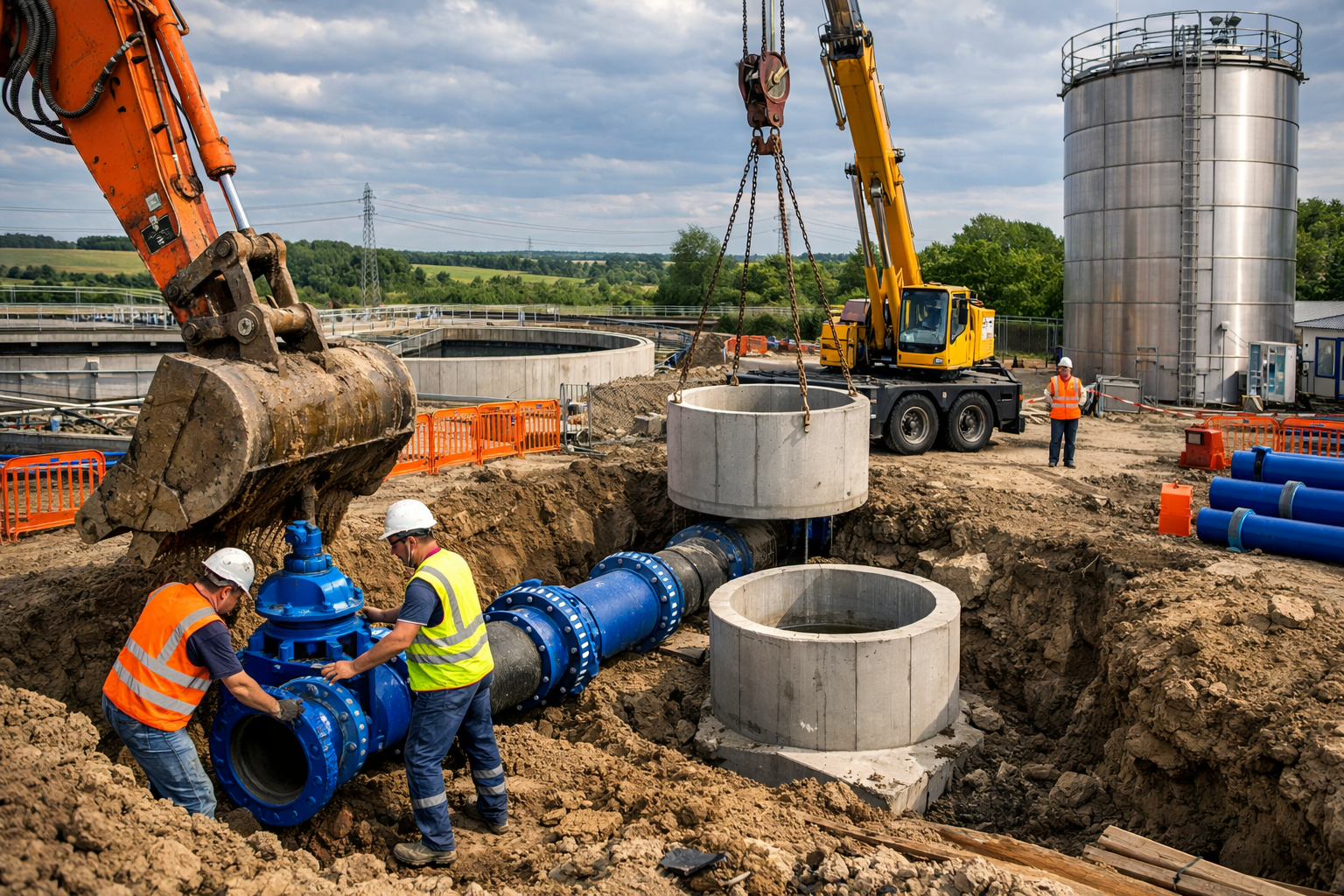
Its proposed scope covers water and sewerage pipelines, pumping stations, treatment works, drainage infrastructure, electrical installations, maintenance, and associated engineering and design services. Larger strategic projects would sit alongside customer-facing improvements to distribution and wastewater networks, creating a programme broad enough to require civil, process, mechanical, electrical, control, and environmental capability.
The engagement exercise is testing the market’s capacity and preferred commercial structure rather than inviting tenders. Yorkshire Water is seeking views on lotting, contract models, incentives, collaboration, and innovation, with suppliers asked to respond by 12 August ahead of the planned April 2028 start.
Several of those choices will determine whether the eventual framework attracts a concentrated group of major contractors or a wider regional and specialist supply chain. Large, geographically broad lots can justify permanent delivery teams and investment in plant, systems, and training, but smaller or technically defined packages can widen access and reduce dependence on a handful of suppliers.
The commercial model will be equally consequential. Water frameworks increasingly link payment and future workload to safety, productivity, environmental performance, customer disruption, carbon, programme certainty, and asset outcomes. An incentive regime can encourage consistent performance, although it becomes less credible when contractors are expected to carry risks arising from incomplete design, uncertain site conditions, consents, or operational constraints outside their control.
Yorkshire Water is already delivering an £8.3bn investment programme for 2025 to 2030, its largest to date. That AMP8 plan includes upgrades to treatment and network infrastructure, measures to reduce pollution and leakage, and a £406m programme to replace more than 1,000km of ageing clean water mains.
The company has also assembled frameworks for complex non-infrastructure works, developer services, wastewater operations, storm-overflow investment, and technical assurance. The proposed AMP9 and AMP10 arrangement would extend procurement planning beyond the current period rather than simply reproducing those appointments.
An April 2028 commencement would overlap with the final two years of AMP8. That would give Yorkshire Water and its appointed suppliers time to mobilise, develop designs, recruit delivery teams, and secure capacity before the next regulatory period begins in 2030.
The overlap reflects the timescales involved in major water projects, which rarely fit neatly inside a single five-year control period. Schemes can require land acquisition, environmental assessment, planning, detailed design, enabling works, and phased construction before the principal asset is ready to commission, while operational sites must often remain live throughout modification.
A visible ten-year pipeline can support investment in scarce expertise, including process engineering, electrical and control systems, specialist civils, commissioning, and environmental management. It can also provide regional subcontractors with repeat work, although that benefit depends on how effectively the final lot structure and call-off arrangements distribute opportunities below the appointed tier one partners.
Long duration does not remove delivery risk. Material prices, labour availability, regulation, environmental obligations, and water sector performance requirements will change over a decade, so the contracts will need workable indexation, change control, and risk-allocation mechanisms rather than assumptions fixed at award.
Much of the work will also take place on operational assets, where shutdown windows, temporary treatment, customer continuity, and commissioning dictate the construction sequence. A framework that connects design, delivery, and operational teams early can reduce late changes, but only if asset information and programme priorities are sufficiently mature when packages are released.
The £3bn figure remains indicative, and the engagement does not guarantee the eventual value or volume of work. It nevertheless places the commercial planning for Yorkshire Water’s post-2030 infrastructure programme into the market while the present AMP8 cycle is still in its early delivery years.
Supplier responses will influence whether the arrangement becomes a compact alliance-style model, a broader regional framework, or a collection of specialist packages. The final structure will shape both access to the work and Yorkshire Water’s ability to carry skills, designs, and delivery capacity from AMP8 into the decade that follows.