IN Brief:
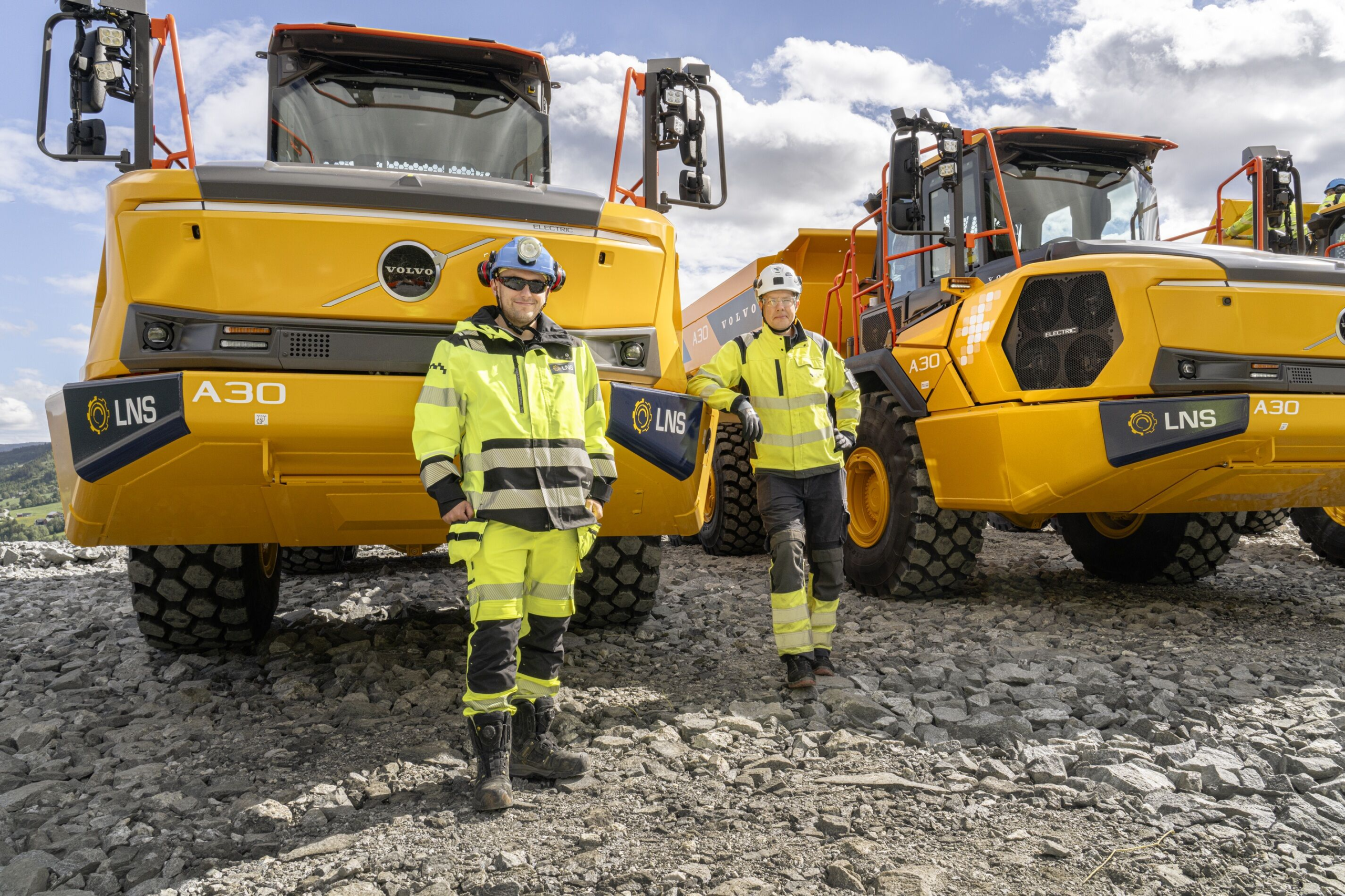
- Volvo CE has delivered four serial-produced A30 Electric articulated haulers to LNS in Norway.
- Three further machines will join work on approximately 20km of tunnels for the Hemsil 3 hydropower project.
- Blasting cycles provide planned charging windows, while zero tailpipe emissions can reduce underground ventilation demand.
Volvo Construction Equipment has delivered the first four serial-produced A30 Electric articulated haulers to Norwegian contractor LNS for work on the Hemsil 3 hydropower project, with three further machines due to join the fleet.
The battery-electric haulers will operate during construction of approximately 20km of tunnels for Hafslund Kraft’s new power station in Hallingdal, across the municipalities of Hemsedal and Gol. The scheme is scheduled for completion in 2029 and is expected to increase annual electricity generation by about 110GWh.
Built at Volvo CE’s Braås facility in Sweden, the first machines travelled roughly 700km to the site. Their deployment represents the first operational use of a serial-produced electric articulated hauler in this size class on a major construction project.
Tunnel work provides a demanding but potentially well-matched application for battery-electric plant. Haul routes are repetitive, ventilation carries a high operating cost, and blasting cycles create predictable pauses during which equipment can be charged without necessarily interrupting production.
Removing tailpipe emissions can reduce the diesel particulates, nitrogen oxides, heat, and fumes that ventilation systems must manage underground. Electricity demand for fans may fall where the wider fleet becomes cleaner, while workers experience a quieter and less polluted operating environment.
The A30 Electric still has to deliver the payload, traction, braking, durability, and cycle times expected from a conventional articulated hauler. LNS and Volvo Maskin will monitor the machines in live production, where gradients, wet conditions, rough haul roads, charging windows, and cold weather will test performance beyond a controlled demonstration.
Charging strategy will determine how effectively the fleet integrates with blasting and excavation. Power capacity, charger location, cable routing, queueing, and contingency arrangements must be coordinated with tunnel logistics, while the temporary electrical installation needs protection from water, dust, impact, and changing work fronts.
Seven electric haulers will represent a substantial connected load when charging overlaps. Site teams must balance fast turnaround against available supply and battery life, potentially staggering sessions or using programmed charging to avoid peaks that exceed the temporary network’s capacity.
The project follows Volvo CE’s wider expansion of electric construction equipment and mobile charging options, which has moved beyond compact machines towards heavier applications whose energy demand and operating patterns require more extensive site planning.
Heavy plant electrification has progressed more slowly than the transition in passenger vehicles because machines work under variable loads, often far from permanent power, and are expected to remain productive across long shifts. Articulated haulers also carry large payloads over changing gradients, creating high and uneven energy consumption.
Projects with repeatable routes and defined pauses are likely to adopt the technology first. Quarries, mines, tunnels, large earthworks, and fixed-site material operations can plan charging around production cycles more easily than dispersed civil engineering work where machines move frequently between locations.
Hydropower construction offers an additional alignment between the project and its equipment, although the environmental case still depends on the electricity source, battery manufacture, machine utilisation, and the diesel displaced over the working life. High annual hours and consistent loading improve the potential return from both carbon and operating-cost reductions.
Total cost will remain a key consideration for contractors. Electric machines can reduce fuel and some maintenance requirements, but they carry higher capital costs and may require chargers, grid reinforcement, energy management, training, and new workshop procedures. Residual values and battery replacement costs are still developing as the market matures.
Reliability carries particular weight underground, where a disabled machine can obstruct a haul route and disrupt several connected activities. Dealer support, spare parts, remote diagnostics, recovery plans, and technician competence will be as important as the performance of the battery and drivetrain.
Site safety procedures must also adapt. High-voltage systems require trained personnel and defined isolation processes, while emergency responders need information on battery location, damage assessment, fire behaviour, and the safe handling of a machine involved in a collision or electrical fault.
Reduced noise can improve communication and working conditions, although it may also make moving plant less noticeable to pedestrians. Lighting, cameras, proximity detection, route segregation, and acoustic warnings will remain necessary even where the traditional engine sound has disappeared.
Data from Hemsil 3 will help contractors compare predicted and actual energy use across loads, gradients, temperatures, and charging patterns. Those figures are needed to size future fleets and infrastructure accurately, because assumptions based on smaller equipment or road vehicles provide limited guidance for heavy off-road production.
As manufacturers move electric plant into higher-capacity classes, construction programmes will need to consider energy infrastructure during tender and mobilisation rather than after machine selection. Temporary power can no longer be treated solely as a supply for cabins, lighting, and small tools when major production equipment depends on it.
The seven-machine fleet gives Hemsil 3 sufficient scale to test those arrangements across daily operation rather than isolated trials. If the haulers maintain output while reducing ventilation and fuel demand, the project could provide a replicable model for electrifying heavy underground transport on other tunnel, mining, and hydropower schemes.