IN Brief:
- Leica’s MC1 machine-control system is now available as an aftermarket retrofit for Hyundai HD130A dozers.
- The package supports laser, total-station, dual-GNSS, on-cab, and on-blade configurations.
- Real-time model guidance can reduce survey staking and grading passes, provided design data, calibration, and revision control remain accurate.
Hyundai Construction Equipment and Leica Geosystems have extended 3D machine control to HD130A dozers through an aftermarket package, allowing existing machines to use Leica’s MC1 platform without waiting for a factory-fitted configuration.
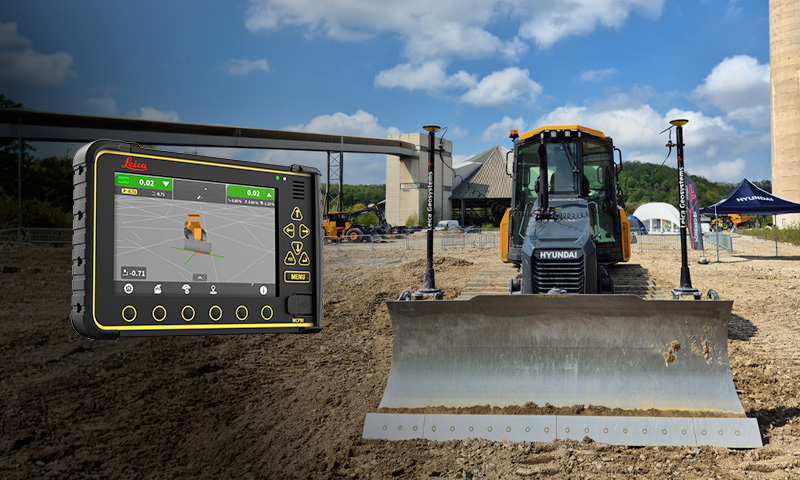
The retrofit supports 2D and 3D dozer applications, including dual-laser, total-station, and dual-GNSS arrangements. Operators receive real-time cut-and-fill guidance from the project design model, enabling the blade to be positioned against the specified surface as work progresses.
Hyundai and Leica have designed the package as a plug-and-play installation available through the dealer and service network. The system can be configured for on-cab or on-blade positioning, depending on the accuracy, visibility, and working conditions required by the contractor.
Leica MC1 connects the machine with the wider project data environment, including the Leica ConX cloud platform and supporting survey and stakeout tools. Updated models and progress information can move between site and office without relying on repeated paper drawings or manual transfer.
For dozer operators, continuous guidance reduces dependence on profiles, stakes, and repeated survey checks. The display shows the relationship between the blade and the target surface, helping the driver maintain line and level across bulk earthworks, formation, drainage, roads, platforms, and final grading.
Fewer passes can reduce fuel use, track wear, labour, and programme time, although the gains depend on the quality of the model and the operator’s ability to use the system. A highly accurate machine working from incorrect or outdated design information will reproduce the error efficiently across a large area.
Aftermarket availability broadens the potential market because contractors can upgrade machinery already in service rather than linking digital adoption to the replacement cycle. That route can be particularly useful for fleets whose machines remain mechanically productive but lack the control systems now requested on larger or more tightly specified projects.
Installation must still be supported by calibration, survey control, data preparation, and training. Sensors, antennas, masts, displays, and hydraulic interfaces need to function as one system, while project teams must establish who is responsible for model approval, revisions, and the checks used to verify completed work.
The launch follows a wider shift from standalone equipment towards connected and increasingly automated site production. A Develon autonomous excavator operating on a Swiss site has demonstrated how digital models, sensing, and machine control are moving from guidance towards the automated execution of repetitive excavation tasks.
Dozer control represents a more established stage of that transition, with the operator remaining responsible while software provides positioning and, in some configurations, assists blade movement. The technology can improve consistency across long shifts and reduce reliance on a small number of highly experienced grading specialists.
Skills requirements do not disappear; they change. Operators need to understand surface models, offsets, tolerances, and system status alongside conventional machine handling, while engineers and surveyors must prepare information in a form that can be trusted at the point of work.
Model management becomes especially important where designs change frequently. Earthworks teams can progress rapidly, so an obsolete surface uploaded for even part of a shift may create significant rework. Clear revision control, connectivity, and communication between design, survey, and production teams are therefore central to the claimed productivity gains.
GNSS-based control also depends on reliable positioning and suitable site conditions. Urban canyons, tree cover, structures, tunnels, radio interference, and poor satellite visibility can reduce performance, making total-station or laser configurations necessary where the required accuracy cannot be maintained through satellites alone.
The ability to select between those configurations gives contractors flexibility across different projects, but it also increases the need for competent setup and support. Dealer technicians will need to diagnose faults that cross mechanical, hydraulic, electronic, software, and survey disciplines rather than treating the machine and control package as separate products.
Commercial adoption will be influenced by utilisation. A retrofit is easier to justify where a dozer spends much of its time on controlled grading work and can move between projects that use compatible digital processes. Benefits diminish where machines perform short, irregular tasks or where site information remains largely two-dimensional and paper-based.
Clients and main contractors are increasingly specifying digital evidence of completed levels, quantities, and progress. Connected machine control can contribute to those records, although data produced by the equipment must be checked before it is treated as formal verification or incorporated into payment and as-built information.
Cybersecurity and access control are also becoming part of plant management as machines connect to cloud platforms and receive project models remotely. Contractors need to control user permissions, software updates, data ownership, and the handling of commercially sensitive design and production information.
By offering MC1 as an aftermarket option, Hyundai and Leica are lowering one barrier to adoption across mixed-age fleets. The installation gives HD130A owners a route into model-based grading, but the productivity improvement will depend on the surrounding workflow: accurate design data, disciplined revisions, suitable positioning infrastructure, trained operators, and reliable technical support.
As machine guidance becomes a standard expectation on larger earthworks packages, contractors will increasingly assess plant on its ability to connect with project information rather than on mechanical performance alone. The HD130A retrofit extends that capability without requiring a new dozer, allowing digital investment to follow operational demand instead of the fleet replacement timetable.