IN Brief:
- RAICo1 has added a ten-user immersive environment for planning complex nuclear decommissioning work.
- The facility combines robotics data, live information, and 360-degree visualisation for collaborative rehearsal and monitoring.
- Sellafield expects the approach to reduce time spent in hazardous environments by up to 40%.
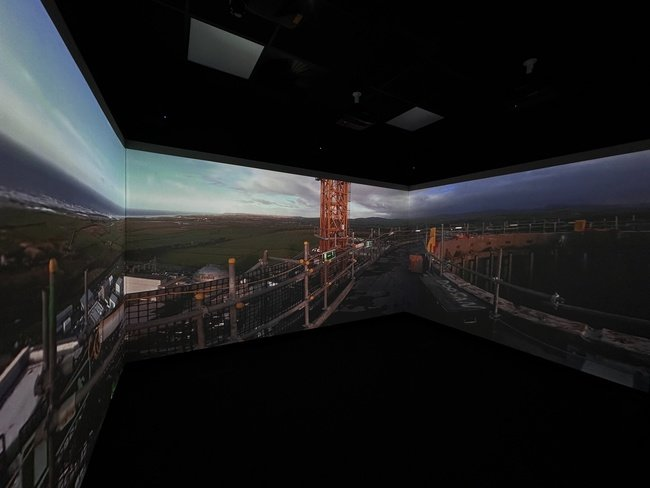
Sellafield’s Robotics and Artificial Intelligence Collaboration facility in West Cumbria has added an immersive planning environment combining live operational information, remotely operated robotics, and 360-degree visualisation. The system gives engineers and operators a shared environment in which to plan and rehearse complex decommissioning activity before people or equipment enter hazardous areas.
AtkinsRéalis developed the capability with Sellafield Ltd and immersive technology specialist Igloo Vision at the RAICo1 facility. Designed for up to ten users, the room can present digital versions of facilities and operating scenarios while displaying imagery and information gathered by robotic platforms on site.
A team preparing work in a restricted area can use the environment to follow the proposed route virtually and assess conditions as information changes. Engineers, operators, and project staff can therefore review access, equipment positions, work sequences, and emerging constraints together rather than relying on separate drawings, desktop models, or individual screens.
Sellafield expects the combination of robotics and live data streaming to reduce time spent in hazardous environments by up to 40% where remote operations and monitoring can be used. Radiological conditions, contamination, restricted access, and other hazards make physical exposure a fundamental constraint on nuclear decommissioning, so work completed before entry can have a direct effect on both safety and productive time.
Richard Brook, digital solutions lead for nuclear at AtkinsRéalis, said: “Teams can better visualise challenges and work through solutions together before activities begin on site.” The company integrated Igloo Vision’s immersive platform with Sellafield’s information and operational requirements, drawing on experience from its wider immersive technology work.
The deployment forms part of Sellafield’s broader use of robotics, artificial intelligence, modelling, and advanced visualisation across its decommissioning programme. Another immersive capability is being developed on the Sellafield site, while RAICo1 provides a facility where the operator, technology companies, researchers, and supply chain partners can develop and demonstrate new approaches.
Nuclear decommissioning provides a demanding test for the technology because existing facilities are complex, access is controlled, and physical conditions may differ from historic records. Updated visual information from remote platforms can be brought into the planning environment, giving teams a more current basis for decisions before personnel are committed to an intervention.
The system also connects digital planning more directly with the machines expected to perform the work. Robotics can otherwise become a specialist equipment package brought into a project after the method has largely been established; at RAICo1, information from remotely operated platforms contributes to the planning process itself.
That can expose practical limitations earlier. Visibility, tooling, reach, access widths, obstructions, communication coverage, equipment positioning, and recovery arrangements can be examined as part of the method rather than discovered after mobilisation into a controlled area. The result still depends on engineering judgement and physical verification, but fewer decisions need to be made for the first time at the workface.
Collaborative use is equally important on programmes involving multiple engineering disciplines and specialist suppliers. Decommissioning work can combine structural intervention, temporary works, lifting, remote handling, radiation protection, waste management, instrumentation, electrical systems, and controls within a single package. A shared visual environment allows those interfaces to be examined together rather than passed sequentially between disciplines.
RAICo1 therefore sits closer to project delivery than a conventional demonstration room. Its value will depend on whether the rehearsals change methods, reduce physical entries, shorten time in controlled areas, or identify constraints before they affect live work. Those outcomes can be measured against individual work packages rather than relying on a general claim that immersive technology improves collaboration.
The official project material says the facility will also support planning, training, and decision-making, with early collaboration between the partners intended to leave capacity for further expansion. Sellafield is developing another immersive capability on site, creating the prospect of linking innovation and demonstration work more closely with operational delivery.
The next evidence will come from repeated deployment. A 360-degree room is visually more impressive than another project dashboard, but Sellafield’s own benchmark is more useful: less time in hazardous areas, better-informed interventions, and decommissioning work rehearsed before the consequences of an avoidable mistake become considerably harder to undo.