IN Brief:
- Ravago Building Solutions UK has launched Ravatherm XPS X FUSION for floors and inverted roof applications.
- The range achieves a consistent lambda value of 0.030 W/mK and is available up to 200mm thickness.
- The launch follows a seven-figure investment in manufacturing processes at Ravago’s King’s Lynn production facility.
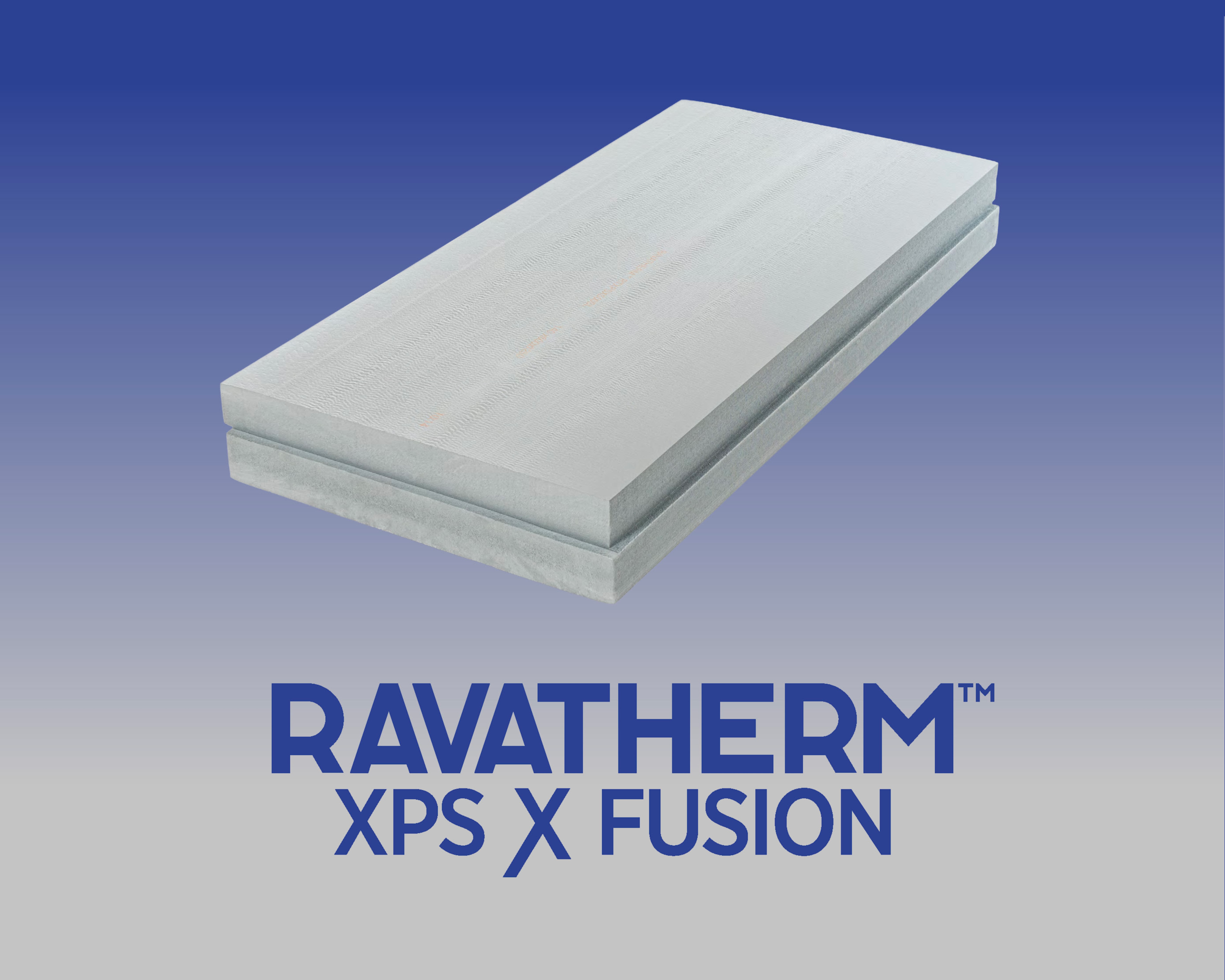
Ravago Building Solutions UK has launched Ravatherm XPS X FUSION, a next-generation range of extruded polystyrene thermal insulation boards for floors and inverted roofs.
The new range has been developed following a seven-figure investment in advanced manufacturing processes at Ravago’s UK production facility in King’s Lynn. It is designed to deliver improved thermal performance and greater consistency in a uniform board format suitable for precision applications and general construction.
Ravatherm XPS X FUSION achieves a consistent lambda value of 0.030 W/mK. Boards are available up to 200mm thickness with either shiplap or butt-edge profiles and have a compressive strength of 300 kPa. The range is intended for floors and inverted roof systems, including green and blue roofs, where compressive strength, moisture resistance, and long-term thermal performance are required.
The range replaces Ravatherm XPS X 300 SB and Ravatherm XPS X 300 SL, which will be discontinued and succeeded by Ravatherm XPS X FUSION 300 SB and Ravatherm XPS X FUSION 300 SL. Ravago said the improved thermal performance will allow specifiers and contractors to achieve target U-values using thinner insulation build-ups in some applications.
Joan Ferrer, commercial director at Ravago Building Solutions UK, said: “Ravatherm XPS X FUSION builds on more than 65 years of XPS innovation at Ravago, setting a new benchmark for performance and consistency. This evolution of our manufacturing capability reflects how we are continually investing in offering enhanced thermal insulation solutions for the UK construction market.”
He added: “By introducing this new technology into our production line, we not only achieve improved thermal performance for our products, but we also gain the flexibility to meet the evolving needs of architects, specifiers and contractors working on increasingly demanding projects.”
Building envelope specifications are being pushed by regulation, client carbon targets, and the practical constraints of dense construction. Insulation products are increasingly expected to support lower U-values without creating unmanageable build-ups, particularly where floor thresholds, roof heights, drainage falls, and interfaces with other systems are tightly controlled.
Inverted roofs place particular demands on insulation. Boards sit above the waterproofing layer and must retain thermal performance while exposed to moisture, loading, and long-term service conditions. Green and blue roofs add further complexity through drainage layers, water attenuation, growing media, paving, plant access, and maintenance requirements.
The consistency of thicker boards is commercially important as well as technical. On roofing projects, flatness and dimensional stability affect installation quality, drainage performance, and interfaces with membranes, upstands, and finishes. In low-energy buildings and Passive House projects, variations in insulation performance or build-up depth can also affect compliance calculations and detailing.
The investment at King’s Lynn also points to the manufacturing pressures behind the materials market. Product availability and lead times remain sensitive after several years of volatility in insulation supply, raw material costs, and energy pricing. Greater operational flexibility in board thicknesses can help manufacturers respond to project-specific demand and reduce delays for contractors working to tight programmes.
Insulation suppliers are also under pressure to improve documented performance, sustainability credentials, and support for more demanding building standards. Manufacturing investment is becoming a competitive issue across the board materials market, with major investment in panel production capacity in Ireland showing how closely product development and factory capability are now linked.
For specifiers, Ravatherm XPS X FUSION adds another option where high compressive strength and moisture resistance are required alongside improved thermal performance. For contractors, its practical value will rest on board consistency, availability, and ease of integration into established floor and roof build-ups.
Thermal requirements are tightening, but buildability remains decisive. Ravago’s new range is positioned as a manufacturing-led upgrade for projects where insulation performance, dimensional control, and programme certainty need to work together rather than compete for space in the detail.