IN Brief:
- Murphy has carried out the first permanent-works use of Ecocem ACT concrete in the UK.
- The pour was used for a capping beam at Shipley Depot on the Transpennine Route Upgrade.
- The job suggests low-carbon cement systems are moving closer to standard deployment on major civils works where carbon accounting, performance, and programme all matter.
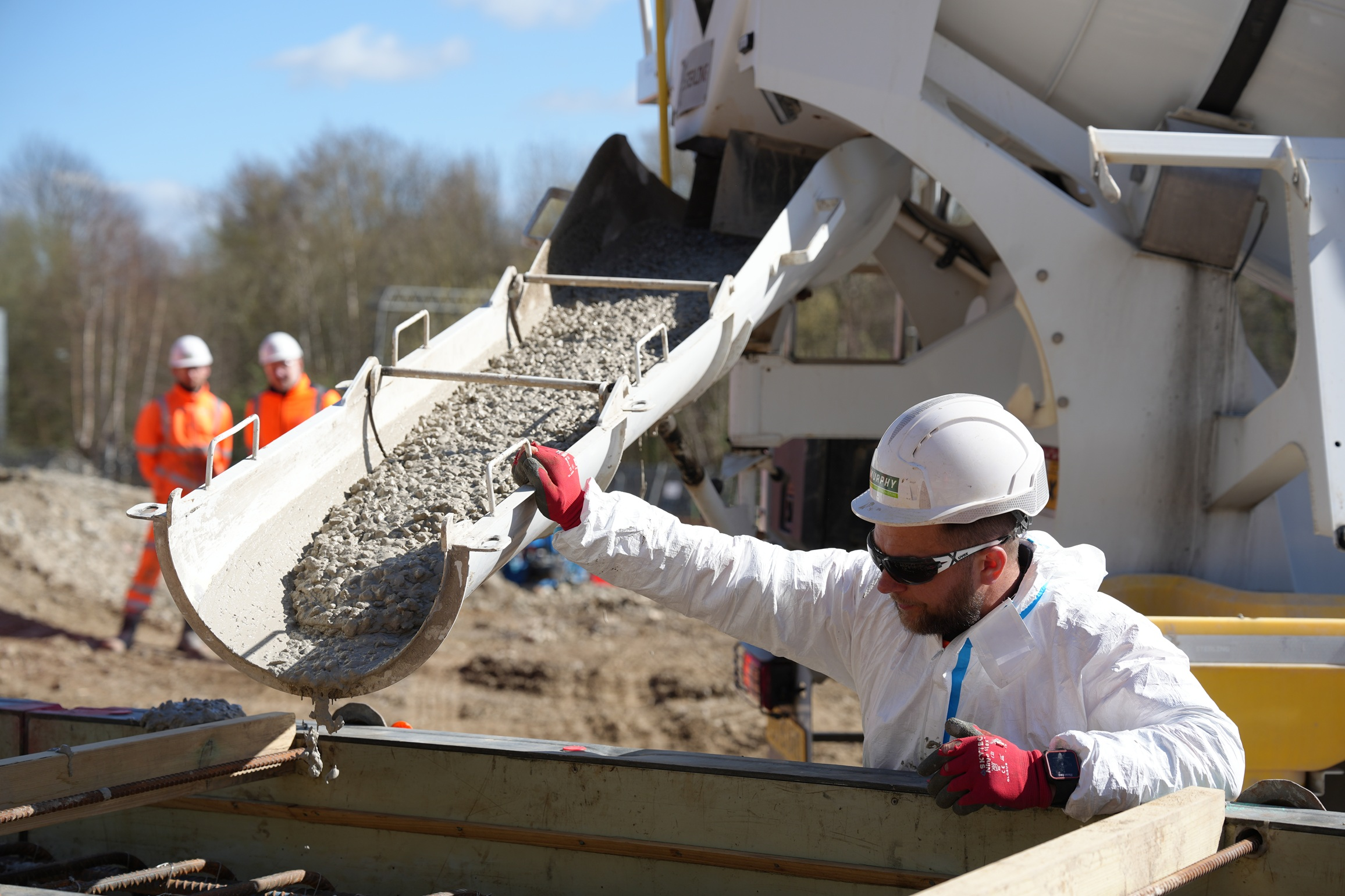
Murphy has carried out what it describes as the first permanent-works use of Ecocem ACT low-carbon concrete in the UK, deploying the material for a capping beam cast on a contiguous pile wall at Shipley Depot as part of the Transpennine Route Upgrade.
The pour was delivered with Breedon and Ecocem, with Murphy associating the work with a meaningful reduction in embodied carbon against a conventional benchmark mix once the full set of pile caps is complete. On its own, the saving is substantial enough to attract attention. More important, though, is where the material has been used. Permanent works carry a different weight from demonstration slabs, temporary applications, or tightly controlled trials. They sit directly within the long-term performance expectations of the asset.
Shipley Depot forms part of the TRU East alliance, which brings together Network Rail, VolkerRail, Siemens, SYSTRA, and Murphy on the York-to-Leeds section of the wider Transpennine Route Upgrade. In that setting, materials are not selected lightly. They have to work within demanding engineering parameters, programme controls, and client assurance processes. That is why the move from earlier ACT pours into permanent structural use matters. It indicates that lower-carbon cement systems are beginning to shift from proof-of-concept status into more routine engineering decisions.
The detail of the application is worth dwelling on. A capping beam for a contiguous pile wall is not a decorative or low-consequence element. It sits within the structural logic of a serious retaining arrangement, where sequencing, reinforcement, concrete quality, and long-term behaviour all have to be controlled carefully. Successful use in that context sends the market a far more useful signal than a generic statement about greener concrete ever could.
Concrete remains one of the hardest embodied-carbon issues in infrastructure delivery. Contractors have made progress on plant, logistics, and temporary energy use, but major civils work still depends heavily on cement-intensive materials. That is why attention has turned so sharply towards clinker reduction, supplementary cementitious materials, alternative binders, and mix redesign. The challenge is not finding promising technologies. It is getting them through standards, procurement, insurance, engineering acceptance, and site practice at the same time.
This latest pour suggests that barrier is beginning to move, albeit slowly. Murphy had already used ACT on earlier work, but permanent structural use is the more revealing milestone. Infrastructure clients are increasingly asking for carbon reductions that go beyond superficial substitution. At the same time, they still expect predictable performance, familiar installation methods, and a clear audit trail through the supply chain. Materials that cannot satisfy all three tend to stall. Materials that can satisfy them start to build momentum quickly.
The timing is not accidental. Rail, highways, and energy clients are under growing pressure to cut embodied emissions without compromising delivery. Carbon reporting is now more systematic, PAS 2080 principles are more embedded in major programmes, and designers are under greater pressure to justify material choices early in the programme. As a result, suppliers and contractors are being drawn into closer collaboration much earlier in the design and planning process. The Murphy, Breedon, and Ecocem partnership fits that pattern.
There is still some distance to travel before lower-carbon cement systems become default choices across infrastructure. Availability, specification familiarity, regional supply, and client confidence will all influence how quickly uptake spreads. Even so, permanent-works use on a live programme is where material change stops being aspirational and starts becoming contractual. Shipley Depot is not the end point of that shift, but it is the sort of milestone that tends to push the market forward.