IN Brief:
- European rental confidence declined across current conditions, activity, utilisation, and investment measures.
- Spain remained the strongest major market, while UK and French respondents reported weaker conditions.
- Most businesses still expect improvement over 12 months, but the positive balance has narrowed.
The European Rental Association recorded a broad weakening in equipment-rental confidence during the second quarter of 2026.
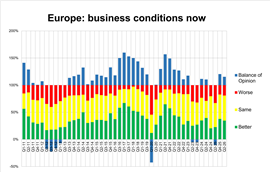
Based on approximately 80 responses, the latest RentalTracker survey reported lower positive balances for current business conditions, year-on-year activity, utilisation, fleet investment, and the outlook for the coming 12 months.
The balance of respondents describing current conditions positively stood at 15%, compared with 20% six months earlier. That measure represents the difference between the proportion reporting improvement and the proportion reporting deterioration.
Year-on-year business activity produced a positive balance of 15%, down from 21% in the previous survey, while fleet utilisation fell more sharply from 29% to 11%. The utilisation result indicates that more rental companies are seeing pressure on the intensity with which their fleets are being used.
Expectations for 2027 capital expenditure also softened. The balance of companies planning to increase investment declined to 9%, from 17% six months earlier, although more businesses still expect to raise spending than reduce it.
The 12-month business outlook remains positive but less confident. Fifty-three per cent of respondents expect conditions to improve, whereas 19% anticipate deterioration, creating a positive balance of 34% compared with 48% in the previous survey.
Employment intentions have held up more strongly. Around 41% of respondents expect to increase staff numbers, while approximately 8.5% foresee reductions, suggesting that many rental companies are maintaining plans for operational growth despite greater caution around equipment purchasing.
Country-level results varied considerably. Spain remained the strongest of the major rental markets, while businesses in the UK and France reported weaker conditions across several measures.
UK respondents recorded deterioration in current activity, utilisation, and recruitment expectations. Even so, 31% of businesses in the UK and Ireland expect fleet investment to increase, indicating that replacement and modernisation requirements have not disappeared.
French respondents were more defensive, with none of the participating businesses expecting to raise capital expenditure. Under those conditions, maintenance, fleet age, resale, and utilisation are likely to receive greater attention than expansion.
Fleet spending becomes more selective
Rental markets frequently provide an early indication of construction activity because utilisation responds quickly to changes in project starts, weather, programme delays, and contractor confidence. Equipment that is no longer required can be returned immediately, whereas owned machinery may remain on a contractor’s balance sheet during periods of reduced use.
Different equipment categories will respond at different stages of the cycle. Earthmoving machinery, access platforms, telehandlers, pumps, generators, tools, temporary accommodation, and specialist lifting equipment each depend on different project types and phases.
Lower investment expectations therefore do not imply that purchasing will stop. Fleets require continuous replacement as machines age, accumulate operating hours, or become more expensive to maintain, while safety requirements, emissions rules, customer specifications, and battery-electric alternatives create additional pressure for renewal.
The more important distinction lies between replacement and expansion. A rental company may maintain substantial capital expenditure while holding its overall fleet size broadly level because each new machine replaces an older asset.
Finance costs and residual values are central to that calculation. Rental assets are purchased on the assumption that hire income, utilisation, maintenance expense, and eventual resale proceeds will generate an acceptable return over several years.
Where demand becomes uncertain, businesses are likely to scrutinise model, power source, specification, fleet quantity, and expected resale value more closely. Specialist machines may command higher rates, but they can also remain idle for longer when the projects requiring them are delayed.
Greater emphasis on utilisation has accelerated investment in digital fleet management. The consolidation of mixed-fleet telematics and asset data allows rental businesses to compare location, operating hours, idling, service requirements, carbon output, and productivity across equipment from multiple manufacturers.
Data can expose underused assets, although it cannot replace operational judgement. A machine may be retained because it provides emergency cover, supports a specialist activity, or must be available during a short but critical stage of construction.
Rental rates will come under pressure if utilisation falls across several providers at once. Discounting can keep machines working, but lower rates weaken returns and reduce the capital available for replacement.
Price discipline becomes particularly difficult where competing depots carry similar equipment and construction activity is concentrated among a limited number of local projects. Transport costs also restrict the distance over which standard machines can be moved economically.
The resilience of recruitment intentions suggests that many companies still expect activity to recover. Rental operations require engineers, drivers, inspectors, controllers, depot staff, sales teams, and technical support, and shortages in those roles can constrain growth even when machines are available.
The survey does not indicate a uniform contraction across Europe. Instead, it shows that confidence has lost momentum, national conditions are diverging, and the next phase of fleet investment will be more targeted.
Machines with dependable utilisation, strong manufacturer support, measurable operating advantages, and credible residual values are likely to attract capital first. Broad fleet expansion will remain harder to justify until the improvement expected over the next 12 months becomes visible in sustained site activity.