IN Brief:
- Esh Construction has completed the £23m Stockton Waterfront urban park.
- The scheme includes a 55m-wide land bridge, amphitheatre, landscaped gardens, event spaces, and play areas.
- The project forms part of Stockton-on-Tees Borough Council’s wider town-centre regeneration programme.
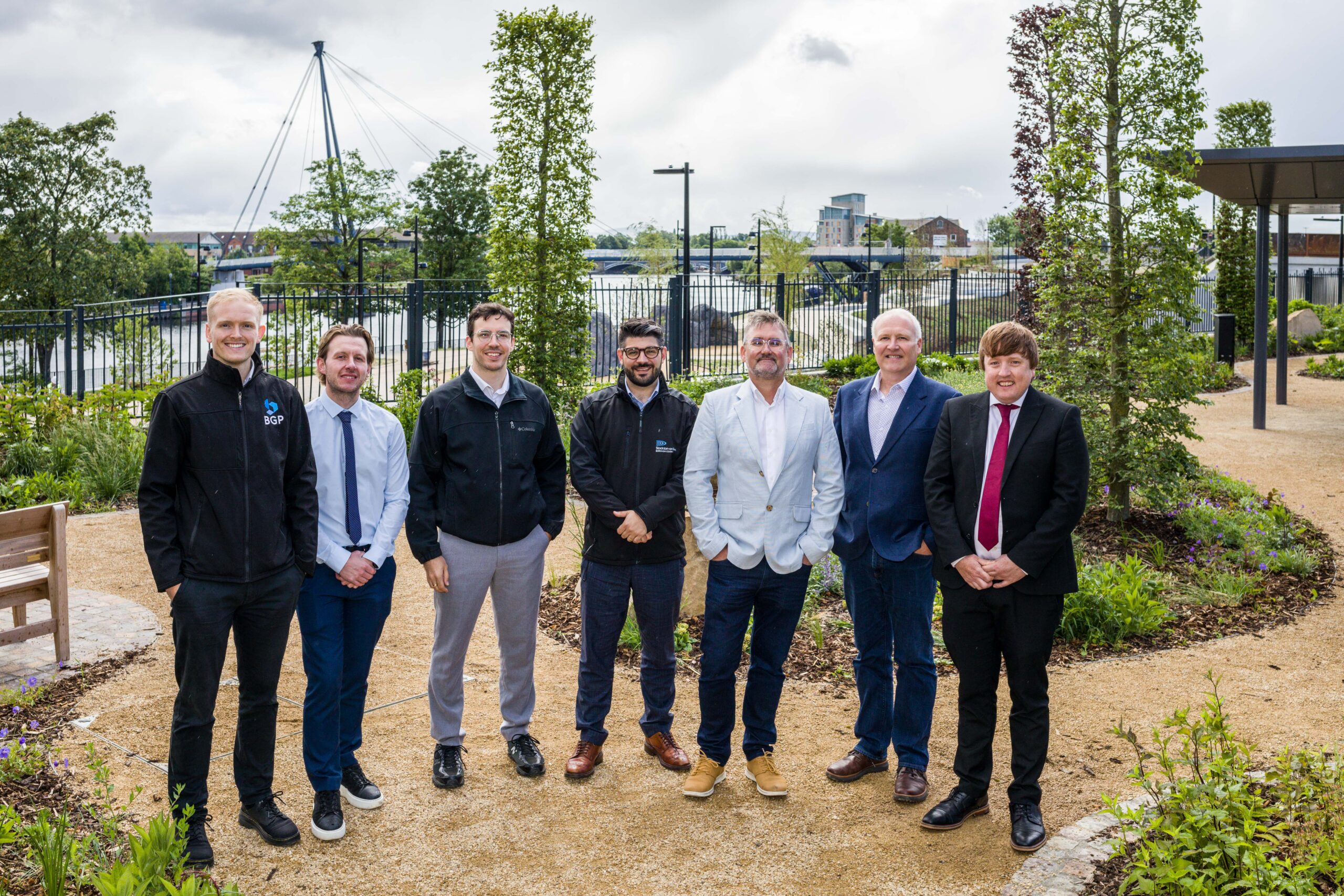
Esh Construction has completed and handed over Stockton Waterfront urban park, marking delivery of one of the North East’s major town-centre regeneration schemes.
The £23m project has been delivered in partnership with Stockton-on-Tees Borough Council and Ryder Architecture. It has reshaped a prominent section of the town centre, reconnecting Stockton High Street with the River Tees through a new multi-functional public park.
At the centre of the scheme is a 55m-wide land bridge over the A1305 Riverside Road, creating uninterrupted pedestrian access between the High Street and the riverside. The bridge structure was formed using 47 prestressed concrete beams, each measuring up to 21.5m in length, with 170m³ of concrete poured to form the bridge deck.
A 200m reinforced earth retaining Tensar wall was also constructed alongside the newly realigned A1305 Riverside Road carriageway, supported by more than 320 rigid inclusion piles.
The completed park includes an amphitheatre, flexible event spaces including the Oval Lawn, landscaped gardens, and three play areas designed for inclusive use across age groups. The amphitheatre extends over 2,000m², connects the upper and lower park, and includes 402 granite steps.
The landscaping includes more than 17,000 plants, 224 species, and 153 trees. The planting scheme was designed by the late Nigel Dunnett, a leading figure in modern landscape design.
The project has been funded by Stockton-on-Tees Borough Council, with £16.5m from the Ministry of Housing, Communities and Local Government and £20m from Tees Valley Combined Authority. The park is due to open to the public on Saturday 20 June, alongside Armed Forces Day events.
Stockton Waterfront combines civil engineering, public realm, highways, landscape, and placemaking in one project. Urban regeneration schemes are often judged by their finished spaces, but delivery depends on heavy enabling works, traffic management, utilities, retaining structures, access coordination, and careful sequencing in constrained town-centre environments.
The scheme also reflects a wider shift in local regeneration. Councils are increasingly looking beyond retail-led town-centre renewal, using housing, public realm, leisure, events space, and improved pedestrian connections to reposition central areas. Graham’s £76.8m Wolverton regeneration scheme follows a comparable pattern, connecting underused central land with homes, commercial uses, public space, and local infrastructure.
For Esh, the project adds to a regional delivery portfolio spanning civil engineering, public-sector buildings, and housing. Its recent Hartlepool refurbishment programme showed planned investment and building renewal capability, while Stockton Waterfront demonstrates a more infrastructure-led regeneration role.
The land bridge was the project’s most technically demanding element. Reconnecting a high street to a riverside may be a simple placemaking ambition, but physically delivering that connection required bridge engineering, road realignment, retaining structures, piling, concrete works, and landscape integration.
The public value of the scheme will now be tested through use. A park of this scale has to attract footfall, support events, remain safe and maintainable, and encourage further investment around it. Construction completion is therefore the first stage of the regeneration programme rather than its final measure.
Stockton-on-Tees Borough Council is already looking towards further development through Tees Central, a new community planned at the heart of the Tees Valley. The Waterfront park gives that longer programme a visible public anchor, turning a previously disconnected town-centre edge into civic space built around access, landscape, and the river.