IN Brief:
- The Grade B listed former Municipal Buildings are being converted into 43 council homes under an £18.4m contract.
- CCG began work in spring 2026 after receiving the contract from North Lanarkshire Council in February.
- The project retains the former council chamber and key façades while adding residential accommodation and commercial workspace.
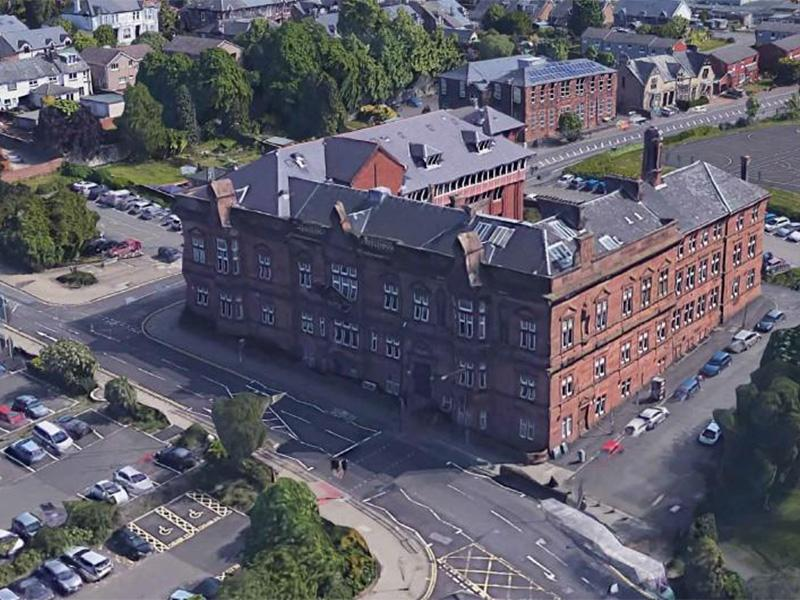
CCG (Scotland) is progressing an £18.4m conversion of Coatbridge’s former Municipal Buildings into 43 council homes, combining restoration of the Grade B listed civic building with partial demolition, new accommodation and commercial workspace.
North Lanarkshire Council awarded the redevelopment contract to the Glasgow based construction and manufacturing group in February 2026, with work beginning during the spring. The council has now reported progress as the vacant complex on Kildonan Street is adapted for residential use.
The buildings occupy a prominent town centre site at the junction of Kildonan Street, Muiryhall Street and Dunbeth Road. The original Municipal Building dates from 1894 and served as the headquarters of the Burgh of Coatbridge. Part of the complex was destroyed by fire in 1967 and a four storey wing was subsequently added in 1991.
Council offices remained in use until 2022, after which the property became vacant. The current project is retaining and restoring substantial parts of the historic structure while introducing 43 affordable homes, a central residents’ amenity space, car parking with electric vehicle provision and secure cycle and bin storage.
The former council chamber is also being retained and adapted to provide commercial and touchdown office accommodation. That element keeps one of the building’s most significant civic interiors in use while separating it from the residential areas being formed elsewhere in the complex.
The scheme does not retain every existing structure. Part of the former police wing is being demolished, although the Muiryhall Street façade and east gable are being kept. A rooftop extension to the northern wing will provide additional residential space, creating a programme that combines conservation, demolition and new construction within the same footprint.
David Wylie, managing director of CCG, said the Kildonan Street building had played a central role in Coatbridge for more than 130 years and described the company’s involvement in securing a new use for it as an important part of maintaining that legacy.
Listed civic buildings of this type rarely lend themselves to straightforward residential conversion. Existing floor plates, window positions, structural spans and circulation routes were designed around public and administrative functions rather than modern housing layouts, while historic elements limit where new openings, service routes and structural alterations can be introduced.
The combination of façade retention and partial demolition adds another layer to the construction sequence. Retained sections have to remain stable while adjoining structures are removed, after which new elements must connect to old fabric whose geometry and condition may differ from modern tolerances.
The rooftop extension introduces further interfaces, with new loads, weathering details and services having to be integrated into an existing building assembled across more than one period.
Mechanical and electrical work is central to the conversion. Individual dwellings require domestic services, ventilation, metering, fire protection and acoustic separation, while common areas and retained commercial space introduce different operational requirements. Listed fabric can restrict the routes available for ducts, pipework and cabling, increasing the importance of coordination before finishes are reinstated.
The project forms part of North Lanarkshire Council’s wider housing and regeneration programme. The authority has committed to delivering 6,000 additional affordable homes by 2035, with the Coatbridge scheme using an existing civic asset rather than relying solely on new development sites.
Retaining substantial portions of the structure also avoids complete demolition and replacement. Heritage conversion can require more complex labour and specialist work than a comparable new build, but it allows an established building to remain in productive use while adding homes within an existing town centre.
The location makes the commercial element particularly relevant. Retaining the former council chamber for workspace prevents the development becoming entirely residential and keeps employment related activity within a building that historically served a public function.
North Lanarkshire Council housing convener Michael McPake said the project would bring an empty building back into use while preserving important elements of Coatbridge’s heritage. The authority sees the 43 homes as part of both its housing target and a longer programme of investment in underused town centre sites.
Construction will now continue through the more technically demanding stages of adaptation and fit out. With the contract awarded in February and site work under way since spring, the next visible milestones will centre on retained fabric, the new upper level accommodation and formation of individual homes within a complex whose oldest elements date back more than 130 years.