IN Brief:
- Bellway has confirmed a limited number of positions are at risk of redundancy, without establishing a final job-loss total.
- The housebuilder completed 9,695 homes in FY26 but forecasts between 9,000 and 9,400 completions in FY27.
- A weaker forward order book, higher construction costs and sales incentives are increasing pressure on operating margins.
Bellway has placed a limited number of positions at risk of redundancy as the housebuilder reviews its operations in response to challenging conditions across the UK housing market. The company confirmed the employment measures on 11 November, following reports that staff at its head office and regional divisions had been informed of potential reductions.
Bellway has not publicly confirmed how many positions are affected or specified the divisions involved. A spokesperson said the company had taken the decision after reviewing how efficiently the business operates and would support colleagues during the process. The announcement establishes that jobs are at risk, but it does not confirm that every affected position will result in a redundancy.
The housebuilder’s response follows similar restructuring decisions elsewhere in the sector. Taylor Wimpey has opened redundancy consultations, while Vistry has undertaken regional restructuring and staff reductions. Although the scale and arrangements differ between businesses, the decisions coincide with weaker private housing demand and pressure on the profitability of new residential development.
Bellway’s latest results demonstrate the contrast between the volume of construction completed during the previous financial year and expectations for the year ahead. The group delivered 9,695 homes in the year ended 31 July 2026, an increase of 10.8% on the 8,749 completed in FY25. Revenue rose 13.6% to £3.16bn, while statutory profit before tax increased from £221.9m to £270.2m.
Underlying operating profit also increased, rising 5.6% to £320.6m. However, the underlying operating margin fell from 10.9% to 10.1%, indicating that the higher volume of work and stronger revenue did not produce a corresponding improvement in the proportion of income retained as operating profit. Construction cost inflation, sales incentives and the composition of completed housing influenced the financial result.
The margin trend is expected to continue during FY27. Bellway has forecast between 9,000 and 9,400 completions, below the 9,695 achieved in the previous year, while anticipating a further reduction in its underlying operating margin. The company expects build cost inflation, increased use of sales incentives and a greater proportion of bulk sales to affect profitability.
Bulk sales can support housing delivery and cash generation by allowing a housebuilder to sell multiple properties through transactions with institutional or affordable housing purchasers. Their commercial terms can differ from those available through individual private sales, contributing to the margin pressures Bellway expects during the current financial year. The company has indicated that bulk transactions will form a larger proportion of its planned completions.
Lower reservations are also affecting the development pipeline. Bellway reported an average private reservation rate of 0.55 homes per outlet per week during FY26, including bulk sales, compared with 0.57 in FY25. Excluding bulk sales, the rate fell from 0.52 to 0.49. This measure relates to reservations at active selling outlets and provides an indication of the demand supporting future housing completions.
During the nine weeks from 1 August, the private reservation rate excluding bulk sales declined to 0.45 per outlet per week, against 0.48 during the comparable period a year earlier. Including bulk sales, the corresponding rates were 0.50 and 0.51. Bellway’s forward order book at 2 October contained 4,981 homes valued at £1.44bn, compared with 5,285 homes and £1.53bn at the equivalent point in 2025.
The forward order book represents reserved homes that have not yet legally completed. A decline can influence decisions about the pace at which existing developments advance and the timing of additional site openings. Housebuilders balance construction activity against expected sales, working capital and the risk of completing properties before sufficient demand has been secured.
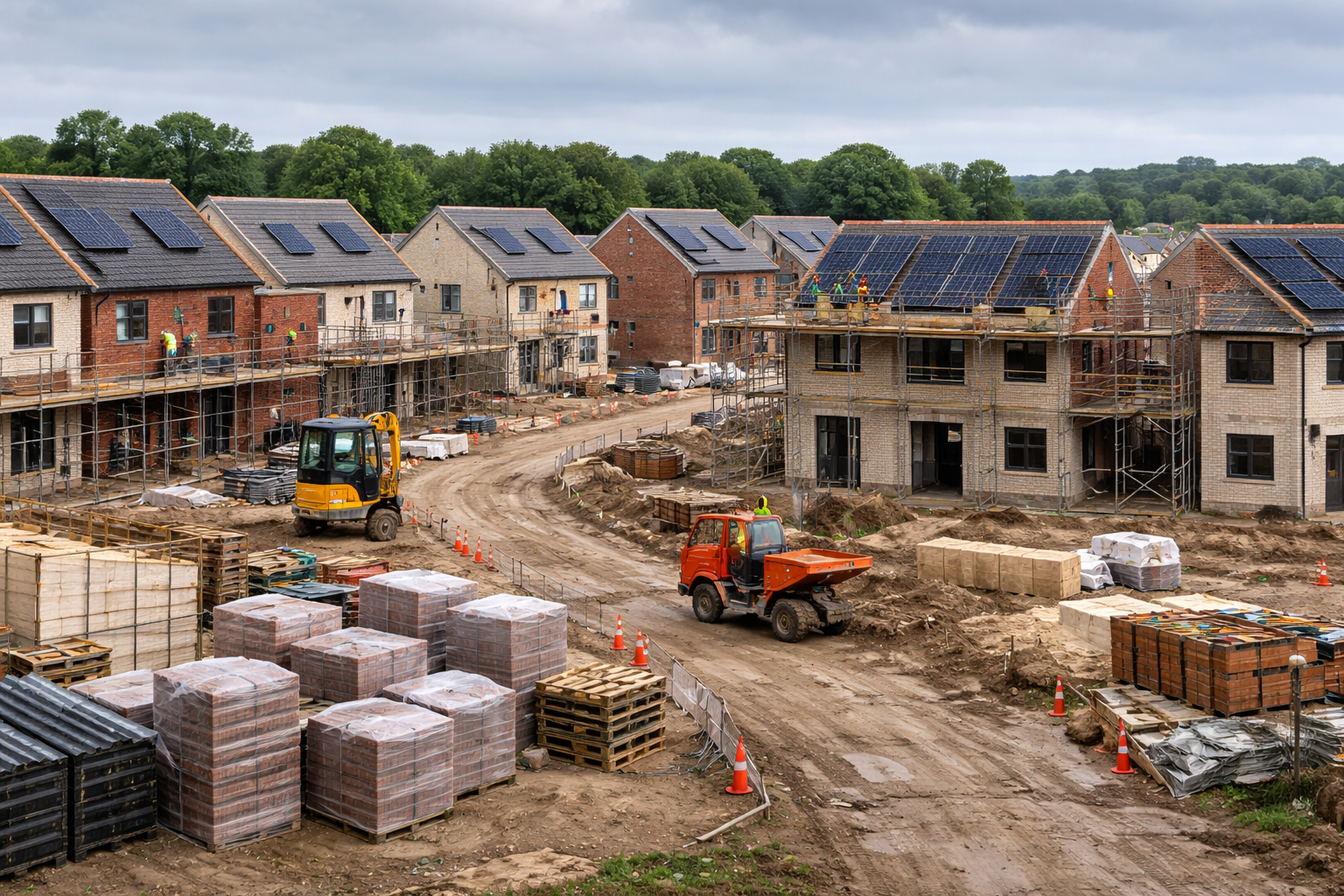
Residential construction requires planning across several stages, including groundworks, structural work, roofing, building services, internal finishes and external infrastructure. Changes to anticipated sales volumes can affect the rate at which plots are released and the sequence in which these activities take place. The resulting workload influences subcontractor requirements, purchasing commitments and the construction management resources needed across a developer’s regional operations.
Employment requirements extend beyond personnel working directly on building sites. Regional housebuilding divisions also undertake land acquisition, planning, estimating, commercial management, technical design, procurement and sales. Changes to development activity and overhead budgets can affect the resources assigned to these functions, although Bellway has not identified the departments or job categories included in its latest at-risk positions.
The company’s October results had already outlined measures to strengthen cost control and operational efficiency. These included greater standardisation across the group, more flexible procurement agreements with suppliers and a wider review of overhead expenditure. The redundancy announcement follows that programme, although Bellway has not disclosed a specific saving attributable to the proposed employment measures.
Bellway continues to maintain substantial development capacity. Its land bank contained 94,666 plots at 31 July, including approximately 48,000 within the strategic land bank. The group traded from an average of 238 sales outlets during FY26 and had 253 outlets at the year-end. Those figures describe the scale of its operating platform but do not establish how quickly the remaining land will be developed into completed homes.
The group has also invested in manufacturing capacity through Bellway Home Space, its timber frame facility that opened in January 2026. Supply of timber frames to regional divisions began during the second half of the financial year. The facility forms part of Bellway’s wider approach to construction delivery and procurement, although the company has not linked its latest staffing decisions to the operation.
Financially, Bellway ended FY26 with net cash of £157.7m, compared with £41.8m a year earlier. The stronger cash position provides resources to support operations and future investment, but it does not remove the need to control overhead expenditure when demand and operating margins are under pressure.
The company expects its average selling price during FY27 to remain close to £325,000. Its outlook nevertheless assumes lower housing completions and continued margin pressure, with mortgage affordability and economic uncertainty constraining demand. Bellway has not published a revised forecast for staffing levels following the latest consultation.
The number of roles ultimately made redundant remains unconfirmed. Bellway will continue reviewing its operating arrangements against the expected housing pipeline, with the outcome of the employment process and the delivery of its forecast 9,000–9,400 completions providing further measures of how the business adjusts to current market conditions.