IN Brief:
- Emerson has received the UK’s first LTM 1150-5.4, one of two machines ordered at Bauma 2025.
- The delivered configuration includes a 66m boom, a double swingaway fly jib and a 7m insert, with a reported maximum hook height of 92m.
- The crane can travel carrying up to 29 tonnes of counterweight under applicable UK Special Types General Order arrangements, subject to road transport requirements.
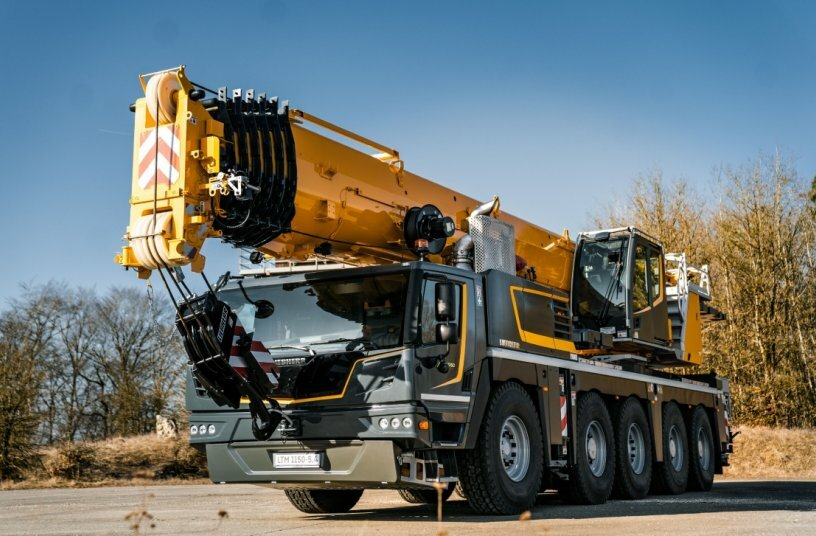
Emerson Crane Hire has taken delivery of the first Liebherr LTM 1150-5.4 mobile crane in the United Kingdom, adding a five-axle, 150-tonne all-terrain machine to its fleet. The crane is the first of two ordered by the Dagenham-based company at Bauma 2025 and will provide additional lifting capacity for construction, infrastructure and industrial projects.
The LTM 1150-5.4 combines a 66m telescopic boom with the latest generation of Liebherr’s LICCON3 crane control system. Emerson specified a double swingaway fly jib extending from 10.8m to 19m, together with a 7m boom insert. The configuration is reported to provide a maximum hook height of 92m, extending the range of lifting arrangements available to the operator.
Liebherr publishes a maximum load capacity of 150 tonnes at a radius of 3m and a maximum model lifting radius of 72m. Emerson’s current equipment listing gives a maximum radius of 68m with jib for its advertised hire configuration. The figures describe different published specifications and should not be interpreted as interchangeable lifting capabilities under every setup.
Actual capacity depends on the operating radius, boom length, jib configuration, installed counterweight and support arrangement. A crane rated to lift 150 tonnes at a short radius cannot lift that same load at its maximum reach. The applicable load chart establishes the permitted capacity for each configuration and must be assessed against the weight, dimensions and intended movement of the load.
The new crane occupies a position between Emerson’s existing 110-tonne and 230-tonne lifting classes. Selecting a machine with capacity suited to the lift can avoid using a larger crane where it is unnecessary, although the decision must also account for access restrictions, available setup space, ground bearing conditions and the required hook height. Rated capacity alone is insufficient to determine whether a crane can complete an operation.
Counterweight transport is one of the features highlighted by Emerson. The LTM 1150-5.4 can carry up to 29 tonnes of counterweight during road movements under applicable UK Special Types General Order requirements. Liebherr lists 45 tonnes as the machine’s total available ballast, with the amount installed for a particular lift determined by the selected operating configuration.
Transporting a substantial proportion of the required ballast on the crane can reduce the need for separate support vehicles on suitable jobs. Conventional mobilisation may involve transporting counterweight independently and assembling it after the crane reaches the site. Where the necessary ballast can be carried within the permitted road configuration, fewer deliveries may be required before lifting operations begin.
The applicable road transport rules still determine how the crane can travel. Vehicle dimensions, axle loads, route restrictions and other movement requirements must be considered, rather than assuming that the full ballast capacity can be carried on every journey. The claimed 29-tonne transport arrangement therefore concerns a permitted operating provision, not an unrestricted carrying allowance.
The five-axle carrier is powered by a six-cylinder diesel engine rated at 400kW. Liebherr specifies a standard 10 x 6 x 10 drive and steering arrangement, with an optional 10 x 8 x 10 configuration. These arrangements support movement on public roads and suitable construction surfaces, but the crane’s ability to enter a particular site remains dependent on local geometry, ground conditions and access arrangements.
Once on site, the crane must be established on a suitable bearing surface before lifting begins. Outrigger reactions depend on the weight of the machine, counterweight, load and working configuration. Where the supporting ground cannot safely carry the expected forces directly, engineered mats or other load-spreading measures may be necessary.
The LTM 1150-5.4 incorporates Liebherr’s VarioBase system, which allows individual outriggers to be positioned according to the available setup space. The crane control system calculates permitted lifting capacities for the configured support arrangement, potentially allowing operation in areas where full symmetrical outrigger extension is restricted by nearby structures or other obstructions.
Variable outrigger positioning does not remove the need for ground assessment or competent lift planning. The system determines allowable capacities within the configured machine parameters, while the site team remains responsible for confirming that support conditions, access arrangements and other lifting hazards have been addressed. A technically permissible crane configuration may still be unsuitable where the ground or surrounding environment cannot support the intended operation.
LICCON3 provides the control and monitoring functions for the new machine. Liebherr’s latest generation system incorporates updated processing and communications capabilities, alongside operator interfaces for the crane’s working functions. The machine also includes driver assistance features and AutoBallast, which supports the handling and configuration of counterweight during setup.
Additional components such as the fly jib and boom insert increase the range of achievable hook positions. They also introduce configuration requirements that must be incorporated into the lifting plan, including the method of assembly, required working area and load chart applicable to the extension. The maximum height or reach available in the manufacturer’s specification is consequently not a substitute for checking the particular configuration being used.
Emerson’s managing director, Liam Clancy, identified the new machine as an addition between the company’s 110-tonne and 230-tonne cranes. Its combination of lifting capacity, reach and transportable counterweight was a principal factor in the purchase decision, providing an alternative for projects whose requirements sit between the existing fleet classes.
The order was placed at Bauma 2025, where the model was introduced as the latest generation of Liebherr’s 150-tonne five-axle crane range. It develops the earlier LTM 1150-5.3 through the adoption of LICCON3 and additional technical features. The delivered unit is the first example of the LTM 1150-5.4 variant in the UK, rather than the first Liebherr crane of this lifting capacity to operate in the country.
Emerson offers the machine for operated hire and managed contract lifting. In the latter arrangement, the agreed scope of services determines responsibility for planning and managing the lifting operation, while applicable statutory duties and site requirements continue to govern the work. The company’s equipment offering covers projects across London, Essex and other areas within its operating region.
The first machine is now in Emerson’s fleet, with the second unit remaining on order. Its deployment will depend on the crane configuration required by each project, including the permitted lifting radius, counterweight, support arrangement and access constraints. Those considerations will determine where the new machine can provide additional capacity within the operator’s existing lifting services.