IN Brief:
- The Royal Botanic Garden Edinburgh Palm Houses reopened on 2 October after five years of restoration.
- More than 5,000 glass panes were replaced alongside extensive repairs to Georgian and Victorian ironwork.
- Around 600 plant specimens are being returned after approximately 800 were removed before construction began.
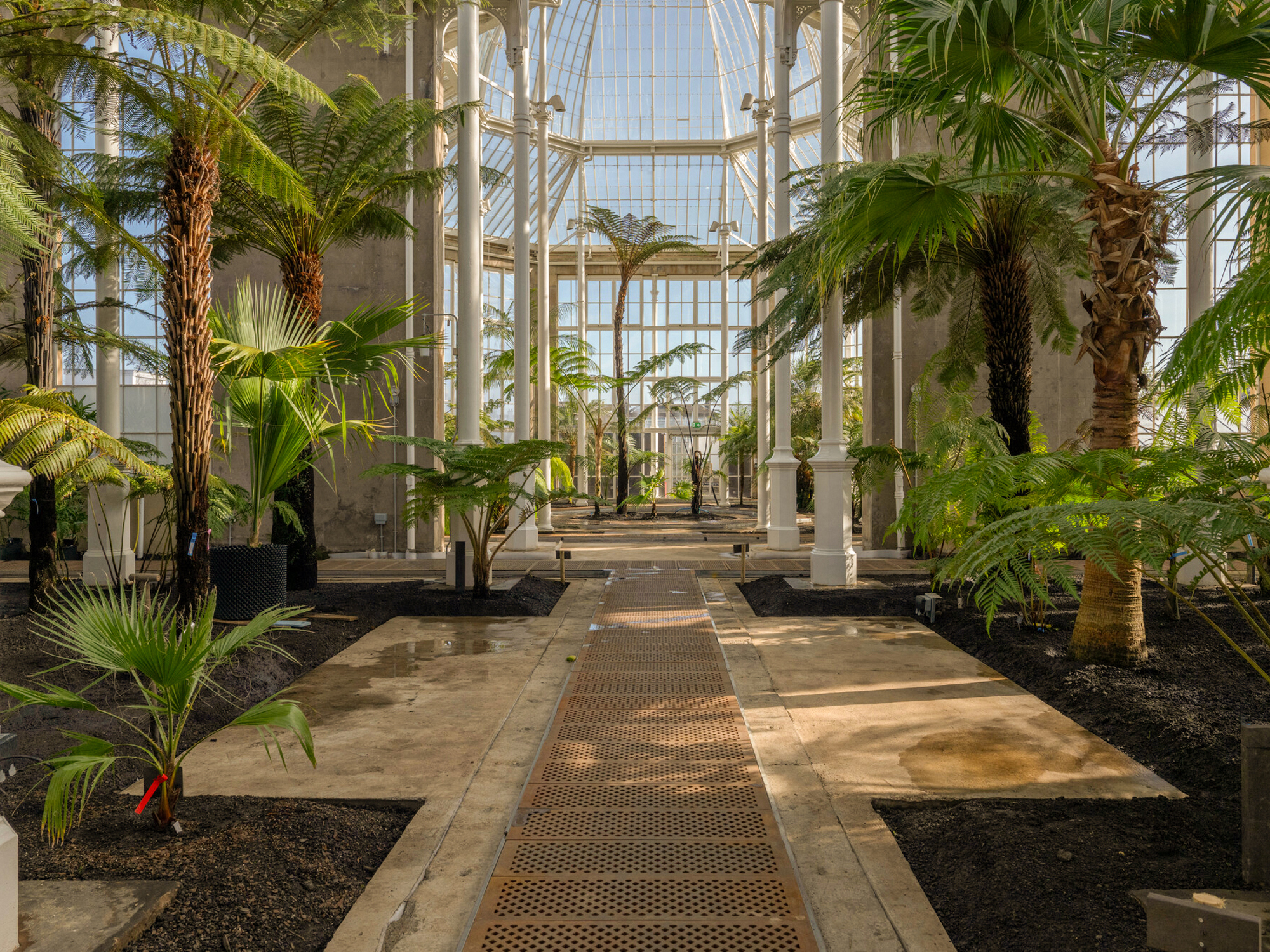
Royal Botanic Garden Edinburgh has reopened its historic Palm Houses following a five-year restoration that combined repairs to 19th-century ironwork and sandstone with replacement glazing designed to withstand increasingly severe weather.
The A-listed buildings reopened on 2 October as the first major completed element of the wider Edinburgh Biomes programme. The older octagonal Palm House dates from 1834, while the adjoining Victorian structure was completed in 1858 and remains the tallest surviving traditional Palm House of its type in the UK.
Restoration involved substantially more than replacing failed glass. Around 600m² of Georgian and Victorian ironwork required repair across columns, arches, roof framing and elevated internal structures that had deteriorated through age and prolonged exposure to moisture.
More than 5,000 individual panes were replaced. Earlier project documentation records 5,750 panes across the structures, each fitted into a historic frame whose geometry differs from the repetitive grids found on modern glazed buildings.
The replacement glazing is toughened and intended to provide greater resilience against wind and increasingly severe weather. In a botanical glasshouse, the envelope also forms part of the environmental system: glazing has to admit the light required by the collection while separating controlled internal conditions from low temperatures, wind and rain.
Deterioration of the original frames meant the project team could not simply remove old panes and install new ones into unchanged ironwork. Corroded and weakened sections first had to be repaired so the supporting structure could carry the replacement glazing safely.
Some metalwork could be conserved in position, while other elements required specialist treatment away from the structure. Approximately 500m² of deteriorating sandstone was also included in the restoration programme, addressing weathered cornices and other masonry around the historic glasshouses.
Drainage has been altered alongside the visible conservation work. Wider guttering has been introduced to increase capacity during heavy rainfall, reducing the amount of uncontrolled water reaching vulnerable masonry and ironwork.
That intervention changes the performance of the building without substantially changing its appearance. Historic glasshouses are especially susceptible to water because failed gutters or joints can accelerate corrosion around metal frames and repeatedly saturate adjoining masonry.
The plant collection imposed another construction constraint. Around 800 specimens were removed before work started, with most transferred elsewhere within the Garden while scaffolding, structural repairs and glazing work occupied the Palm Houses.
Approximately 600 plants are being returned as the restored buildings reopen. Moving mature specimens requires more planning than clearing furniture from a conventional refurbishment: height, root condition, temperature and humidity all determine whether a plant can be moved and how long it can remain in temporary accommodation.
Among the returning collection is an eight-metre stone gate palm. A young Sabal palm grown from the Garden’s historic specimen has also been introduced after the original plant, which had stood for around two centuries, became too large and unsuitable to move safely during restoration.
The interiors of the two Palm Houses have been reconfigured to create a continuous visitor route for the first time in decades. Removing later internal divisions exposes more of the original architecture while changing how people move between the connected glasshouse spaces.
That work had to be coordinated with the environmental conditions required by the plant collection. Internal alterations cannot compromise ventilation, temperature management or the physical separation needed between different growing environments.
The Palm Houses sit within the wider £58m Edinburgh Biomes programme, which addresses ageing glasshouses, plant environments and supporting infrastructure across the Royal Botanic Garden Edinburgh estate.
The Front Range Glasshouses remain closed while other phases continue. Many of the same problems addressed in the Palm Houses recur elsewhere across the estate, where old glazing, heating, drainage and structural systems have to support collections whose environmental requirements leave limited tolerance for failure.
Glasshouses expose those dependencies particularly clearly. A localised glazing failure can admit water and cold, while degraded ironwork can make repeated pane replacement unsafe. Obsolete heating or ventilation can also increase energy use while still failing to maintain the environmental conditions required by the collection.
The five-year Palm Houses project has addressed those problems through conservation of the surviving fabric rather than wholesale replacement. Original iron and stone remain central to the structures, while new glazing and drainage increase their ability to withstand conditions markedly different from those anticipated when the first house was completed almost two centuries ago.
Reopening restores public access to the two landmark buildings while work continues elsewhere under Edinburgh Biomes. Their next test will be operational rather than structural: maintaining stable growing conditions and controlling water around repaired historic fabric over decades rather than through another short cycle of remedial work.