IN Brief:
- The 620-metre tunnel runs beneath the Bristol Channel and forms part of Hinkley Point C’s fish protection system.
- The tunnel boring machine reached the seabed five months after beginning its drive from dry land.
- A floating crane recovered the machine so it can be cleaned and prepared for reuse elsewhere.
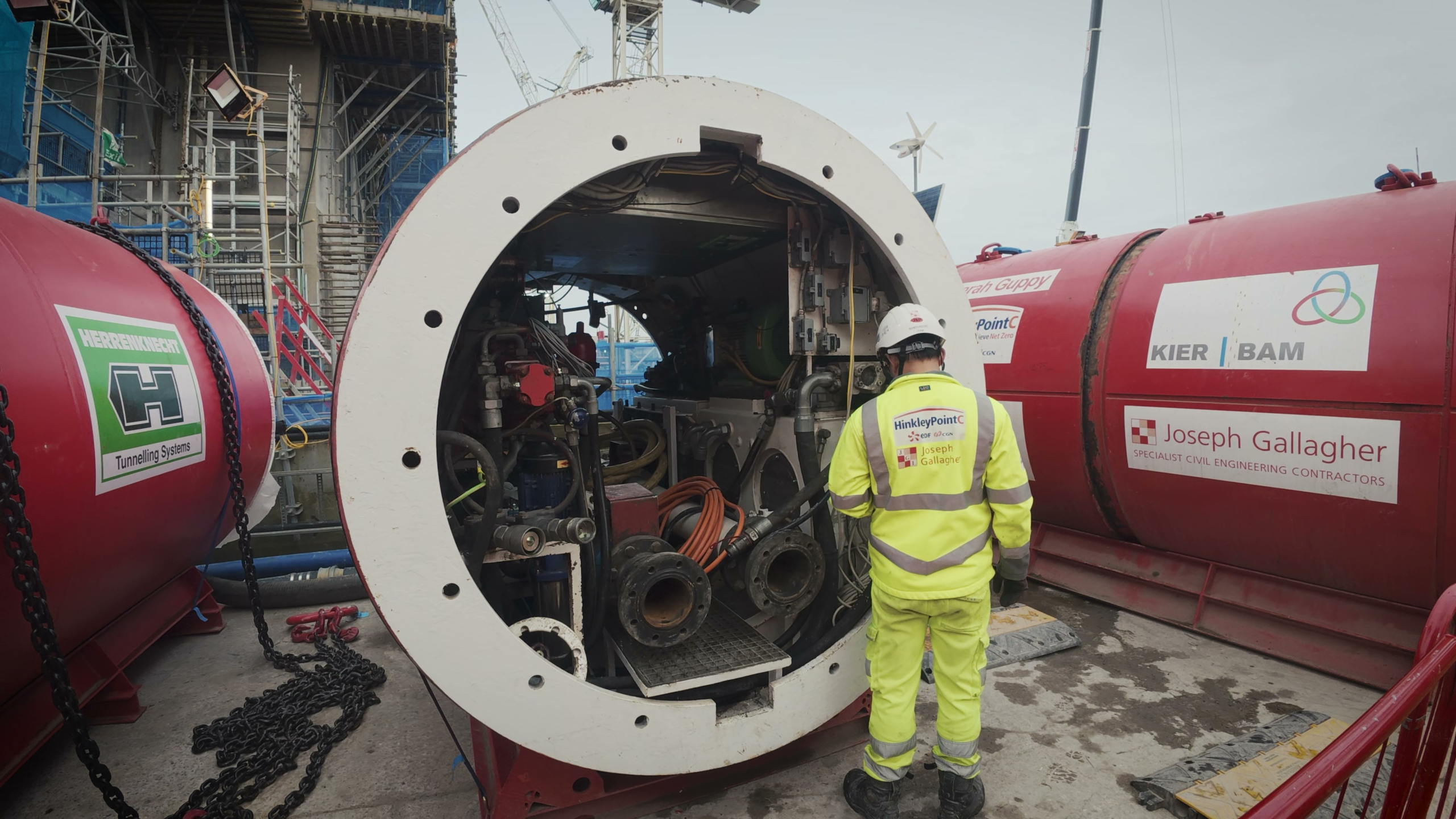
Hinkley Point C has completed the 620-metre tunnel for its fish return system beneath the Bristol Channel, with the tunnel boring machine reaching the seabed five months after setting off from dry land.
The machine was recovered from the channel by floating crane after breakthrough and will be cleaned before being prepared for use on another site. Completion of the drive finishes the excavation required for the return tunnel, one of three measures EDF is installing to reduce the effect of the power station’s cooling-water system on fish.
Hinkley Point C will use seawater as part of the cooling system serving its two EPR reactors. Water enters through offshore intake structures, making the design of those structures and the systems around them an important interface between the power station and the marine environment.
EDF’s protection arrangement combines four low-speed intake heads, an acoustic fish deterrent and the fish return system. The intake heads are designed to keep water velocity low enough for fish to swim away from distances as close as two metres, while the acoustic system is intended to discourage fish from approaching the intake area.
The return tunnel provides a route back to the Bristol Channel for fish that enter the system despite those measures. Its function therefore depends on the wider intake arrangement rather than on the tunnel as an isolated piece of civil engineering.
The tunnel boring machine was named Sarah Guppy by local schoolchildren after the Bristol engineer and inventor. It began the 620-metre drive on land before advancing beneath the channel and emerging through the seabed rather than into a conventional reception shaft.
That construction sequence transfers the final recovery operation from underground works to marine lifting. Once the machine reached its breakthrough point, a floating crane was used to recover it from the seabed so the equipment could be taken away rather than left beneath the channel.
Recovery also preserves the possibility of reusing the machine on another project after cleaning and refurbishment. Tunnel boring equipment carries substantial value in its cutting, drive, bearing and control systems, making recovery preferable where project geometry and marine conditions allow it.
The Bristol Channel presents a demanding environment for permanent and temporary works because of its tidal range, currents and exposed marine conditions. The return tunnel also has to connect with offshore infrastructure that will remain part of the power station throughout its operating life rather than serving only the construction programme.
The four low-speed intake heads will sit within a channel around 20 kilometres wide. EDF says fish will be able to swim away from the intakes from distances as close as two metres, reducing the number expected to enter the cooling-water system before the acoustic deterrent and return arrangement provide further protection.
Those measures are being installed as Hinkley Point C progresses from major structural construction into increasingly complex mechanical, electrical and systems work. The nuclear island, turbines and supporting infrastructure depend on a network of permanent services whose components have been constructed across land, underground and offshore work areas.
Marine civil engineering has been required because cooling water must be drawn from and returned to the Bristol Channel at sufficient scale for two large reactors. The tunnels and offshore structures consequently form part of the operating power station rather than temporary construction infrastructure that can be removed once the reactors are built.
Completing the fish return excavation removes the tunnelling operation from this part of the system, but connection, testing and commissioning work still has to follow before the completed route becomes part of the operational cooling-water network.
The recovered TBM meanwhile leaves the site as an asset capable of being used again. Its five-month drive has produced a permanent 620-metre connection between the landward system and the seabed while avoiding the need to construct a marine reception chamber solely to dismantle the machine underground.