IN Brief:
- The L30 and L35 receive their first major front- and rear-frame redesign since the original machines appeared in 1998.
- New rear mounting points, hydraulic interfaces, and trailer-coupling options are intended to broaden the jobs handled by one machine.
- Production of the updated compact wheel loaders is scheduled to start late in 2026.
Volvo Construction Equipment has redesigned the front and rear frames of its L30 and L35 compact wheel loaders, introducing new equipment interfaces, easier service access, and revised cab entry ahead of production later in 2026.
The update is the first major redesign of the machines’ front and rear frames since the original L30 and L35 were introduced in 1998. Volvo CE is retaining the established compact-loader platform while changing the areas that determine how readily the machines can be equipped, maintained, and accessed during daily work.
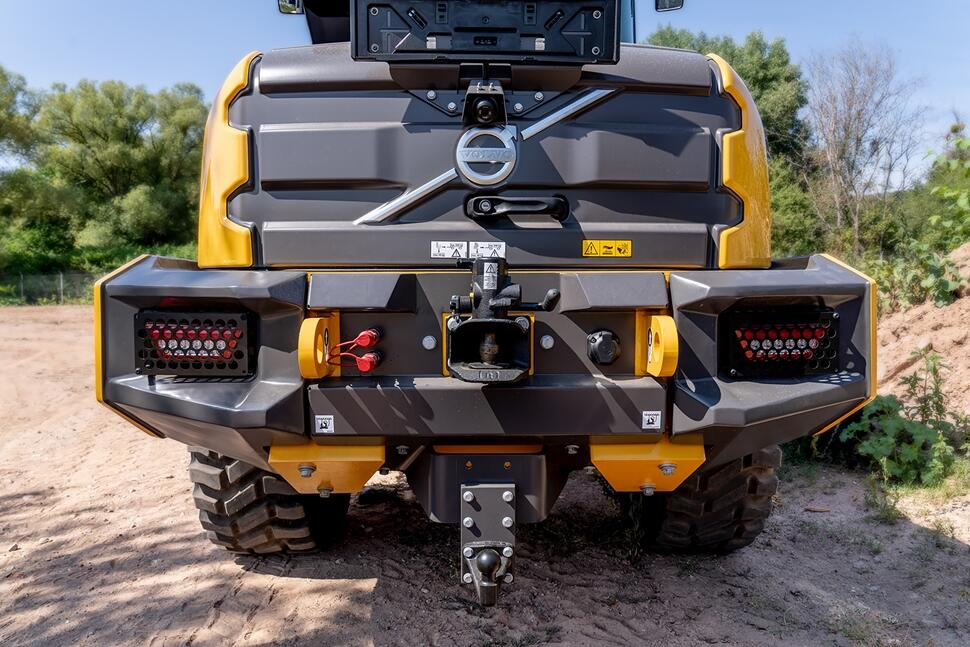
The most visible change is at the rear. Split side-mounted counterweights are combined with a raised steel frame and prepared mounting points, creating space for towing hardware, hydraulic equipment, and electrical connections without relying on the same level of bespoke modification after delivery.
Available configurations include a shunting hitch, 50mm ball coupling, and fixed or height-adjustable 40mm pin couplings. A rear mounting plate can also accommodate double-acting hydraulics and trailer electrical connections, extending the range of duties the loader can support away from its front attachment.
That changes the rear of the machine from a largely fixed counterweight arrangement into a deliberate equipment interface. Compact loaders are often expected to move between loading, pallet handling, towing, sweeping, snow clearing, landscaping, and support work, so configuration time can influence utilisation as much as outright cycle performance.
The existing hydraulic system supports that broader role. Optional high-flow hydraulics provide up to 100 litres per minute on the L30 and 110 litres per minute on the L35, with additional functions available for attachments that require independent proportional control.
Volvo has not used the redesign to chase a larger engine figure. Both machines retain the established powertrain architecture, keeping the focus on versatility, serviceability, and daily operation rather than turning the update into a new size class.
That is significant for contractors that already know the machines’ dimensions, handling characteristics, and transport requirements. Changing interfaces around a familiar platform can improve the range of work covered by the loader without forcing operators, workshops, and transport teams to adapt to an entirely different machine.
Service access has been revised alongside the equipment mounting points. The split rear counterweights can be removed to expose components, while a larger opening in the front frame gives technicians more room for maintenance and the installation of hydraulic or electrical options.
Access time is a small element of any individual service task but accumulates over a machine’s working life. Components that are difficult to reach increase labour time during routine maintenance and extend downtime when faults have to be traced on a live site or in a mixed-fleet workshop.
The redesigned counterweights also incorporate rear LED lights in positions intended to reduce exposure to damage. Rotationally moulded mudguards provide wider non-slip standing surfaces, supporting cleaning and maintenance around the cab and lighting.
Cab entry has been revised with three steps, new handrails, and a door that can be secured fully open. These changes are modest compared with a new drivetrain or lifting system, but repeated access throughout a shift makes step geometry and handhold position part of the machine’s day-to-day safety and usability.
The updated L30 and L35 retain the high seating position and visibility associated with the existing models, together with the adjustable steering column, joystick controls, and five-inch display. Volvo is therefore changing the route into and around the cab more than the basic operating environment once the driver is seated.
Compact wheel loaders occupy a broad part of the construction equipment market because their value comes from switching tasks quickly. Buckets and forks may account for much of the workload, but hydraulic attachments and towing duties can keep the same machine productive during periods when conventional loading demand is low.
The new rear interfaces extend that principle beyond the front quick coupler. A loader able to carry additional hydraulic or electrical equipment at the rear can be configured for more specialist duties without permanent workshop alterations that reduce resale flexibility or tie the machine to one application.
Volvo CE plans to show the updated machines publicly at GaLaBau in Nuremberg during September 2026, with production scheduled to begin later in the year. The timing gives dealers and customers a transition period before the revised frames enter normal supply.
The L30 and L35 have remained in the range for almost three decades because the basic compact-loader format continues to fit construction, industrial, agricultural, and municipal work. The redesign does not alter that role; it addresses the accumulated practical demands that build up around a long-lived platform.
That makes utilisation the useful measure of the update. Faster servicing, simpler equipment installation, safer cab access, and more rear-mounted options are individually incremental changes, but together they determine how much of a working day the loader can spend on productive tasks rather than in the workshop or waiting for another machine.