IN Brief:
- Site establishment is underway before restoration work begins at Bitts Park Lodge later in September.
- Story Contracting and Story Homes are providing the initial repair package at no cost to Cumberland Council.
- Carlisle College students are expected to gain practical construction experience through the live refurbishment project.
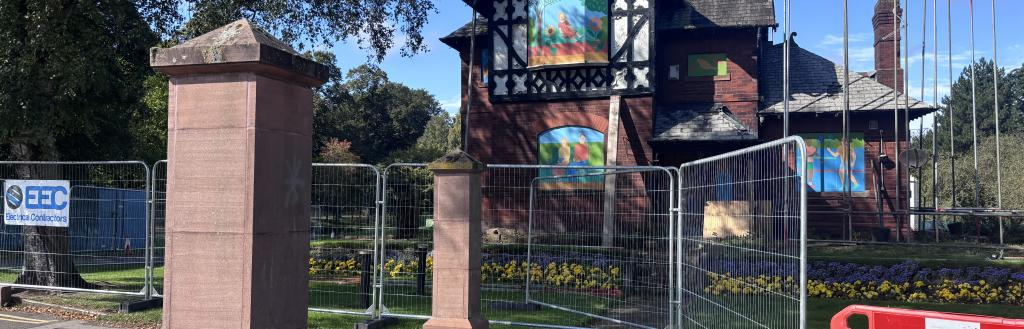
Cumberland Council is preparing Bitts Park Lodge in Carlisle for restoration, with contractors establishing the site compound, temporary power, welfare facilities, fencing, and scaffolding before repair work begins later in September.
The historic building has remained unused since it was badly affected by flooding in 2015. Its first phase of restoration will be delivered through a partnership involving the council, Story Contracting, Story Homes, Carlisle College, and Habitat for Humanity Great Britain.
Story Contracting and Story Homes will provide the initial construction work using their own teams and supply-chain partners, with the package being delivered at no cost to the council. The immediate objective is to return the lodge to a dry, secure, and structurally serviceable condition before its eventual use is finalised.
Planned work includes roof repairs, replacement joinery, doors and windows, electrical work, insulation, surveys, and general preparation. Current mobilisation activity is turning a building that has stood vacant for more than a decade into an active construction site.
Cllr Mark Fryer, Leader of Cumberland Council, said: “It is great to see that the final preparations are being made so this important project can begin. With activity now beginning on the site it is an exciting time for everyone involved.
“This partnership has the potential to show how the public, private and education sectors can work together in different ways to create wider community benefits.”
The partners first set out the restoration plan earlier this year, with options for the completed building including a café and community hub. Those possibilities remain separate from the present works, which are focused on repairing the existing fabric rather than fitting the building out for a final operator.
That sequence reduces the risk of committing money to an internal layout before a long-term use is settled. Making the building weather-tight and addressing damaged or deteriorated components gives the council a stable structure around which later design decisions can be made.
Roofing, windows, doors, and insulation sit early in the programme because controlling water ingress and improving the external envelope are prerequisites for most subsequent refurbishment. Surveys and electrical works will establish the condition of existing systems and identify what can be retained, repaired, or replaced in a later phase.
The lodge presents a different set of construction conditions from a new building. Existing dimensions and materials have to be verified rather than assumed, while the condition of concealed elements may only become clear as damaged finishes and components are removed.
More than a decade without normal occupation adds further uncertainty. Water penetration, previous flood damage, ventilation, corrosion, timber condition, and redundant services can all influence the sequence once contractors gain full access.
Retaining the existing structure also reduces the amount of new material required compared with demolition and replacement. The approach preserves the embodied material already present in the building while concentrating expenditure on the interventions needed to make it usable again.
That does not make refurbishment inherently straightforward. Older buildings often demand more site-based decisions because new components have to interface with existing construction that was designed to different standards and may have been altered several times during its life.
The partnership with Carlisle College introduces a training element alongside the physical repair work. Students are expected to gain exposure to the live project once the construction programme is established, allowing elements of their training to take place around a genuine refurbishment rather than solely within workshop conditions.
An existing building can provide particularly useful experience because tasks rarely follow perfectly standard details. Trainees have to work around actual dimensions, established materials, interfaces, sequencing, and the condition uncovered as construction progresses.
The project also provides a small-scale example of how contractors and educational organisations can support public estates where conventional capital funding is difficult to secure. Community buildings can remain vacant for long periods because their repair competes against statutory expenditure on roads, schools, housing, and social care.
External contributions can change that calculation, although the work still requires a defined client, competent contractors, appropriate surveys, and normal controls over design, safety, and quality. A donated package cannot bypass the same technical obligations that would apply under a conventionally procured contract.
Habitat for Humanity Great Britain is supporting the wider initiative through advocacy and environmental-impact work, while Story’s construction businesses are supplying the delivery resources needed to establish and repair the site.
The decision not to fix the final use before the fabric is secured gives the project a clearer first objective. Once the building is weather-tight, safe, and understood in greater technical detail, the council can assess the cost and design implications of whichever operational model is selected.
Scaffolding and temporary facilities now mark the project’s transition from proposals into physical delivery. The initial repairs are modest compared with larger public construction programmes, but they will determine whether a flood-damaged building that has stood unused since 2015 can return to productive use rather than continuing to deteriorate.