IN Brief:
- Borders College is progressing a Housing and Net Zero Accelerator Hub through the Borderlands development process.
- The facility would provide training and upskilling in sustainable construction and renewable technologies.
- Outline and Full Business Cases are still required before funding for the project can be confirmed.
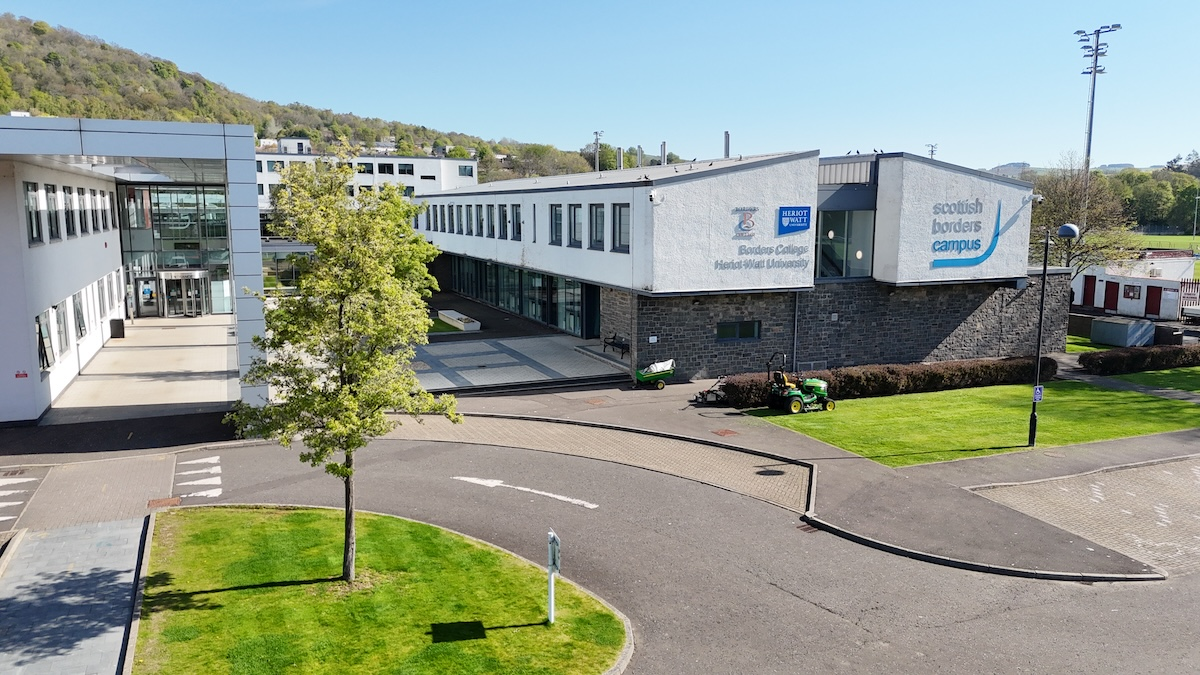
Borders College is progressing plans for a Housing and Net Zero Accelerator Hub intended to expand sustainable-construction and renewable-technology training in the Scottish Borders, with the proposal now moving through the Borderlands Inclusive Growth Deal development process.
The project is one of several skills investments being advanced by colleges in the South of Scotland. Borders College is developing the construction-focused hub alongside a separate Human Health Innovation Lab, while Dumfries and Galloway College is working on a Centre for Net Zero.
No construction funding has yet been confirmed for the Borders College scheme. The project must complete an Outline Business Case and Full Business Case before capital can be released, leaving the final scope, cost, delivery programme, and operating model subject to further assessment.
The proposed hub would provide training and upskilling linked to sustainable construction and renewable technologies. Its stated purpose is to increase the regional skills base needed for lower-carbon buildings and energy systems while giving employers a closer source of technical training.
The project sits within the South of Scotland Skills programme, backed by up to £7 million of Scottish Government capital funding through the wider Borderlands Inclusive Growth Deal. Funding is intended to support projects as they achieve the programme milestones required for approval.
For Borders College, the accelerator concept develops an existing sustainability-training agenda rather than introducing an entirely new subject area. The college already provides technical and practical construction education and has invested in facilities intended to demonstrate low-energy building principles.
The proposed hub would give that work a more substantial physical base at a time when construction skills requirements are broadening beyond individual trades. Airtightness, insulation, ventilation, heat pumps, building controls, renewable systems, and energy-performance testing increasingly overlap within the same projects.
The interfaces between those systems are particularly important. A well-specified heat pump cannot compensate indefinitely for a poorly insulated or air-leaky building, while high levels of airtightness create their own ventilation requirements that have to be understood and installed correctly.
Training environments therefore need to reproduce more than isolated product installation. Learners benefit from seeing how fabric, services, controls, sequencing, testing, and commissioning interact, particularly where one poorly executed detail can compromise the intended performance of the wider building.
Retrofit raises further complications because existing buildings rarely present the clean interfaces available in new construction. Installers can encounter unknown substrates, moisture, restricted service routes, inconsistent dimensions, occupied spaces, and previous alterations that were never properly recorded.
That makes practical fault finding as important as theoretical specification. A regional training hub can provide space for mock-ups, test rigs, assemblies, and controlled demonstrations that are difficult to accommodate in ordinary classrooms.
The Scottish Borders also has a geographic constraint. A dispersed rural population means specialist training can involve substantial travel, while smaller construction businesses may find it difficult to release workers for extended courses far from active projects.
Creating more capacity within the region can reduce that barrier, although the eventual value of the proposed hub will depend on the qualifications offered, the equipment installed, and the extent to which local employers shape delivery. Facilities built around technologies that change quickly need a plan for continuing investment after the capital project is complete.
The Borderlands business-case process is intended to test those assumptions. An Outline Business Case must establish the strategic and economic case in greater detail, while the Full Business Case needs to demonstrate that the final project is affordable, deliverable, and capable of producing the stated benefits.
That work could still change the physical design. Training demand, capital cost, operating expenditure, partnership arrangements, or available funding may alter the size and configuration of the facility before a construction brief is fixed.
The distinction matters in reporting the project because progression through a funding pipeline is not equivalent to a contract award or start on site. The current development is an approval to continue preparing the case for investment, with further gates still standing between the concept and construction.
Skills infrastructure nevertheless has a direct relationship with construction delivery. Governments can raise energy standards or support retrofit programmes, but physical outcomes depend on designers, supervisors, installers, and commissioning teams understanding how the specified systems should be built and verified.
Poor workmanship can erase part of the theoretical benefit of better products. Gaps in insulation, badly sealed penetrations, incorrect ventilation settings, inappropriate controls, and weak commissioning can all leave buildings performing differently from their design calculations.
That places colleges within the wider construction supply chain even though they do not supply materials or undertake contracts. Their output is the workforce expected to deliver increasingly technical specifications, often under programme pressure and across projects where regulatory scrutiny of building performance is rising.
Borders College now has to turn the broad case for a Housing and Net Zero Accelerator Hub into the detailed evidence required by the Borderlands programme. Until those business cases are approved, the facility remains a proposed training investment rather than a funded building project.
If it clears those stages, the next challenge will be ensuring the completed hub reflects the practical construction problems that employers actually face. A new training building has limited value if the equipment and curriculum inside it lag behind the sites, products, and regulatory requirements its learners encounter after qualification.