IN Brief:
- The Department for Education has appointed Tilbury Douglas to construct the replacement Skelton Primary School.
- The two-storey T-shaped building will accommodate approximately 630 pupils and include sports, dining, teaching, and staff space.
- Solar panels, air-source heat pumps, new playing fields, a sports court, and a wildflower meadow form part of the scheme.
Tilbury Douglas has been appointed by the Department for Education to build a replacement for Skelton Primary School, advancing a scheme that combines a new 630-pupil teaching building with sports provision, landscaping, and lower-carbon building services.
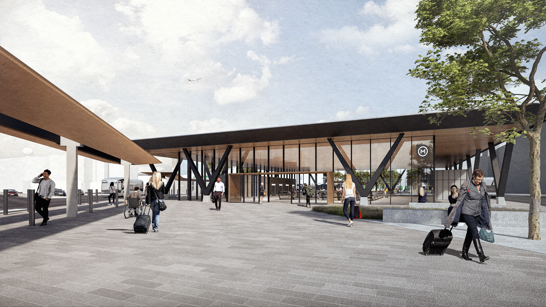
The project centres on a two-storey T-shaped school replacing the existing ageing accommodation. Teaching rooms and staff offices will be supported by a large multipurpose sports and dining hall, while external works include playing fields, a sports court, parking, and landscaped areas.
Tilbury Douglas will deliver the scheme for the Department for Education, with photovoltaic panels and air-source heat pumps incorporated into the energy strategy. A wildflower meadow is planned on the footprint of the existing school once demolition and the wider site sequence allow that area to be released.
Planning records describe the project as redevelopment of Skelton Primary School through demolition of existing buildings and construction of a replacement teaching block, together with associated playing fields and landscaping. Subsequent condition applications show detailed elements, including the sports-court layout, continuing through the planning process as delivery preparations move forward.
The appointment adds another occupied education project to Tilbury Douglas’s current school workload. Projects of this type require the contractor to sequence new construction around an operating campus, keeping pupil access, safeguarding, deliveries, temporary routes, utilities, and emergency arrangements functioning while work progresses nearby.
The new building therefore represents only one part of the programme. Even where most of the replacement school can be built on a relatively clear area, the later removal of old accommodation and completion of playing fields or landscaping can extend the site sequence beyond the main building handover.
Skelton’s proposed wildflower meadow demonstrates that dependency. It is intended for the footprint of the existing building, so at least part of the final external environment cannot be completed until pupils and staff have transferred into the replacement facilities and demolition has released the land.
The energy specification follows the direction established across much of the Department for Education’s rebuilding programme. Air-source heat pumps reduce reliance on fossil-fuel heating, while roof-mounted photovoltaic generation can offset part of the building’s electrical demand, but overall performance will still depend on fabric, ventilation, controls, occupancy patterns, and commissioning.
Primary schools create varied energy loads across classrooms, halls, kitchens, offices, sports areas, and circulation spaces. Heating, ventilation, lighting, hot water, and solar generation therefore have to operate as a coordinated system rather than a collection of individual low-carbon products, particularly where the building is expected to meet tighter operational-energy targets.
Tilbury Douglas has also placed early emphasis on regional procurement. The contractor says 75% of subcontract orders placed to date have gone to businesses within 50 miles of the project, while two Meet the Buyer events have been used to introduce local suppliers to the programme.
Local procurement can widen participation in a public-sector project, but it does not reduce the principal contractor’s technical obligations. Structural, mechanical, electrical, façade, fire-safety, finishing, and external-works packages still have to meet common programme, quality, documentation, and safety requirements regardless of supplier size or location.
The school also has to be commissioned as an operating environment before occupation. Heating and ventilation controls, fire systems, lighting, access control, kitchen equipment, ICT infrastructure, and teaching spaces all need testing and handover, while external routes and safeguarding boundaries have to be ready for the first day pupils use the new building.
That transition can be more demanding than the physical completion of the teaching block. Furniture and equipment moves, staff familiarisation, temporary arrangements, and phased demolition have to be coordinated around the school calendar, with limited tolerance for programme slippage once an occupation date is fixed.
Tilbury Douglas has a broader Department for Education workload that includes other replacement and specialist school projects. A recent £31m preconstruction appointment at Cavendish School in Eastbourne demonstrates the range of education work moving through the contractor’s pipeline, although each site carries a different combination of existing buildings, pupil needs, and sequencing constraints.
At Skelton, the design is comparatively straightforward in headline terms — a two-storey mainstream primary school — but the live-campus context makes logistics and sequencing a substantial part of delivery. Playing fields, parking, the sports court, landscaping, utility changes, demolition, and the final meadow all have to be coordinated around the central move into the replacement building.
No main contract value or completion date was stated in the appointment announcement. The immediate milestones will therefore be mobilisation, progress on the replacement teaching block, and the point at which the new building can take pupils and release the existing footprint for demolition and final external works.
With much of the early subcontract procurement already placed locally, the project has moved beyond a simple appointment announcement. The delivery test now lies in converting that supply chain into an operational school while maintaining education on the existing site and bringing the old and new parts of the campus through a controlled transition.