IN Brief:
- Planning approval clears a Livingston redevelopment providing more than 21,000m² of workplace accommodation for around 3,000 Sky employees.
- GRAHAM has been appointed principal contractor for the three-storey scheme, which will replace four Kirkton Campus buildings and leased Alba Campus space.
- The design combines an ultra-low-energy building, on-site solar generation, new landscaping, active-travel links, and a summer 2029 occupation target.
Sky has secured planning permission for its new Livingston campus, allowing GRAHAM to progress a major West Lothian workplace project designed to consolidate operations for around 3,000 employees.
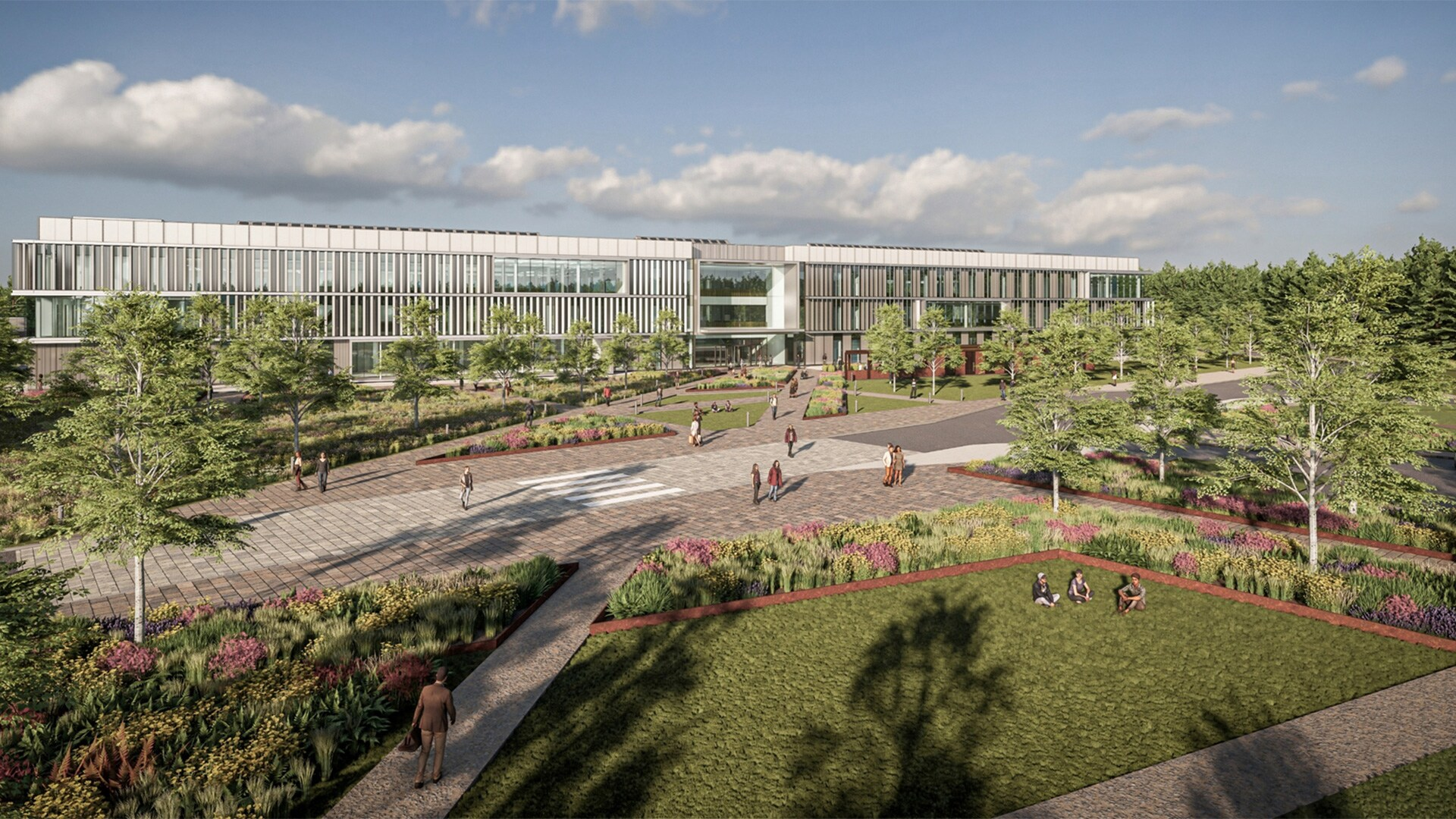
The development will provide more than 21,000m² of accommodation and replace four existing buildings at Sky’s Kirkton Campus along with leased premises at the nearby Alba Campus. The company describes the scheme as a 15-acre campus redevelopment, with occupation of the new building planned for summer 2029.
GRAHAM has been appointed principal contractor. Its appointment gives the project a defined delivery team as the scheme moves beyond planning and into detailed coordination, procurement, enabling activity, and main construction.
The new headquarters is planned as an ultra-low-energy, three-storey building powered partly by renewable energy, including on-site solar panels. Sky’s plans also include new landscaped areas, improved active-travel links, flexible workspaces, event facilities, a meeting centre, café, restaurant, and upgraded employee amenities.
Consolidating several occupied buildings into one campus creates a more complicated construction sequence than a standalone greenfield office. Existing operations have to continue while demolition, new construction, services work, external works, and eventual staff relocation progress around them.
The four existing Kirkton buildings are due to be replaced, which places demolition and site logistics close to an active workplace. Temporary pedestrian routes, construction traffic, service diversions, fire access, noise, dust, and segregation between employees and site operations will need to be coordinated through the programme.
Those constraints extend into the building-services strategy. An office serving around 3,000 people must bring together envelope performance, ventilation, heating and cooling, lighting, controls, renewable generation, occupancy patterns, and commissioning if its low-energy design is to perform as intended after handover.
Solar generation is one part of that system rather than a substitute for reducing demand. The operational result will depend on how the building fabric and services perform together, particularly as occupancy varies across a large flexible workplace.
That puts detailed design and commissioning on the same critical path as the visible construction. Systems that meet individual specifications can still underperform when controls, sensors, plant, and user settings are not integrated effectively, making testing and seasonal optimisation important before the campus settles into full operation.
The external works carry their own delivery requirements. Sky intends to increase landscaped green space and provide improved walking and cycling connections, while areas around the existing estate will be reorganised as buildings are removed and the new campus takes shape.
Landscape and active-travel elements are sometimes treated as late packages, but their drainage, levels, routes, utilities, lighting, and interfaces with access roads have to be coordinated much earlier. On an occupied campus, temporary arrangements also have to function safely until permanent routes are complete.
Sky has said the investment will create opportunities for local suppliers, SMEs, and other businesses during construction and subsequent operation. GRAHAM has similarly stated that it plans to work with local suppliers during delivery, giving the project a potentially broad package base across building, services, fit-out, and external works.
The scale of that supply chain will become clearer as procurement advances. A large but relatively low-rise headquarters still requires extensive structural, envelope, mechanical, electrical, fit-out, landscaping, and specialist packages, while the occupied-site constraints increase the importance of coordination between them.
The project also reflects a wider estate strategy rather than an expansion of disconnected office space. Sky has already relocated operations in Glasgow and Dunfermline into more modern accommodation, while Livingston remains one of its principal employment centres in Scotland after more than three decades in the area.
Bringing separate Livingston operations into a consolidated campus gives the company an opportunity to retire older accommodation while designing workplace, energy, and maintenance requirements around a single development. The construction case therefore combines replacement, consolidation, and operational efficiency rather than simply adding floor area.
Sky originally submitted the scheme in January, when it set out an indicative programme of planning determination during summer 2026 followed by occupation in summer 2029. Planning approval has arrived broadly within that timetable, leaving around three years for detailed delivery and transition into the completed campus.
That period still contains most of the construction risk. Demolition sequencing, ground conditions, procurement, design coordination, building services, weather, commissioning, and phased occupation can all affect the route from permission to use, particularly where the existing estate remains active around the work.
For GRAHAM, the immediate task is to convert an approved scheme into a deliverable programme without losing the energy and landscape commitments established through design. Planning consent is the point at which that work becomes more concrete: the drawings now have to survive procurement, construction tolerances, commissioning, and three Scottish winters before the planned 2029 occupation.