IN Brief:
- Limestone from Holcim UK's Torr Quarry is being placed as rock armour at The Sanctuary in Weymouth.
- The £8m coastal works include a sea wall, cliff stabilisation, and heavy armourstone around the £52m residential scheme.
- Installation is due to finish in September, with quarrying, specialist haulage, and individual stone placement tightly linked to the programme.
Holcim UK is supplying limestone from its Torr Quarry in Somerset for rock-armour coastal defences at The Sanctuary residential development in Weymouth. The material is being used around the £52m Newtons Cove scheme, where developer Juno MMXX is building 141 homes on a former Ministry of Defence site.
The development includes townhouses, apartments, a 60-bed care home, and leisure and community facilities. Coastal protection forms part of an associated £8m package covering a new sea wall, cliff stabilisation, and heavy rock armour along the exposed edge of the site. Installation began in June and is scheduled to finish in September 2026.
The armourstone ranges from smaller graded material to very large individual blocks, making extraction, loading, transport, and placement part of the engineering problem. Holcim is working with Frome-based haulier JF Pearce, which is using adapted vehicles with converted shipping-container bodies to carry the larger limestone boulders from Somerset to the Weymouth site.
Once delivered, the blocks are placed individually by specialist contractors building the sea defence. The operation links quarry production directly to the coastal construction sequence: stone has to arrive in the specified grading and at a rate the site can safely unload and position without overwhelming a constrained development beside the shoreline.
Armourstone turns quarry output into infrastructure
Rock armour appears mechanically simple once installed, but its performance depends on mass, geometry, grading, durability, and the profile on which the stone is placed. Individual blocks need to interlock and dissipate wave energy while resisting displacement and abrasion, and the layers beneath them must remain stable as water moves around and through the defence.
Those requirements make the quarry part of the engineering specification. A source capable of producing conventional aggregate is not automatically suitable for supplying large armourstone consistently, because the rock has to be extracted in the required sizes without excessive fracturing and then sorted for the designed grading. Material properties that are relatively ordinary in roadstone become significant when individual pieces form a permanent coastal structure.
Transport introduces another set of constraints. Heavy, irregularly shaped blocks cannot be handled like bulk aggregate in a standard tipper, and vehicle payload, loading method, road access, unloading, and lifting arrangements all have to be coordinated. A delayed or unsuitable load can interrupt specialist placement plant whose productivity depends on the correct stone arriving in sequence.
The adapted vehicles used by JF Pearce reflect those demands. The quarry-to-site journey has to protect the load, comply with road requirements, and deliver the stone in a form that can be handled safely at Newtons Cove. The logistics plan therefore connects extraction at Torr with crane or excavator movements on the coastline rather than treating transport as a separate merchant function.
The coastal package is also fundamental to the wider development. The Sanctuary occupies exposed former Ministry of Defence land beside the sea, so cliff stabilisation and shoreline protection are infrastructure required for the long-term use of the site rather than an architectural addition to the housing scheme. Programme or performance problems in the sea defence would consequently carry implications beyond the £8m coastal works themselves.
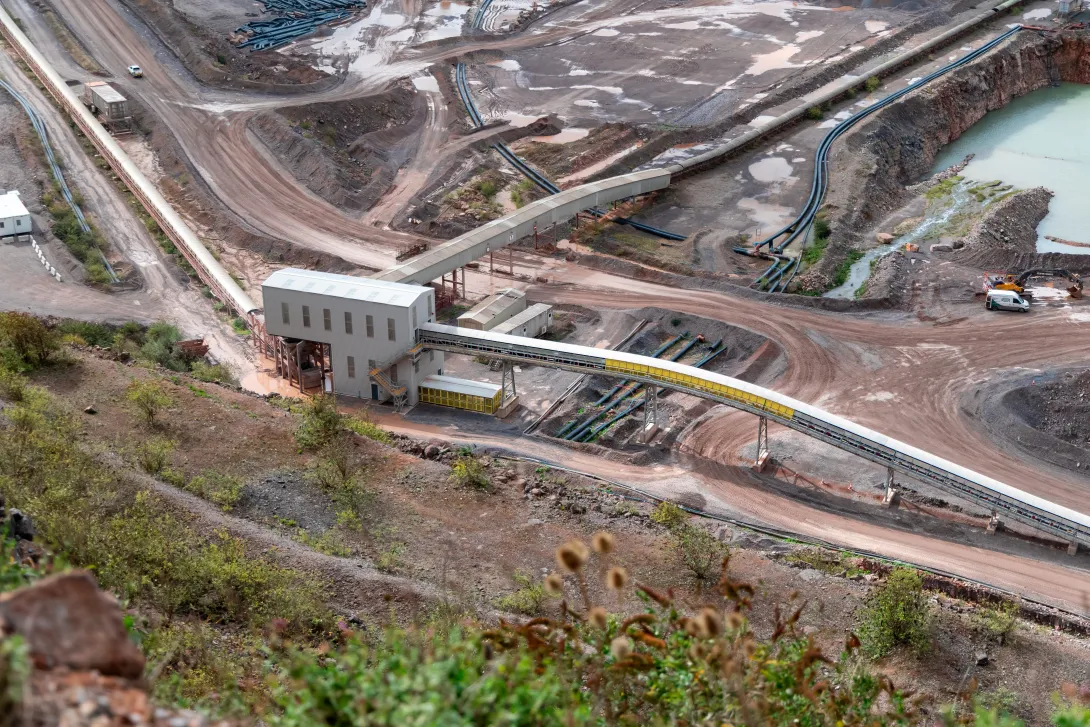
Torr Quarry has substantial fixed infrastructure behind the supply operation. Holcim has invested in extraction and conveying systems at the Somerset site, which supplies materials into concrete, asphalt, road construction, and specialist engineering markets. Armourstone accounts for a particular part of that output but relies on the same quarry access, processing, stock management, and dispatch capacity as other products.
Current published accounts differ over the total tonnage being delivered to Weymouth, so the overall quantity has deliberately been excluded from this article. The underlying project facts are consistent: Torr limestone is being used as rock armour, the residential development is valued at £52m, the coastal package at £8m, and installation is expected to finish in September. The physical delivery remains substantial regardless of the unresolved aggregate tonnage figure.
The programme is now approaching its final installation period. Completion depends on keeping extraction, specialist haulage, site access, and stone placement aligned until the designed coastal profile is complete. Unlike many manufactured building systems, there is little opportunity to disguise poor coordination behind a finished surface — each block remains part of the final structure and has to arrive with the mass and durability required for decades of exposure.
For The Sanctuary, the value of the material is ultimately measured in what it prevents. The homes, care facility, and associated development can only occupy the site with confidence if the shoreline and cliff remain stable over the life of the scheme. That places an apparently basic quarry product on the same critical path as the buildings it is there to protect.